Albert1
- 1,221
- 0
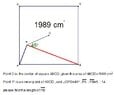
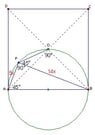
The discussion revolves around determining the length of segment PB in a geometric configuration involving a square and points A, B, O, and P. The context includes mathematical reasoning and the application of geometric principles such as rotation and congruence of triangles.
There appears to be some agreement on the calculations leading to the length of PB, but the methods of rotation and the implications of congruence are discussed with different approaches, indicating a lack of consensus on the best method.
The discussion relies on specific geometric assumptions and the congruence of triangles, which may not be universally accepted without further clarification of the configuration.