What does this R command translate into in plain English?

  • Thread starter Thread starter user366312
  • Start date Start date
  • Tags Tags
    English
Join the discussion
Registration is free. Ask a follow-up in this thread, or start your own.
5 replies · 2K views
user366312
Gold Member
Messages
88
Reaction score
3
TL;DR
mean(mat[2, mat[1, ] == 1] == 1)

What does this R command translate into plain English?
According to my understanding:
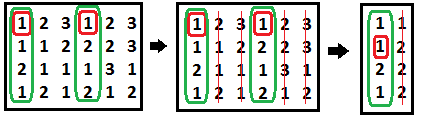
243198

So the mean is: (1+1+2+1)/4 = 1.25.

Is my understanding correct?

If I am correct, what does it actually try to achieve?
 
Physics news on Phys.org
user366312 said:
mean(mat[2, mat[1, ] == 1] == 1)

Why would anyone write a command like that?

It helps to break the problem down into steps:
  • First, consider what does mat[1,] evaluate as?
  • Next, what is the output of mat[1,]==1?
  • Next, what is mat[2, mat[1, ] == 1]?
  • Next, what is mat[2, mat[1, ] == 1] == 1?
  • Finally, you can calculate mean(mat[2, mat[1, ] == 1] == 1).
Given the matrix you provide in the OP, I get 0.5 as the final answer.
 
  • Like
Likes   Reactions: sysprog
Ygggdrasil said:
Given the matrix you provide in the OP, I get 0.5 as the final answer.

Yeah, I figured that out myself.

Thanks for the help anyway.
 
user366312 said:
Yeah, I figured that out myself.

Thanks for the help anyway.
That response looks as if you cared mainly about the answer, and not so much about the specifics of the clarifyingly cogent method carefully elucidated by @Ygggdrasil by which he arrived at it.

I'm sure your gratitude is appreciated by him; however, your edification would be immensely more gratifying.

Please at least don't fail to notice the value of the innermost-first innermore-next approach taken to parsing the expression.
 
sysprog said:
That response looks as if you cared mainly about the answer, and not so much about the specifics of the clarifyingly cogent method carefully elucidated by @Ygggdrasil by which he arrived at it.

I'm sure your gratitude is appreciated by him; however, your edification would be immensely more gratifying.

Please at least don't fail to notice the value of the innermost-first innermore-next approach taken to parsing the expression.

Speculation is bad for health!

I spent almost 4 hours on this to understand it properly.
 
user366312 said:
Speculation is bad for health!

I spent almost 4 hours on this to understand it properly.
I didn't mean to disparage the value of your thinking things through for yourself. When I posted, I of course could not see all the avenues of your reasoning, and was responding merely as an observer of the prior posts. Thanks for reading and responding to what I wrote.