What factors affect the heat transfer coefficient?

Click For Summary
SUMMARY

The heat transfer coefficient for convective heat transfer is primarily influenced by the air side resistance rather than the material of the rods. In forced air convection scenarios, the overall heat transfer coefficient is largely independent of the rod material and is determined by the cross flow Reynolds number and Prandtl number of the air. However, when different fluids are involved, such as liquids or gases flowing through a tube, the heat transfer coefficient on the tube side must also be considered, which can significantly affect the overall heat transfer coefficient.

PREREQUISITES
  • Understanding of heat transfer principles
  • Knowledge of Reynolds number and Prandtl number
  • Familiarity with forced convection concepts
  • Basic thermodynamics related to heat transfer
NEXT STEPS
  • Research the impact of Reynolds number on heat transfer coefficients
  • Study the Prandtl number and its significance in convection
  • Explore heat transfer coefficients in different fluid systems
  • Investigate the effects of material properties on heat transfer in various applications
USEFUL FOR

Mechanical engineers, thermal system designers, and students studying heat transfer principles will benefit from this discussion.

theBEAST
Messages
361
Reaction score
0
1. Homework Statement and the attempt at the solution

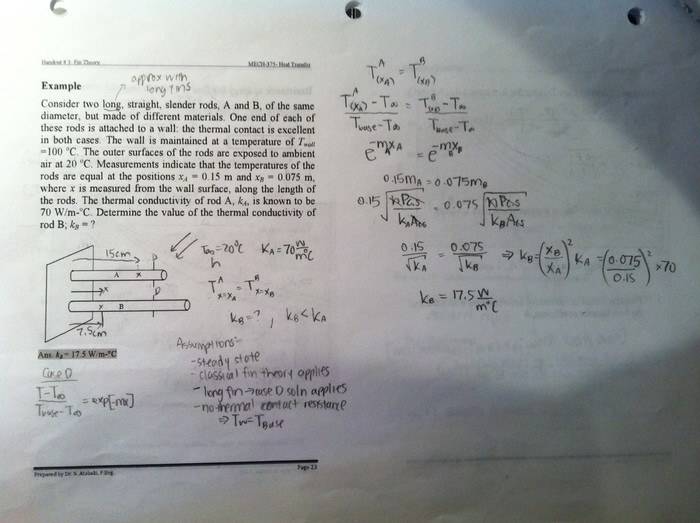
Alright, here is a picture of the problem along with my solution:
qg8BOw5.jpg


My solutions gives the correct answer but the only part I don't understand is why the heat transfer coefficients are the same. If the two rods are made of different materials don't you have a different coefficient? Or is coefficient independent of the material... If so, what does it depend on? Shape?
 
Physics news on Phys.org
theBEAST said:
1. Homework Statement and the attempt at the solution

Alright, here is a picture of the problem along with my solution:
qg8BOw5.jpg


My solutions gives the correct answer but the only part I don't understand is why the heat transfer coefficients are the same. If the two rods are made of different materials don't you have a different coefficient? Or is coefficient independent of the material... If so, what does it depend on? Shape?
The resistance to heat transfer is going to be dominated by the resistance on the air side of the interface. So the heat transfer coefficient is going to be essentially the heat transfer coefficient on the air side. With this situation, then yes, the overall heat transfer coefficient is virtually independent of the rod material. For forced air convection over the fins, it is determined by the cross flow reynolds number and prandtl number of the air.

Chet
 
Chestermiller said:
The resistance to heat transfer is going to be dominated by the resistance on the air side of the interface. So the heat transfer coefficient is going to be essentially the heat transfer coefficient on the air side. With this situation, then yes, the overall heat transfer coefficient is virtually independent of the rod material. For forced air convection over the fins, it is determined by the cross flow reynolds number and prandtl number of the air.

Chet

In what case would it be different then? When the fluids are different? So whenever there are different materials exposed to convective heat transfer with the surrounding air can we use the same heat transfer coefficients all the time?
 
theBEAST said:
In what case would it be different then? When the fluids are different? So whenever there are different materials exposed to convective heat transfer with the surrounding air can we use the same heat transfer coefficients all the time?
You can use the same heat transfer coefficient on the air side, but there may also be some heat transfer resistance that needs to be taken into account on the "inside the cylinder" side. For example, if you have a tube with liquid or gas flowing through it, rather than a metal rod, you will need to consider the resistance on the tube side of the interface, particularly in the case of a gas. You can have a heat transfer coefficient on the tube side that can be of the same order as on the air side. So the overall heat transfer coefficient will be substantially lower than on either side.
 

Similar threads

  • · Replies 14 ·
Replies
14
Views
3K
  • · Replies 2 ·
Replies
2
Views
1K
  • · Replies 4 ·
Replies
4
Views
2K
  • · Replies 3 ·
Replies
3
Views
2K
  • · Replies 4 ·
Replies
4
Views
2K
Replies
3
Views
2K
  • · Replies 2 ·
Replies
2
Views
1K
  • · Replies 6 ·
Replies
6
Views
3K
  • · Replies 5 ·
Replies
5
Views
2K
  • · Replies 3 ·
Replies
3
Views
6K