What factors affect the heat transfer coefficient?

Click For Summary

Homework Help Overview

The discussion revolves around the factors affecting the heat transfer coefficient, particularly in the context of different materials and their interaction with air. Participants are exploring the implications of material properties on heat transfer in a scenario involving rods and convection.

Discussion Character

  • Conceptual clarification, Assumption checking

Approaches and Questions Raised

  • Participants are questioning the independence of the heat transfer coefficient from the material of the rods and discussing the role of air-side resistance in heat transfer. They are also considering scenarios where different fluids might affect the heat transfer coefficients.

Discussion Status

Some participants have provided insights into the dominance of air-side resistance in determining the overall heat transfer coefficient, suggesting that it may be independent of the rod material in certain conditions. There is ongoing exploration of when different coefficients might apply, particularly in relation to the fluids involved.

Contextual Notes

Participants are considering the implications of using the same heat transfer coefficients across different materials and the potential need to account for additional resistance in scenarios involving fluids flowing through tubes.

theBEAST
Messages
361
Reaction score
0
1. Homework Statement and the attempt at the solution

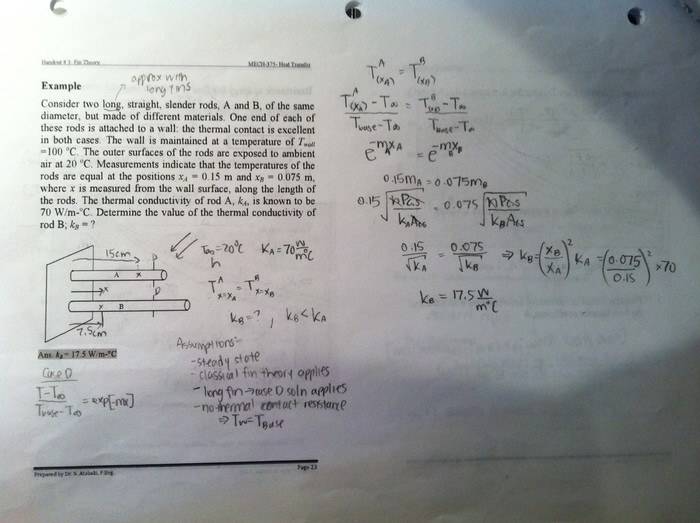
Alright, here is a picture of the problem along with my solution:
qg8BOw5.jpg


My solutions gives the correct answer but the only part I don't understand is why the heat transfer coefficients are the same. If the two rods are made of different materials don't you have a different coefficient? Or is coefficient independent of the material... If so, what does it depend on? Shape?
 
Physics news on Phys.org
theBEAST said:
1. Homework Statement and the attempt at the solution

Alright, here is a picture of the problem along with my solution:
qg8BOw5.jpg


My solutions gives the correct answer but the only part I don't understand is why the heat transfer coefficients are the same. If the two rods are made of different materials don't you have a different coefficient? Or is coefficient independent of the material... If so, what does it depend on? Shape?
The resistance to heat transfer is going to be dominated by the resistance on the air side of the interface. So the heat transfer coefficient is going to be essentially the heat transfer coefficient on the air side. With this situation, then yes, the overall heat transfer coefficient is virtually independent of the rod material. For forced air convection over the fins, it is determined by the cross flow reynolds number and prandtl number of the air.

Chet
 
Chestermiller said:
The resistance to heat transfer is going to be dominated by the resistance on the air side of the interface. So the heat transfer coefficient is going to be essentially the heat transfer coefficient on the air side. With this situation, then yes, the overall heat transfer coefficient is virtually independent of the rod material. For forced air convection over the fins, it is determined by the cross flow reynolds number and prandtl number of the air.

Chet

In what case would it be different then? When the fluids are different? So whenever there are different materials exposed to convective heat transfer with the surrounding air can we use the same heat transfer coefficients all the time?
 
theBEAST said:
In what case would it be different then? When the fluids are different? So whenever there are different materials exposed to convective heat transfer with the surrounding air can we use the same heat transfer coefficients all the time?
You can use the same heat transfer coefficient on the air side, but there may also be some heat transfer resistance that needs to be taken into account on the "inside the cylinder" side. For example, if you have a tube with liquid or gas flowing through it, rather than a metal rod, you will need to consider the resistance on the tube side of the interface, particularly in the case of a gas. You can have a heat transfer coefficient on the tube side that can be of the same order as on the air side. So the overall heat transfer coefficient will be substantially lower than on either side.
 

Similar threads

  • · Replies 14 ·
Replies
14
Views
3K
  • · Replies 2 ·
Replies
2
Views
1K
  • · Replies 4 ·
Replies
4
Views
3K
  • · Replies 3 ·
Replies
3
Views
2K
  • · Replies 4 ·
Replies
4
Views
2K
Replies
3
Views
2K
  • · Replies 2 ·
Replies
2
Views
1K
  • · Replies 6 ·
Replies
6
Views
3K
  • · Replies 5 ·
Replies
5
Views
2K
  • · Replies 3 ·
Replies
3
Views
6K