What gauge wire to use? noob circuits

Click For Summary

Discussion Overview

The discussion revolves around selecting the appropriate gauge wire for powering LED strips from a power supply, focusing on the implications of wire length, current capacity, and environmental conditions. Participants explore concepts related to chassis wiring versus power transmission wiring, as well as the characteristics of different wire types.

Discussion Character

  • Technical explanation
  • Debate/contested
  • Mathematical reasoning

Main Points Raised

  • One participant describes their setup of LED strips powered by a 240W PSU and seeks guidance on wire gauge for points A and B, noting uncertainty about the impact of wire length on gauge selection.
  • Another participant clarifies that the wiring in this context would be considered chassis wiring, contrasting it with power transmission wiring used for high voltage applications.
  • Discussion includes details about wire characteristics such as conductor material, number of strands, and insulation types, emphasizing that the appropriate wire type depends on its application.
  • For a current of 8.1 amps, one participant suggests that 16 AWG copper wire is suitable, while also mentioning that 20 AWG could suffice for short runs in open air at room temperature.
  • Concerns are raised about the compatibility of a 20A, 240W power supply with the total current draw of 16 light bars at 8.1 amps each, leading to questions about the power supply's capability.
  • Another participant provides specific dimensions for wire runs, indicating that the (A) wires will be 6-10 feet and the (B) wires will be 10-15 cm, and suggests that 24 AWG may be appropriate for the shorter runs.
  • There is a consensus that 16 AWG is a good choice for the longer runs, but the exact definition of a "short run" is questioned.

Areas of Agreement / Disagreement

Participants express differing views on the appropriate wire gauge for various lengths and currents, with some suggesting 16 AWG for longer runs and others proposing 24 AWG for shorter runs. The discussion remains unresolved regarding the compatibility of the power supply with the total current draw.

Contextual Notes

Participants note that ambient temperature can affect wire performance, with expectations that temperatures will not exceed 40C, typically remaining between 25-32C. There is also mention of the importance of wire length in determining gauge, but no consensus on the specific implications of length is reached.

Sam_A
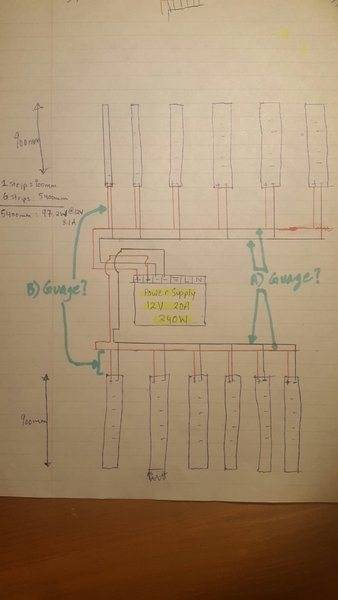
2 sets of 6x LED strips, each 12v 8.1a 97.2W, powered by a single cv 240W PSU, in parallel. The 2 sets are split at the PSU end, each set getting 120W separately. Schematic below,
2017-07-15 12.28.29.jpg


What I don't know is what gauge wire to use at points A and B? Can you please explain what should be used and why?

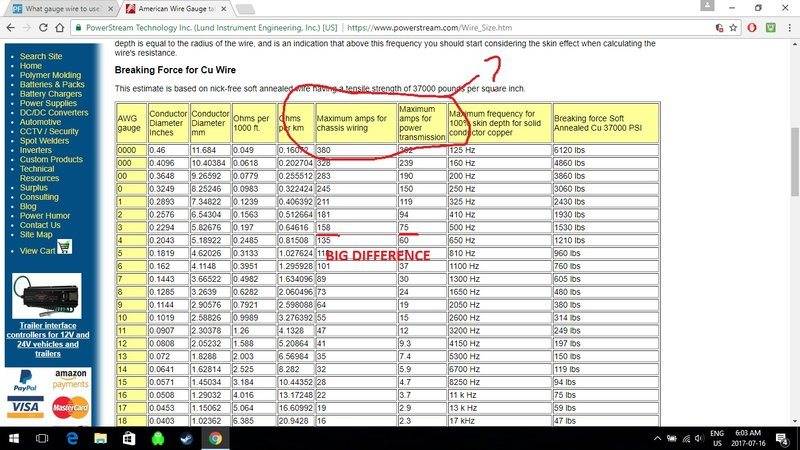
I looked at the AWG chart and I don't understand chassis wiring and power transmission wiring. What category do my wires fall under?
awgchart.jpg


Also, I haven't figured out yet how long exactly will my wires be at point A and B. I know length of the wire has some effect on the gauges, but don't know what effect. Can anybody please present a general guideline or pattern describing what happens as I increase or decrease my wire length?
Much appreciated!
 
Last edited by a moderator:
Engineering news on Phys.org
Sam_A said:
2 sets of 6x LED strips, each 12v 8.1a 97.2W, powered by a single cv 240W PSU, in parallel. The 2 sets are split at the PSU end, each set getting 120W separately. Schematic below,
View attachment 207259

What I don't know is what gauge wire to use at points A and B? Can you please explain what should be used and why?

I looked at the AWG chart and I don't understand chassis wiring and power transmission wiring. What category do my wires fall under?!
For what you are doing it would be considered chassis wiring. Power transmission wiring usually refers to the aluminum, or aluminum/copper clad wires used for high voltage transmission lines. I don't know what they are referring to in the above chart.

What is a wire?
  • Conductor material (copper, tinned copper, aluminum, nickel, silver, etc.).
  • # of strands (1 strand = solid, as in house wiring, or multiple strands of lighter gauge wire, i.,e. - 7x32 is 7 strands of 32 AWG)
  • Insulation material (cloth, rubber, plastic, mica, etc.), thickness, temperature and voltage limits.
What type of wire is appropriate depends on what it is used for. For instance, solid wire is fine for house wiring, but a very poor choice where a lot of flexing is involved. Spark plug wires have very thick insulation because they must operate at high voltage. Cloth covered, silicone rubber insulated copper wire is a good choice for motor leads, but TGGT or (Teflon-Glass-Glass-Teflon) or MG (Mica-Glass) nickel-alloy wire must be used inside industrial ovens, and other high temperature environments. A lot of it boils down to how hot the wire can be allowed to be. Ambient temperature matters, as does whether it is a single conductor in free air (good cooling), or multiple conductors enclosed within conduit.

For 8.1 amps, 16 AWG copper covers all the bases, but for short runs in open air at room temperature you can get away with wire as small as 20 AWG.

For each set of (6) 8.1A light bars, the wires to the power supply carry 48.6 amps.

What I don't understand is how a 20A, 240W power supply will work with 16 light bars at 8.1 amps each (1166W).
 
Last edited:
  • Like
Likes   Reactions: berkeman and Sam_A
Asymptotic said:
For 8.1 amps, 16 AWG copper covers all the bases, but for short runs in open air at room temperature you can get away with wire as small as 20 AWG.
What would you recommend for my setup? How short exactly is a short run?

To give some dimensions, the (A) 8.1a wire(s) will be 6-10 feet each, and the (B) 1.35a wires will be 10-15cm.

The ambient temperature I don't expect to rise past 40C. Mostly, I expect it in the 25-32C range.
 
Oh, I misunderstood.
If each light bar is 1.35A, their 10 to 15 cm runs can be 24 AWG.
16 AWG is still a good choice for 6 to 10 foot runs of the (A) wires.
 

Similar threads

Replies
13
Views
3K
  • · Replies 28 ·
Replies
28
Views
17K
  • · Replies 7 ·
Replies
7
Views
3K
  • · Replies 3 ·
Replies
3
Views
2K
Replies
3
Views
6K
  • · Replies 9 ·
Replies
9
Views
3K
  • · Replies 5 ·
Replies
5
Views
6K
Replies
22
Views
5K
Replies
7
Views
8K
  • · Replies 17 ·
Replies
17
Views
4K