What happens when the switch is closed in a 555 timer and left there?

Click For Summary

Discussion Overview

The discussion revolves around the behavior of a 555 timer circuit when the trigger switch is closed during a timing cycle. Participants explore the implications of this action on the circuit's operation, particularly focusing on waveform outputs and timing characteristics. The context includes simulation results and theoretical considerations regarding the 555 timer's functionality.

Discussion Character

  • Exploratory
  • Technical explanation
  • Debate/contested
  • Experimental/applied

Main Points Raised

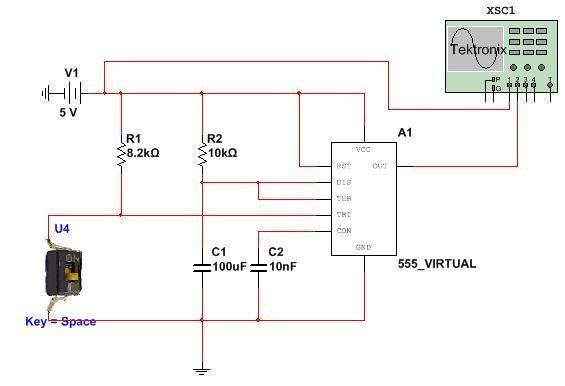
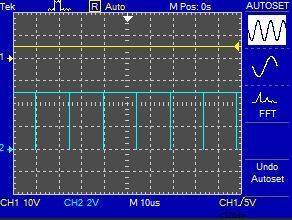
  • One participant presents a circuit and waveform from a simulation, seeking clarification on the observed behavior when the trigger switch is closed during the timing cycle.
  • Another participant suggests that the capacitor may not have enough time to charge, which could affect the timing cycle when the trigger is activated again.
  • A participant calculates a time constant based on resistor and capacitor values, questioning the actual capacitance used in the simulation and suggesting a bypass capacitor for stability during switching.
  • One participant references a datasheet, explaining the trigger requirements for the 555 timer and how holding the trigger low for too long can affect the output state, indicating that the output will follow the trigger signal in such cases.
  • A later reply expresses skepticism about the simulation results, emphasizing that different manufacturers' 555 timers may behave differently under non-standard configurations.

Areas of Agreement / Disagreement

Participants express differing views on the behavior of the 555 timer in this scenario, with no consensus reached on the implications of closing the switch during the timing cycle. Some participants provide theoretical insights while others question the reliability of the simulation results.

Contextual Notes

Limitations include potential discrepancies in component values, the nature of the simulation versus real-world behavior, and variations in 555 timer models from different manufacturers that may affect performance.

Solarmew
Messages
37
Reaction score
1
Here's my circuit
pic1.JPG


The question at hand is what happens when the trigger switch is closed during the timing cycle (after being closed once already to initiate said cycle)

here's the waveform I'm getting, but I'm not sure what to make of it.
pic2.JPG


could someone please help me understand what it's doing?
 
Engineering news on Phys.org


is it because the capacitor doesn't have time to charge, so when it tries to trip, it's forced to go back immediately?


10K X 100 uf = 1 second time constant.
You're showing a pulse every 14 microseconds.

I'd guess C1 is more like 100 picofarads.
Have you a photo of it, or is this a simulation?

Try bypassing the supply with a few uf physically near the 555... that's always good practice because 555 takes a gulp of current when it switches.

old jim


this is just a simulation, i didn't get a chance to do this on a breadboard because we ran out of time :< but i wanted to see what happens if i do it in MultiSim ... and this is what happens (see pic of the waveform) ... and i have no idea why


From the Phillips datasheet available here,
http://www.doctronics.co.uk/pdf_files/555an.pdf

Trigger Requirements
Due to the nature of the trigger circuitry, the timer will trigger on the
negative-going edge of the input pulse. For the device to time-out
properly, it is necessary that the trigger voltage level be returned to
some voltage greater than one third of the supply before the timeout
period. This can be achieved by making either the trigger pulse
sufficiently short or by AC coupling into the trigger. By AC coupling
the trigger (see Figure 3), a short negative-going pulse is achieved
when the trigger signal goes to ground. AC coupling is most
frequently used in conjunction with a switch or a signal that goes to
ground which initiates the timing cycle. Should the trigger be held
low, without AC coupling, for a longer duration than the timing cycle
the output will remain in a high state for the duration of the low
trigger signal, without regard to the threshold comparator state.
This
is due to the predominance of Q15 on the base of Q16, controlling
the state of the bistable flip-flop. When the trigger signal then returns
to a high level, the output will fall immediately. Thus, the output
signal will follow the trigger signal in this case.

I don't trust that simulation.

old jim
 
Last edited by a moderator:


I haven't scrutinized the operation in question here. But I can point out that not all 555's are the same. For input combinations outside those encountered in the timer's myriad designed applications, chips from different manufacturers can and do behave consistently differently.

So for configurations outside the norm, you may find yourself confined to using a particular manufacturer's 555 to provide the i/p o/p characteristic you want.
 

Similar threads

  • · Replies 5 ·
Replies
5
Views
863
  • · Replies 38 ·
2
Replies
38
Views
23K
  • · Replies 9 ·
Replies
9
Views
3K
  • · Replies 9 ·
Replies
9
Views
2K
  • · Replies 6 ·
Replies
6
Views
2K
  • · Replies 19 ·
Replies
19
Views
2K
Replies
11
Views
4K
  • · Replies 6 ·
Replies
6
Views
4K
  • · Replies 6 ·
Replies
6
Views
11K
Replies
12
Views
7K