What is the equation of a circle touching a parabola in polar coordinates?

Join the discussion
Registration is free. Start your own thread to ask a follow-up.
4 replies · 3K views
Suvadip
Messages
68
Reaction score
0
A circle is drawn through the focus of the parabola $2a/r=1+ \cos( \theta)$ to touch it at the point $\theta=\alpha$. Find the eq. of the circle in polar form.

Please help
​


Last edited by a moderator:
Mathematics news on Phys.org
Re: conic in polar coordinates

suvadip said:
A circle is drawn through the focus of the parabola $2a/r=1+ \cos( \theta)$ to touch it at the point $\theta=\alpha$. Find the eq. of the circle in polar form.

Please help
​


Welcome to MHB, suvadip! :)

I'm assuming that your circle is one with its center at (-b,0) assuming that its radius is b.
If that is the case, the polar representation of that circle is:
$r_1 = -2b \cos \theta \qquad (1)$​

Let's combine that with your parabola
$r_2 = \dfrac{2a}{1+\cos \theta} \qquad (2)$​

Now we're looking at a point where the tangents of both curves are parallel.
Do you know how to express a tangent in polar coordinates?
If you want, I can explain.
For now, let me just say that the tangent has a radial component of $r'(\theta)$ and a transverse component of $r(\theta)$.

The tangents are parallel if the ratios of the radial components with their transverse components are equal.
In other words if:
$\dfrac{r_1'(\theta)}{r_1(\theta)} = \dfrac{r_2'(\theta)}{r_2(\theta)} \qquad (3)$​

Can you solve that?
 
Last edited:
Re: conic in polar coordinates

Hold on!
Is this pre-university math? :confused:
Am I missing something?
 
Re: conic in polar coordinates

suvadip said:
A circle is drawn through the focus of the parabola $2a/r=1+ \cos( \theta)$ to touch it at the point $\theta=\alpha$. Find the eq. of the circle in polar form.

Please help
​


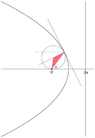
Writing the equation of the parabola as $r = 2a-r\cos\theta$, you see that the focus is at the origin and the directrix is the vertical line through the point $(2a,0)$.

​
(Click on the diagram to see a bigger version.)​

Using the property of the parabola that light rays from infinity are reflected to the focus, you see that the normal at the point of tangency makes an angle $\alpha/2$ with the horizontal. The centre of the circle has to lie on this normal line. Next, the value of $r$ when $\theta=\alpha$ is $\dfrac{2a}{1+\cos\alpha}$, and using a half-angle formula from trigonometry you can write this as $\dfrac{a}{\cos^2(\alpha/2)}.$

In the above diagram, the vertices of the pink triangle are the origin, the centre of the circle, and the point of tangency of the circle and parabola. The long side of the triangle has length $\dfrac{a}{\cos^2(\alpha/2)}$, and the centre of the circle has to lie on the perpendicular bisector of this line. The triangle is isosceles, its equal angles are both $\alpha/2$, and its shorter sides are both equal to the radius of the circle, call that $R$. It follows that $\dfrac{a}{2\cos^2(\alpha/2)} = R\cos(\alpha/2)$, and therefore $R = \dfrac{a}{2\cos^3(\alpha/2)}$. The polar coordinates of the centre of the circle are therefore $R$ and $\frac32\alpha$.

Now use the formula given here for the polar equation of a circle through the origin, to get the polar equation of the circle as $r\cos^3\bigl(\frac12\alpha\bigr) = a\cos\bigl(\theta - \frac32\alpha\bigr).$

@ ILikeSerena: If I have understood this question correctly, it certainly isn't pre-university math! (But I don't know which section to transfer it to.)​
 
Attachments
  • parabola.png
    parabola.png
    4.3 KB · Views: 113
Re: conic in polar coordinates

Opalg said:

​
(Click on the diagram to see a bigger version.)​


Good point!
I didn't consider that the angle $\alpha$ should be considered as given and that the circle doesn't need to have a center on the x-axis.
@ ILikeSerena: If I have understood this question correctly, it certainly isn't pre-university math! (But I don't know which section to transfer it to.)

As it is, I'd consider it Analysis (our new sub forum ;))