What is the flow through pipe in an open channel?

Click For Summary
To determine the flow velocity through a pipe reducing in diameter within an open canal, key factors include the initial water velocity of 3 m/s, water depth of 1.5 m, and the varying diameters of the pipe (inlet at 0.9 m, reduced at 0.6 m, and outlet at 0.8 m). The flow is characterized as turbulent due to the conditions of the open canal. The nozzle's placement at the center and bottom of the canal influences the flow dynamics, suggesting that the velocity profile will not be linear. An energy balance approach can be utilized to analyze the flow characteristics and transitions. Understanding these parameters is essential for accurately assessing flow behavior in this scenario.
shafqut
Messages
3
Reaction score
0
I know this is easy but i need to know the flow velocity through a pipe reducing in diameter inside a canal.
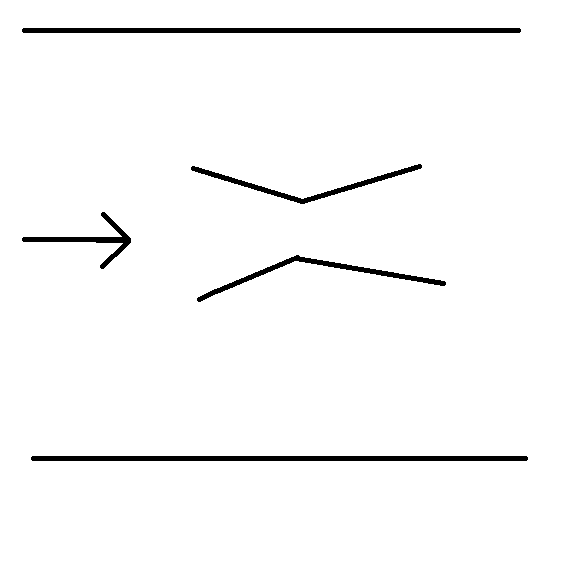
upload_2015-6-4_9-46-0.png

the
water velocity is 3m/s
water depth is 1.5 m
the pipe is at the bottom
inlet diameter 0.9m
small reduced diameter 0.6m
outlet diameter = 0.8m

note: this is an open canal with velocity 3m/s
canal width is 6.096 m

At least tell me how this should be approached
 
Last edited:
Engineering news on Phys.org
Please provide more information regarding the location of nozzle wrt canal and how is the flow characteristics(laminar or turbulant)?

And as the nozzle is on open canal this property will also affect the flow velocity:
pipe_velocity_profile.gif

Though it is for pipe flow it will also affect canal flow so the velocity profile will not be linear.
 
Flow is turbulent..
the nozzle is at the center and at the bottom.
please mention any assumption you are taking .. can this be done using energy balance ?
 
My idea is that I want to use immerse Whitetail Antlers in a fishtank to measure their volumetric displacement (the Boone and Crockett system is the current record measurement standard to place in a juxtaposition with) I would use some sight glass plumbed into the side of the tank to get the change in height so that I can multiply by the tank cross-section. Simple Idea. But... Is there a simple mechanical way to amplify the height in the sight glass to increase measurement precision...

Similar threads

  • · Replies 7 ·
Replies
7
Views
2K
Replies
0
Views
2K
  • · Replies 31 ·
2
Replies
31
Views
4K
  • · Replies 4 ·
Replies
4
Views
2K
  • · Replies 8 ·
Replies
8
Views
3K
Replies
9
Views
2K
Replies
2
Views
1K
  • · Replies 8 ·
Replies
8
Views
2K
  • · Replies 2 ·
Replies
2
Views
4K
  • · Replies 20 ·
Replies
20
Views
10K