What is the metallic circular component in this voltage sensor?

Click For Summary

Discussion Overview

The discussion centers around the metallic circular component found in a voltage sensor module. Participants explore its purpose, design, and potential marketing implications, with a focus on both technical and aesthetic considerations.

Discussion Character

  • Exploratory
  • Debate/contested
  • Technical explanation

Main Points Raised

  • One participant suggests the component might serve as a heat shield.
  • Another proposes it could be a mounting hole.
  • Some participants argue it is merely a decorative feature intended to enhance perceived value, comparing it to chrome trim on cars.
  • Concerns are raised about the practicality of gold plating, with one participant noting it may be a waste and could be a marketing strategy to boost sales.
  • Discussion includes speculation on the cost breakdown of the product, suggesting that the gold plating may not significantly impact production costs.
  • One participant reminisces about similar designs used in vacuum tube testers, noting that gold plating was uncommon in mechanical devices.
  • A humorous remark is made about the component resembling a "flux capacitor," questioning the board's capability for high power ratings.

Areas of Agreement / Disagreement

Participants do not reach a consensus on the purpose of the metallic circular component, with multiple competing views and speculative ideas presented throughout the discussion.

Contextual Notes

Participants express uncertainty regarding the actual function of the component, and assumptions about its design and marketing implications vary widely.

Wrichik Basu
Science Advisor
Insights Author
Gold Member
Messages
2,188
Reaction score
2,694
While searching for something else, I stumbled upon this https://robu.in/product/voltage-sensor-module/. It is idiotic to buy something like this, because a voltage divider doesn't cost more than a few cents. But what is the metallic circular component in the middle of the sensor? Some kind of heat shield?
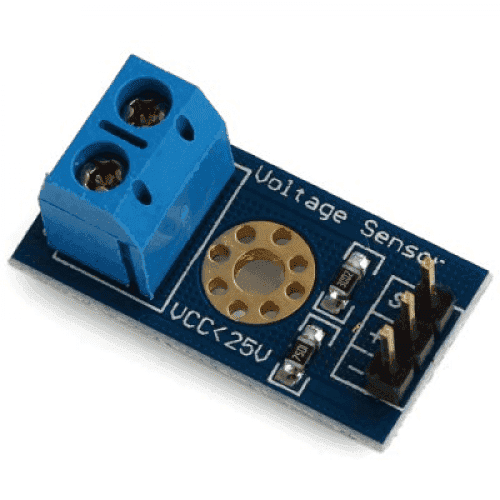
1589559397788.png
 
Engineering news on Phys.org
I don't know the answer, but my guess would be it's a mounting hole.
 
I would vote it is a "Feature Item, " a useless doodad added to make the purchaser believe they have an exotic item. (Think chrome trim on a car, or the pattern on your dinner plate.)
 
  • Like
Likes   Reactions: DaveE and Wrichik Basu
It looks like a waste of gold plating to me. But I wasn't ever much inclined to think like the sales and marketing types. For a product like this, that sort of "feature" could double sales.
 
DaveE said:
It looks like a waste of gold plating to me. But I wasn't ever much inclined to think like the sales and marketing types. For a product like this, that sort of "feature" could double sales.
This is Chinese product. The Chinese PCB with gold plating and panelizing costs for maker $0.17, terminal block $0.04, other components - $0.03. Plus $0.5 for Chinese goventment subsidized shipping. Total material&shipping cost is $0.74, and catalog price linked here is $1.3, which looks reasonable. Without over-engineered gold-plated mounting hole the material&shipping cost for maker will be down to $0.65 though. My guess is what "voltage sensor" was fabricated on same breakable board as another small production volume PCB which actually do need gold plating, therefore gold plating of "voltage sensor" become essentially "free" for maker. Or maker decided what 15% lower price margin will pay off due higher selling volume of expensive-looking part.
 
  • Like
Likes   Reactions: DaveE
Gold plating can be made very thin - it looks good but doesn't survive mounting/plugging - any mechanical action will destroy it.
 
The circular device design reminds me of pin straighteners ubiquitous on common vacuum tube testers and devices in my childhood. One would insert the tube in the device to straighten bent pins but also to remove oxidation from the connectors before running tests or replacing tubes. Many/most television and radio chassis would include a pin straightener for convenience, matched to the vacuum tubes in the unit.

Brass was not uncommon but I never saw gold plating used on what was essentially a mechanical device. Bit of memorial day nostalgia.
 
Looks like a "flux capacitor" to me...is that board rated for gigawatts?

There used to be tube testers at the drug store if my memory serves...
 
  • Haha
Likes   Reactions: Klystron

Similar threads

  • · Replies 6 ·
Replies
6
Views
3K
  • · Replies 21 ·
Replies
21
Views
4K
  • · Replies 6 ·
Replies
6
Views
3K
Replies
27
Views
4K
Replies
11
Views
24K
  • · Replies 2 ·
Replies
2
Views
3K
Replies
2
Views
1K
Replies
2
Views
2K
Replies
12
Views
2K
  • · Replies 4 ·
Replies
4
Views
6K