What is the resultant electric field?

Click For Summary

Homework Help Overview

The problem involves calculating the resultant electric field from three coherent sources represented by sinusoidal functions. The task requires finding the resultant amplitude and phase using phasors for various phase shifts.

Discussion Character

  • Exploratory, Conceptual clarification, Mathematical reasoning

Approaches and Questions Raised

  • Participants discuss the necessity of summing the three electric fields and suggest using phasor diagrams for visualization. Questions arise regarding the calculation of the phase α and the derivation of a general algebraic solution.

Discussion Status

Some participants have offered guidance on using phasor diagrams to find the amplitude ER and phase α without relying on trigonometric identities. There is an ongoing exploration of how to derive the general solution and the potential need for trigonometric identities in that process.

Contextual Notes

Participants are navigating the constraints of the problem, including specific phase values and the requirement to derive a general solution. There is uncertainty about the interpretation of "general algebraic solution" and the methods allowed for calculation.

shanepitts
Messages
84
Reaction score
1
1. Homework Statement
image.jpg

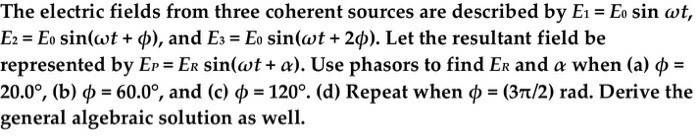
The electric fields from three coherent sources are described by E1 = E0 sin omega t, E2 = E0 sin(omega t + phi), and E3 = E0 sin(omega t + 2phi). Let the resultant field be represented by EP = ER sin(omega t + alpha). Use phasors to find ER and alpha when (a) phi = 20.0 degree, (b) phi = 60.0 degree, and (c) phi = 120 degree. (d) Repeat when phi = (3pi/2) rad. Derive the general algebraic solution as well.

Homework Equations


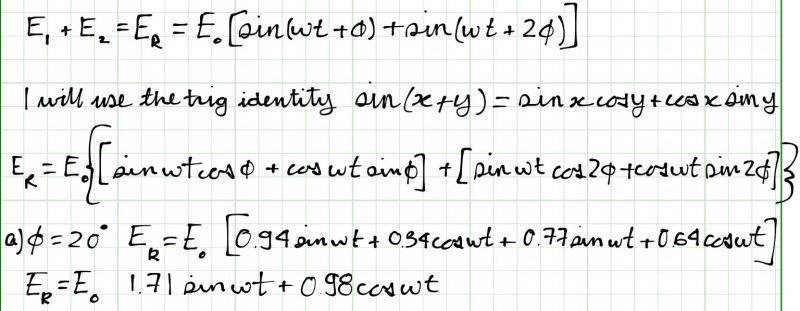
sin(a+b)=sinacosb+cosasinb

E1+E2=ER

The Attempt at a Solution


image.jpg


Moreover, I am not sure how to calculate α and what is meant by deriving the general algebraic solution?[/B]
 
Physics news on Phys.org
I believe that you are required to find the sum of all three electric fields. Also, I think you are supposed to get the answer by drawing the phasors and getting the answer from your drawing without using trig identities.
 
  • Like
Likes   Reactions: shanepitts
TSny said:
I believe that you are required to find the sum of all three electric fields. Also, I think you are supposed to get the answer by drawing the phasors and getting the answer from your drawing without using trig identities.

After finding the phase via the phaser diagrams, how could I find the algebraic solution?Should I use the trig identities?
 
You should be able to get the phase ##\alpha## and the amplitude ##E_R## from the phasor diagram without using trig identities. You just need geometry and trig functions.
 
  • Like
Likes   Reactions: shanepitts
TSny said:
You should be able to get the phase ##\alpha## and the amplitude ##E_R## from the phasor diagram without using trig identities. You just need geometry and trig functions.
 
I'm interpreting "find the general algebraic solution" as "find the general solution in terms of arbitrary ##\phi## and## E_0##. The phasor diagram shows how the result is the sum of three vectors. So, you can get the result by adding the three vectors either graphically or by method of components. The method of components is kind of messy and I think you would need to use some trig identities to get to a simple final result. But, if you draw the phasor diagram, then you can get the result by using just geometry and trig functions without needing trig identities.
 
  • Like
Likes   Reactions: shanepitts

Similar threads

  • · Replies 16 ·
Replies
16
Views
1K
  • · Replies 3 ·
Replies
3
Views
2K
Replies
3
Views
1K
  • · Replies 1 ·
Replies
1
Views
2K
  • · Replies 6 ·
Replies
6
Views
3K
  • · Replies 8 ·
Replies
8
Views
2K
Replies
3
Views
7K
Replies
9
Views
2K
  • · Replies 3 ·
Replies
3
Views
2K
  • · Replies 6 ·
Replies
6
Views
1K