SUMMARY
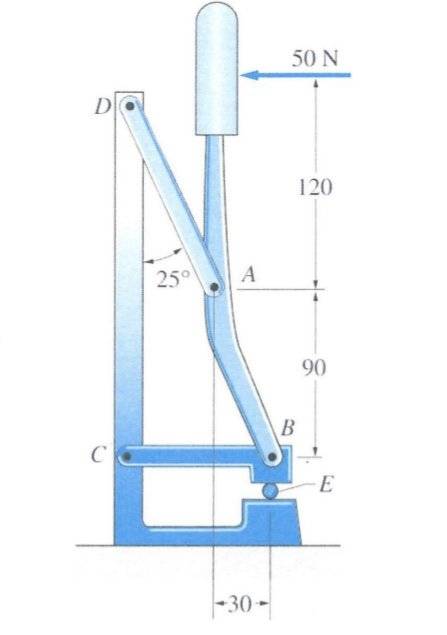
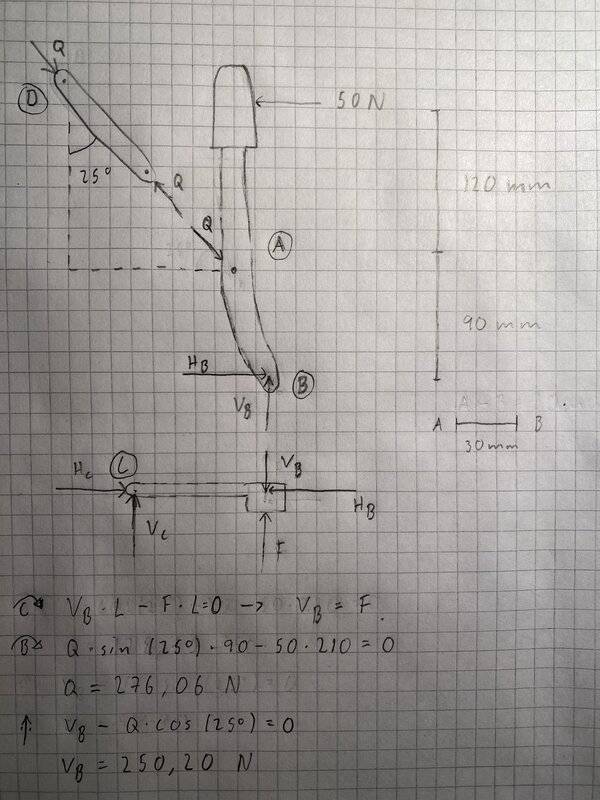
The discussion centers on calculating the resulting force between beam CB and point E, specifically addressing the vertical force at point B and its relation to the force Q acting at point A. The user initially calculated a force of 250N but later confirmed an answer of 877N after considering both horizontal and vertical components of force Q. Key insights include the necessity of accounting for the horizontal displacement of 30 units between points A and B and the moments created by both components of force Q about point B.
PREREQUISITES
- Understanding of Newton's laws of motion
- Knowledge of force components and moments in physics
- Familiarity with trigonometric functions, specifically cosine for resolving forces
- Basic principles of static equilibrium in mechanics
NEXT STEPS
- Study the principles of static equilibrium and how to apply them to solve for unknown forces
- Learn how to calculate moments about a point using both horizontal and vertical force components
- Explore the impact of horizontal displacements on force calculations in structural mechanics
- Review examples of resolving forces into components and their applications in engineering problems
USEFUL FOR
Students in mechanical engineering, physics enthusiasts, and professionals involved in structural analysis or mechanics who seek to deepen their understanding of force interactions and equilibrium conditions.