What Magnets are best to demonstrate deceleration?

  • Context: High School 
  • Thread starter Thread starter ham1
  • Start date Start date
  • Tags Tags
    Deceleration Magnets
Click For Summary

Discussion Overview

The discussion centers on the best type of magnet to use for demonstrating the deceleration of a magnet falling through a copper pipe, focusing on the effects of magnetic forces and eddy currents. Participants explore various magnet shapes, sizes, and configurations, as well as the implications of modifications to the pipe.

Discussion Character

  • Exploratory
  • Technical explanation
  • Debate/contested

Main Points Raised

  • Some participants suggest that a cylindrical magnet with a diameter slightly smaller than the internal diameter of the pipe would be optimal to prevent tumbling.
  • Others argue that a stronger magnet, such as a rare Earth magnet, would provide a more impressive demonstration compared to weaker options like a magnetized nail.
  • There is a proposal to cut a slot down the length of the pipe to enhance visibility of the falling magnet, though some participants question whether this would still allow for effective demonstration of eddy currents.
  • A specific recommendation is made for using an N52 cylindrical neodymium magnet, which is noted for its strength and suitability for the demonstration.
  • Participants discuss the formation of eddy currents and their role in the deceleration of the magnet, with some expressing confusion about how these currents would behave in the context of a magnet falling through a tube.
  • One participant suggests conducting a comparative drop of a second magnet in a plastic tube to account for air resistance, adding another layer to the demonstration.

Areas of Agreement / Disagreement

Participants express a mix of agreement and disagreement regarding the best type of magnet and the impact of modifications to the pipe. There is no consensus on whether cutting a slot would affect the demonstration's effectiveness, and discussions about the behavior of eddy currents remain unresolved.

Contextual Notes

Some participants highlight the importance of the magnet's orientation and the potential effects of air resistance in different environments, but these aspects are not fully resolved within the discussion.

ham1
Messages
1
Reaction score
0
Hello
I'd like to demonstrate to students how a magnet is slowed when falling through a copper pipe due to generation of magnetic force. What type of magnet should I use? ShouId it be cylindrical or flat? Which way shouId it be magnetized? I have 3/4 inch pipe.
Thanks
ham1
 
Physics news on Phys.org
Any that don't jam or tumble in the pipe work. The stronger the field per unit mass the slower it goes. For instance a magnetized nail is not going to be very impressive, whereas a rare Earth magnet is.

As part of the demonstration, try it with two identical magnets. Drop one thru the pipe while the other is simultaneously dropped in free air. Keep them far enough apart (arms length) that they don't interfere with each other.

To get their interest you could call it a curiosity with minimal introduction and no explanation; then ask for explanations. Of course if it is college level someone will know why, whereas grade schoolers probably won't.

Have Fun!
Tom
 
  • Like
Likes   Reactions: davenn and anorlunda
It seems that a cylindrical magnet with a diameter just slightly smaller than the Internal Diameter of the pipe would be best, because it won’t tumble. Also, if there is any way to cut a slot down the length of the tube on one side, it makes the demonstration more impressive, as the students will be able to actually watch the magnet fall in slow motion.

Another nice addition would be to drop a cork or other lightweight object similar to your magnet in size and shape, so they can see that it drops fast.
 
If you cut a slot down the length would it still work?
 
  • Like
Likes   Reactions: davenn
profbuxton said:
If you cut a slot down the length would it still work?

I don't see how. How does the current flow?
 
I recommend an N52 cylindrical neodymium magnet that as said above is slightly smaller in diameter than the pipe is
 
The slots are a judgement call. They improve visibility, but the breaking effect is slightly diminished. So long as the slot does not go the entire length of the tube, a counter emf is still generated.


But dropping a non-magnetic “control” object really brings the point home, IMHO.
 
https://www.kjmagnetics.com/proddetail.asp?prod=R828

This is a rare Earth magnet that is fairly strong. We purchased 100 of them for experiments testing magnetoreception in fish and discovered it in three new species. They also work well for a number of other applications requiring a strong magnet for physics labs and demonstrations, including slowing when dropped through a non-magnetic conducting pipe. These have a hole in them, because we wanted to be able to connect them securely to fishing equipment. There is a slightly stronger magnet available without the hole:

https://www.kjmagnetics.com/proddetail.asp?prod=D88-N52

I tend to recommend the version with the hole. The hole has not been a problem for any experiments or demonstrations, but it is handy for attaching to non-magnetic stuff. Once you have some of these, you'll think of other neat things to do with them.
 
Vanadium 50 said:
I don't see how. How does the current flow?
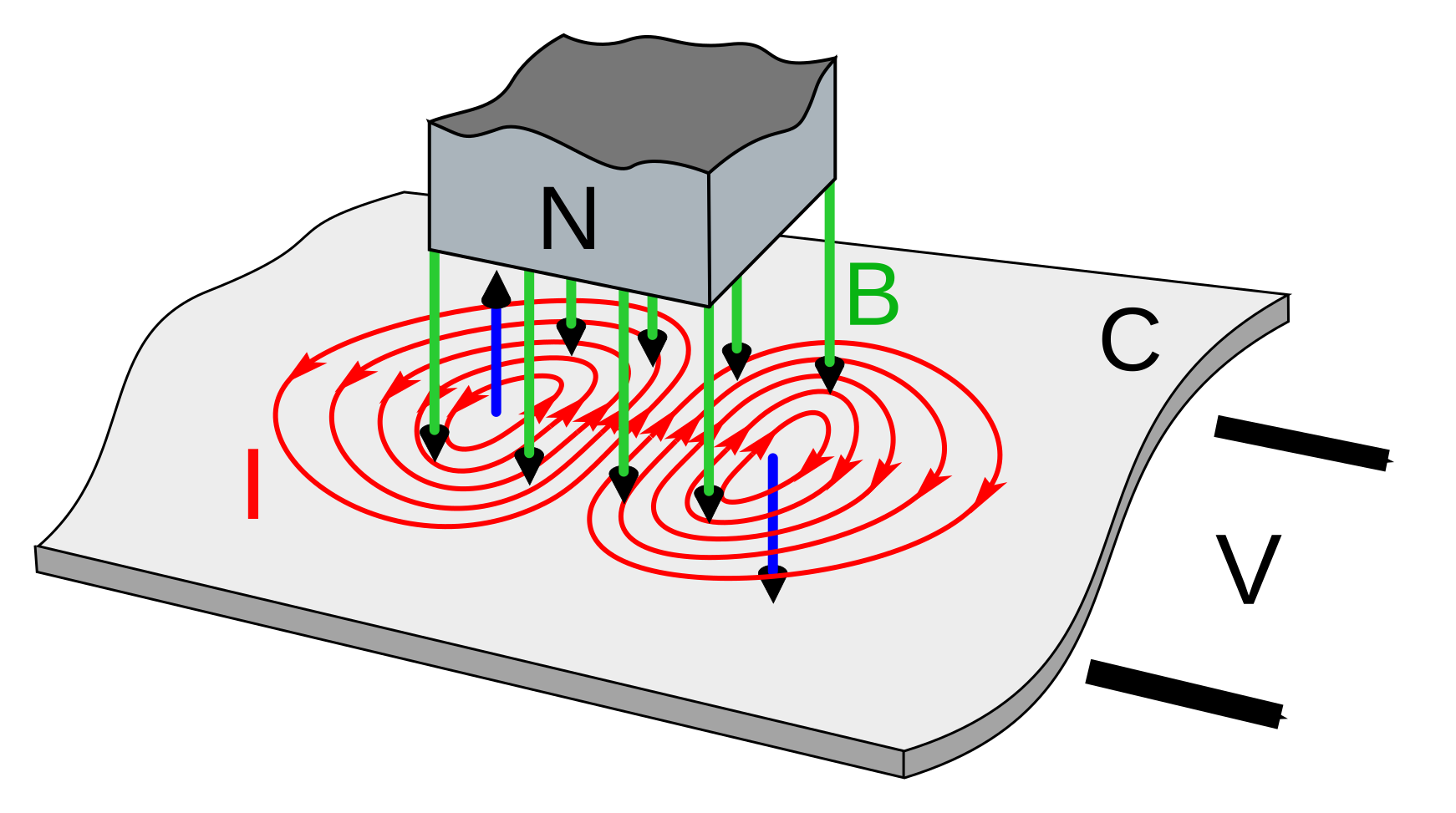
The currents are little eddies. They don't go around the circumference. https://commons.wikimedia.org/wiki/File:Eddy_currents_due_to_magnet.svg
Eddy_currents_due_to_magnet.svg
 
  • #10
anorlunda said:
The currents are little eddies. They don't go around the circumference.https://commons.wikimedia.org/wiki/File:Eddy_currents_due_to_magnet.svg
Eddy_currents_due_to_magnet.svg
I'm desperately trying to figure out how that image relates to a bar or cylindrical magnet being dropped lengthways down a tube ??
It shows a magnet end on to some sort of "S" shaped surface. Doesn't really show a magnet going down a tube

So the point is ... how does the eddy current formation of the above image vary from the magnet in a tube scenario, where the
magnet sides are parallel ( not end) on to the tube

eg...

upload_2018-12-5_7-42-39.png
A Vs B ... your quoted image infers a B setup

My initial thought was the same as V50's

I would suggest that "A", is more stable as in "B" the magnet is more likely to want to tumbleDave
 

Attachments

  • upload_2018-12-5_7-42-39.png
    upload_2018-12-5_7-42-39.png
    4.1 KB · Views: 586
  • #11
Tom.G said:
As part of the demonstration, try it with two identical magnets. Drop one thru the pipe while the other is simultaneously dropped in free air. Keep them far enough apart (arms length) that they don't interfere with each other.

... drop the second magnet down a plastic tube of the same internal diameter, rather than in free air, that way air resistance within
a confined space ( the tube) can be truly accounted for.Dave
 
  • Like
Likes   Reactions: Tom.G

Similar threads

  • · Replies 59 ·
2
Replies
59
Views
7K
  • · Replies 5 ·
Replies
5
Views
2K
  • · Replies 3 ·
Replies
3
Views
2K
  • · Replies 9 ·
Replies
9
Views
2K
  • · Replies 6 ·
Replies
6
Views
2K
  • · Replies 7 ·
Replies
7
Views
2K
  • · Replies 7 ·
Replies
7
Views
3K
  • · Replies 3 ·
Replies
3
Views
1K
  • · Replies 8 ·
Replies
8
Views
2K
  • · Replies 20 ·
Replies
20
Views
6K