What pressure would a strain of 40 µε indicate?

  • Thread starter Thread starter Al_Pa_Cone
  • Start date Start date
  • Tags Tags
    Pressure Strain
Click For Summary

Discussion Overview

The discussion revolves around determining the maximum allowable pressure for a cylindrical pressure vessel and the pressure corresponding to a strain of 40 µε. Participants explore the application of material properties, such as Young's modulus and yield stress, in the context of pressure vessel design, including calculations involving hoop stress and strain.

Discussion Character

  • Technical explanation
  • Mathematical reasoning
  • Debate/contested
  • Homework-related

Main Points Raised

  • One participant presents a hoop stress equation, σ = pr/t, and seeks assistance in applying it to find the pressure corresponding to a strain of 40 µε.
  • Another participant questions the accuracy of the hoop stress being equated directly to pressure and asks what pressure would yield a hoop stress of 500 MPa.
  • There is a discussion about the relationship between axial stress and hoop strain, with some participants suggesting that axial stress may be twice the hoop stress.
  • Several participants express uncertainty about the correct equations to use, with one suggesting the need for Hooke's law in three dimensions for plane stress conditions.
  • One participant mentions their background as a distance learning student and their reliance on the forum for assistance in understanding the concepts.
  • There is a debate over whether to divide the calculated maximum pressure by the safety factor of 4, with some participants affirming this approach while others question the yield criterion being applied.
  • One participant discusses anisotropic yield criteria and its relevance to the problem, indicating that the situation does not reach large plastic deformations.
  • Another participant shares their calculations for pressure and yield stress, seeking verification of their approach and results.

Areas of Agreement / Disagreement

Participants express differing views on the application of yield criteria and the correct approach to calculating pressures. There is no consensus on the final answers for the maximum allowable pressure or the pressure corresponding to a strain of 40 µε, as multiple competing views remain throughout the discussion.

Contextual Notes

Participants note limitations in their understanding of yield stress criteria and the need for specific material properties, such as Poisson's ratio, to apply certain equations correctly. The discussion reflects varying levels of familiarity with the relevant concepts and equations.

Al_Pa_Cone
Messages
143
Reaction score
0
Q6. A cylindrical vessel 2m internal diameter and 4m long has a wall thickness of 6mm. Strain gauges are installed on the vessel to measure hoop strain (see FIG 6).
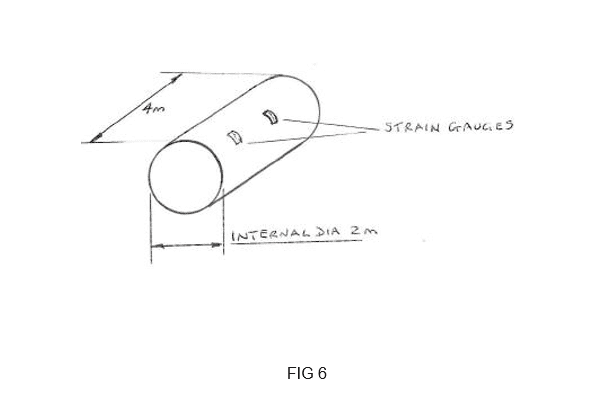
upload_2017-1-4_11-53-6.png

The Young's Modulus of the Material = 290 GN m^-2
The Yield Stress of the Material = 500 MPa

The Questions are
(i) What is the maximum allowable pressure if a factor of safety of 4 is to be used?

(ii) What pressure would a strain of 40με indicate?

For (i) I get:
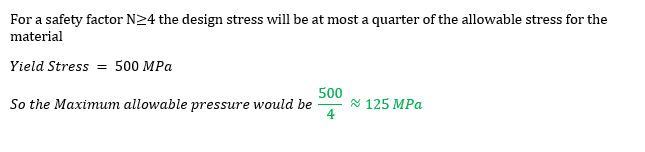
upload_2017-1-4_11-56-26.png

Does this look correct?

for part 2, I cannot find the relevant equation to suit the pressure vessel. I have the hoop equation as
σ = pr/t
Where:
p = Pressure
r = radius of the vessel at 1000mm
t = Thickness of the vessel at 6mm

I am aware the strain is represented as a change in length by 0.000040 but I am not sure how to use this in my working out, given the fact I haven't used the Young's modulus of 290 GN m^-2 either.

Can anyone help me with this question?
 
Physics news on Phys.org
(i) No. As your hoop equation indicates, the hoop stress is not equal to the pressure. What pressure would give a hoop stress of 500 MPa?
(ii) What is the definition of Young's modulus? What stress gives a strain of 40 ##\mu \epsilon## ? What pressure causes this stress?
 
Ok for part (i) This is what I have come up with?
upload_2017-1-4_13-45-35.png

Does this look ok?

I will work on part 2 next.

Thanks
 

Attachments

  • upload_2017-1-4_13-44-49.png
    upload_2017-1-4_13-44-49.png
    10 KB · Views: 817
On the right lines, but the radius isn't 2, is it?
So what is the max allowable pressure?
 
No it isn't you are right, So with a correct radius of 1meter the answer gives 3 MPa. If I follow my original post method that the maximum allowable pressure is 1/4 of this I would get 0.75 MPa or 750000 Pa
 
To answer part 2 using you advice I have as follows:
upload_2017-1-4_14-31-40.png
 
How does the axial stress affect the hoop strain?
 
I think the axial stress is twice the hoop stress therefore twice the hoop strain?
 
Al_Pa_Cone said:
I think the axial stress is twice the hoop stress therefore twice the hoop strain?
What is the exact equation for the hoop strain as a function of the combination of the hoop stress and the axial stress.
 
  • #10
upload_2017-1-5_13-44-52.png


Would this be the relevant equation I am looking for?
 
  • #11
Al_Pa_Cone said:
View attachment 111121

Would this be the relevant equation I am looking for?
No. You need Hooke's law in 3D for conditions of plane stress. Google key words Hooke's Law plane stress.

Are you trying to learn this stuff on your own? Are you using a textbook?
 
  • #12
Yes I am a distance learning student at Tees University. I can call a tutor to ask a question over the phone which is not ideal, but basically I try to learn all this in my spare time without assistance.

I covered hookes law several months ago amongst many other things. I have found this forum to be very helpful in providing the assistance I need to arrive at the correct answers.
I will have another look over my previous notes and see what I can dig out. Thanks for your help
 
  • #13
upload_2017-1-6_9-15-55.png

I have followed the guidelines in the lessons and obtained this figure for pressure?

If this answer is still wrong I will pursue the Hookes law in 3D method although it is not in the methods provided to me through the University.

Thanks
 
  • #14
Al_Pa_Cone said:
No it isn't you are right, So with a correct radius of 1meter the answer gives 3 MPa. If I follow my original post method that the maximum allowable pressure is 1/4 of this I would get 0.75 MPa or 750000 Pa

For part one of this Question, Am I right in dividing the answer I obtained (3MPa) by 4 to get the safety factor maximum pressure? or is 3 MPa the answer? I think I need to divide

Thanks
 
  • #15
Al_Pa_Cone said:
(ii) What pressure would a strain of 40με indicate?

For This part question I have spent some time going back through my lessons provided and found this:
upload_2017-1-9_11-44-12.png

does this look like the correct method to follow in obtaining the pressure value which would cause a strain of 40μ?

This is the last question in my assignment and I am determined to get the highest possible marks. Anyone who can offer help please do.

Thanks
 
  • #16
Al_Pa_Cone said:
For This part question I have spent some time going back through my lessons provided and found this:
View attachment 111304
does this look like the correct method to follow in obtaining the pressure value which would cause a strain of 40μ?
Yes. But, of course, you need to use the corresponding equations involving the stresses and strains in cylindrical coordinates. And don't forget that the stress in the radial direction is much much smaller than the stresses in the axial- and hoop directions, and should thus be taken as zero.
 
  • #17
Just to Check, Is part (i) ok now or should I be dividing by 4 for the safety factor? I think I should divide my answer by 4 to get 0.75 MPa maximum allowed pressure?
upload_2017-1-9_14-35-3.png
 
  • #18
It depends on how they are defining the yield stress.
 
  • #19
I can only attempt my answer from the information provided in the initial question. It says the yield stress of the material is 500MPa?

When it mentions the safety factor of 4 I am sure I need to divide the final pressure by 4 to get my result. I just needed a verification I was doing the correct thing?
 
  • #20
Al_Pa_Cone said:
I can only attempt my answer from the information provided in the initial question. It says the yield stress of the material is 500MPa?

When it mentions the safety factor of 4 I am sure I need to divide the final pressure by 4 to get my result. I just needed a verification I was doing the correct thing?
I was asking about the yield criterion that was being used. Some of the choices are Von Mises, Tresca, or maximum tensile stress over all planes of arbitrary orientation. Which criterion do you think they wanted you to use?
 
  • #21
I have no idea! I am not that clued up on yield stress sorry.
 
  • #23
Thank for providing that link, it was very helpful. According to the information given in the link with regards to Anisotropic yield, This occurs when a metal is subjected to large plastic deformations. As the question states 'What is the maximum allowable pressure if a factor of safety of 4 is to be used?' It doesn't reach the large plastic deformation to use the Anisotropic yield criteria which rules out the use of the von Mises yield criterion. I have copied the details of this link at the bottom of this thread.

So from my lessons on this subject:
upload_2017-1-10_10-16-18.png

So I have the wall Thickness = 6 mm or 0.006 m
The Radius = 1000 mm or 1 m
And the Yeild Stress = 500 MPa

Inuptting these known figures into the above equation and transposing for (P) I have an answer. P = 3 MPa.

In the lesson notes It mentions ' In the absence of a code, we will use N > 4 (i.e the design stress will be at most a quater of the allowable stress for the material.)'
Well the yeild stress is 500 MPa and the pressure I have worked out to be 3 MPa. So if a 3 MPa pressure would cause a yeild of 500 MPa then a safety factor of 4 would require me to divide this firgure by 4 giving Pressure = 0.75 to create a yeild of 125 MPa?

Does this look like it could be a correct answer or am I missing something? from my previous questions, my history would suggest I am missing something.

Anisotropic yield criteria
When a metal is subjected to large plastic deformations the grain sizes and orientations change in the direction of deformation. As a result, the plastic yield behavior of the material shows directional dependency. Under such circumstances, the isotropic yield criteria such as the von Mises yield criterion are unable to predict the yield behavior accurately. Several anisotropic yield criteria have been developed to deal with such situations. Some of the more popular anisotropic yield criteria are:

 
  • #24
Also, This is what I have obtained as a final answer to part b?
with the 3dimentional method I would need the poissons ratio and also I came up against a complication in measuring the x and y stresses when they would be acting on the rounded edges of the cylinder? what surface area would I use in the equation provided stress = force/ cross sectional area?

I have gone with what I think is the correct method. Can anyone verify this?

upload_2017-1-10_11-37-34.png
 
  • #25
Al_Pa_Cone said:
Thank for providing that link, it was very helpful. According to the information given in the link with regards to Anisotropic yield, This occurs when a metal is subjected to large plastic deformations. As the question states 'What is the maximum allowable pressure if a factor of safety of 4 is to be used?' It doesn't reach the large plastic deformation to use the Anisotropic yield criteria which rules out the use of the von Mises yield criterion. I have copied the details of this link at the bottom of this thread.
You are not interpreting it correctly. The von Mises yield criterion is fine for determining the onset of yield even for small deformations.
So from my lessons on this subject:
View attachment 111333
OK. So they are indicating that you should use the maximum principal stress criterion to establish the yield point.
So I have the wall Thickness = 6 mm or 0.006 m
The Radius = 1000 mm or 1 m
And the Yeild Stress = 500 MPa

Inuptting these known figures into the above equation and transposing for (P) I have an answer. P = 3 MPa.

In the lesson notes It mentions ' In the absence of a code, we will use N > 4 (i.e the design stress will be at most a quater of the allowable stress for the material.)'
Well the yeild stress is 500 MPa and the pressure I have worked out to be 3 MPa. So if a 3 MPa pressure would cause a yeild of 500 MPa then a safety factor of 4 would require me to divide this firgure by 4 giving Pressure = 0.75
Correct
to create a yeild of 125 MPa?
No. The yield stress is a property of the material, and is independent of the loading. At 125 MPa, the material will not yield.
 
  • Like
Likes   Reactions: Al_Pa_Cone
  • #26
Al_Pa_Cone said:
Also, This is what I have obtained as a final answer to part b?
with the 3dimentional method I would need the poissons ratio and also I came up against a complication in measuring the x and y stresses when they would be acting on the rounded edges of the cylinder? what surface area would I use in the equation provided stress = force/ cross sectional area?

I have gone with what I think is the correct method. Can anyone verify this?

View attachment 111334
No. This is not done correctly. The strain in the hoop direction is given by: $$\epsilon_{\theta}=\frac{\sigma_{\theta}-\nu \sigma_z}{E}$$where $$\sigma_{\theta}=\frac{pr}{t}$$ and $$\sigma_z=\frac{pr}{2t}$$
 
  • Like
Likes   Reactions: Al_Pa_Cone
  • #27
With this method, I am left with 3 unknown values in the first equation and 2 unknown values in the sub equations.
upload_2017-1-10_14-10-14.png

If don't have the value for Stress in each of the two how can I get a value for pressure? and also the poissons ratio is still unknown in the first equation?

This Is my last assignment question and I was really hoping I had completed it as I have spent weeks on this one! I don't know where to start with this one then.
 
  • #28
Al_Pa_Cone said:
With this method, I am left with 3 unknown values in the first equation and 2 unknown values in the sub equations.View attachment 111346
If don't have the value for Stress in each of the two how can I get a value for pressure? and also the poissons ratio is still unknown in the first equation?

This Is my last assignment question and I was really hoping I had completed it as I have spent weeks on this one! I don't know where to start with this one then.
You solve the strain equation, treating the pressure P as an unknown. This can't be done properly without knowing the Poisson ratio. Assume a typical value of 0.3.
 
  • Like
Likes   Reactions: Al_Pa_Cone
  • #29
upload_2017-1-10_14-41-48.png

Wow! how am I supposed to transpose that for P? I am not to bad at transposition but that looks a nightmare!
 
  • #30
Al_Pa_Cone said:
View attachment 111350
Wow! how am I supposed to transpose that for P? I am not to bad at transposition but that looks a nightmare!
In first year (9th grade) algebra, we learned how to solve a linear algebraic equation in one unknown. Apply what you learned there.
 

Similar threads

  • · Replies 2 ·
Replies
2
Views
2K
  • · Replies 4 ·
Replies
4
Views
2K
  • · Replies 9 ·
Replies
9
Views
5K
  • · Replies 3 ·
Replies
3
Views
5K
Replies
2
Views
3K
Replies
39
Views
7K
  • · Replies 45 ·
2
Replies
45
Views
18K
Replies
7
Views
8K
  • · Replies 9 ·
Replies
9
Views
7K
  • · Replies 9 ·
Replies
9
Views
7K