What velocity does the particle need to get to point B?

Click For Summary
To determine the velocity a particle needs to reach point B, the discussion focuses on breaking the problem into x and y components. The y component involves using the formula with acceleration as sin(a)*9.82, while the x component uses the equation x=V0*t, substituting time from the y calculation. Participants confirm that the approach is correct but caution against substituting numerical values for g without knowing other variables. Additionally, there is a suggestion to clarify the angle notation to avoid confusion in the algebra. Overall, the method discussed is valid, with emphasis on maintaining clarity in variable representation.
ClearWhey
Messages
19
Reaction score
4
Homework Statement
A particle is at point A in a certain moment. The particle rolls with an angle of inclination a. It’s velocity direction is parallel to the upper edge. What velocity V0 does it need to reach into the hole B?

Sorry for my english
Relevant Equations
Look at the picture to get a better idea of the problem.
It was a long time ago I did these kind of problems so I’m a bit rusty. The only thing I can think of is divide it up to two parts one x and one y.

In y the acceleration is sin(a)*9.82? Then put that in the equation and solve for t.

In x the there is no acceleration so the formula is x=V0*t, I put in t from y and solve for V0?

Haven’t gotten the answer paper yet so I have no idea if I’m on the right path or wrong. That is why I’m asking here if I’m solving this question right, if not how should I do it?

Thanks in advance for the help!
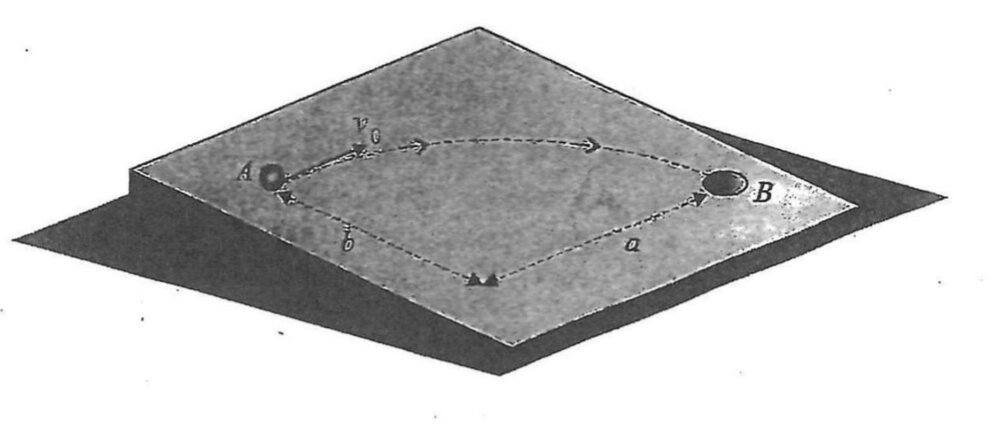
71EDAA2E-1DA0-4245-9624-950298303FA5.jpeg
 
Physics news on Phys.org
Looks like the right approach.
 
  • Like
Likes ClearWhey
You have given the inclination angle as ##a## and according to the figure the "horizontal" distance between A and B also labelled as ##a##. This might lead to confusing algebra.

Perhaps you meant to use ##\alpha## as the angle?
 
  • Like
Likes ClearWhey
gneill said:
You have given the inclination angle as ##a## and according to the figure the "horizontal" distance between A and B also labelled as ##a##. This might lead to confusing algebra.

Perhaps you meant to use ##\alpha## as the angle?

Yes you are correct.

haruspex said:
Looks like the right approach.

What do you think about my solution?
4382B696-6109-4DF2-B5B3-BEE9211F2C16.jpeg
 
ClearWhey said:
What do you think about my solution?
That is right, but there is no point in substituting a numerical value for g when you don't have numbers for the rest of the variables. Just leave it as g.
And if you do substitute a numerical value you must include the units: ##v_0=a\sqrt{\frac{9.82\sin(\alpha)ms^{-2}}{2b}}##
 
  • Like
Likes ClearWhey and etotheipi
haruspex said:
That is right, but there is no point in substituting a numerical value for g when you don't have numbers for the rest of the variables. Just leave it as g.
And if you do substitute a numerical value you must include the units: ##v_0=a\sqrt{\frac{9.82\sin(\alpha)ms^{-2}}{2b}}##

Alright will keep that in mind for the future and thanks for the help!
 
  • Like
Likes jim mcnamara
The book claims the answer is that all the magnitudes are the same because "the gravitational force on the penguin is the same". I'm having trouble understanding this. I thought the buoyant force was equal to the weight of the fluid displaced. Weight depends on mass which depends on density. Therefore, due to the differing densities the buoyant force will be different in each case? Is this incorrect?

Similar threads

  • · Replies 4 ·
Replies
4
Views
1K
Replies
12
Views
1K
Replies
2
Views
4K
  • · Replies 7 ·
Replies
7
Views
1K
  • · Replies 13 ·
Replies
13
Views
1K
  • · Replies 5 ·
Replies
5
Views
1K
  • · Replies 1 ·
Replies
1
Views
1K
Replies
1
Views
1K
  • · Replies 40 ·
2
Replies
40
Views
2K