What's the purpose of this dual coil?

  • Thread starter Thread starter marcophys
  • Start date Start date
  • Tags Tags
    Coil Coils Dual
Join the discussion
Registration is free. Start your own thread to ask a follow-up.
15 replies · 4K views
marcophys
Messages
152
Reaction score
20
What's the purpose of this dual coil?
It has a blue and red cable.
It stood alone, mounted (isolated) on the chassis of a PC PSU.

It's in good condition, so I'm keeping it, but what can be achieved with it?
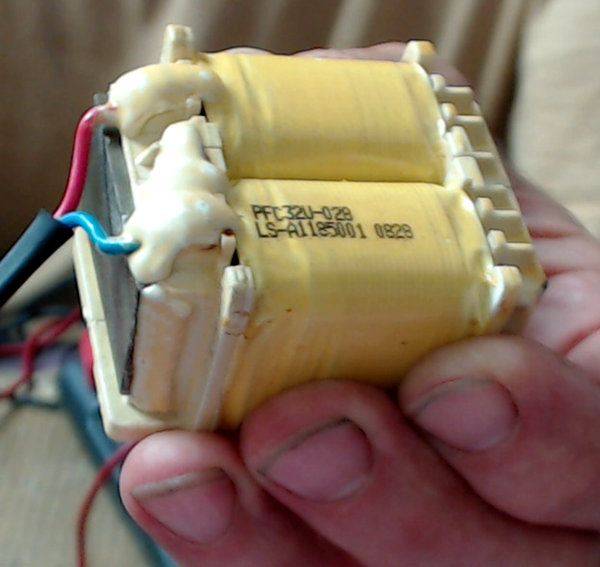
dual-coil.jpg
 
Engineering news on Phys.org
marcophys said:
What's the purpose of this dual coil?
It has a blue and red cable.
It stood alone, mounted (isolated) on the chassis of a PC PSU.

if there is ONLY 2 wires, then it is likely a choke

please confirm that there is only 2 terminals
 
  • Like
Likes   Reactions: marcophys and cnh1995
Yes... specifically blue & red - reading 2.3 Ω
This is what confused me.

Only two connectors (each end of the windings).
Almost no resistance.
Yet cabled blue and red (traditionally +ve -ve).

I looked up choke, but so far, enlightenment has not arrived.
...Ah... but electronic ballast, provides I believe a better explanation (if this is what it is).

Am I correct in believing that this would be placed in the +ve feed to a component?
(but it has blue and red cables... so I'm not sure.)
 
Last edited:
marcophys said:
Yes... specifically blue & red - reading 2.3 Ω
This is what confused me.

Only two connectors (each end of the windings).
Almost no resistance.
Yet cabled blue and red (traditionally +ve -ve).

I looked up choke, but so far, enlightenment has not arrived.
I agree with Dave. You can see the iron core and coils wound around the limbs. Perhaps they are in connected in series aiding fashion, so their mutual inductance increases the effective inductance.

But I can't tell the exact function of that choke. I'll have to do some reading..
 
  • Like
Likes   Reactions: marcophys
I wonder if PFC written on it means anything ?
 
  • Like
Likes   Reactions: cnh1995
CWatters said:
I wonder if PFC written on it means anything ?
Yes, Power Factor Correction.

images.jpg
 
  • Like
Likes   Reactions: sophiecentaur
I just tried it in series with a motor.

The PSU puts out 19v DC no load.
With the motor running, it drops to 7v.
It can be dropped down to 4v and still run.

With the coil in series - still 19v no load.
With the motor ON the voltage drops to 4v but no sign of life from the motor.
Therefore it appears to be greatly limiting the current flow.
Interesting.

If this is it's purpose, it seems a coil could be chosen to protect a motor from overcurrent - say in the case of a stall.

Further thought - the problem would be that the motor probably wouldn't start.
... and anyway, there are probably better ways of managing a motor stall.

However, the good news is that I now have a better understanding of the coil.
Thanks for the help.
 
Last edited:
cnh1995 said:
Yes, Power Factor Correction.

Never have guessed :smile:
 
Marcophys - It won't be to limit current. Google Power Factor Correction.

This is mainly an issue for business users as the electricity meters in commercial and business premises effectively charge more if the equipment used has poor power factor. I don't think the meter in most domestic buildings (eg houses) cares about power factor.
 
  • Like
Likes   Reactions: cnh1995
CWatters said:
Marcophys - It won't be to limit current. Google Power Factor Correction.

I may be confused, but... https://en.wikipedia.org/wiki/Electrical_ballast
indicates that this is the purpose of electrical ballast.

I noted a crossover between choke and ballast - choke ballast.
This may be correct or incorrect.

Perhaps if we knew why, what was happening to the current, as it passes through the coils, we might discern its multiple uses.

My only hard knowledge comes from the test that I carried out.

The voltage dropped from 7v to 4v (by adding the coil in series)... and it failed to even make the motor buzz.
I didn't check the amperage... but it must be very low, because at 4v the motor starts and runs, drawing between 2.5 - 3 amps (once running - there will be a surge, when the motor starts).
 
marcophys said:
The voltage dropped from 7v to 4v (by adding the coil in series)... and it failed to even make the motor buzz.

buzz ? AC motor or DC ? What power supply ?
 
jim hardy said:
buzz ? AC motor or DC ? What power supply ?

It's an offshoot from the turntable thread.
I was tidying up all the mess (trying to move on) :biggrin:
... and I found this dual coil, with only two cables.
I thought, before putting it away, I'll find out what it does.
After some feedback, I figured it was safe to test on the window winder motor.
 
marcophys said:
I may be confused, but... https://en.wikipedia.org/wiki/Electrical_ballast
indicates that this is the purpose of electrical ballast.

That's not very relevant.

In an AC circuit the voltage and current going into a device like a power supply aren't always in phase. This effects the efficiency with which power is used. It is a particular problem where the device is reactive (eg it contains capacitors or inductors). To fix the problem additional capacitors or Inductors can be added to try and get the voltage and current back in phase. You have probably got one of these inductors.

Further reading:

http://gwenergy.co.uk/what-is-power-factor-correction-pfc/
 
  • Like
Likes   Reactions: cnh1995
Old hands like Jim might appreciate this image from that page..

PFC-Beer-Glass.png
 
  • Like
Likes   Reactions: Jony130, sophiecentaur, Asymptotic and 4 others
I would certainly react badly if I had paid for a full pint.
 
  • Like
Likes   Reactions: davenn and jim hardy
sophiecentaur said:
I would certainly react badly if I had paid for a full pint.
Apparently it would be safe to think you would have drank it anyway. :devil:
 
  • Like
Likes   Reactions: sophiecentaur and jim hardy