SUMMARY
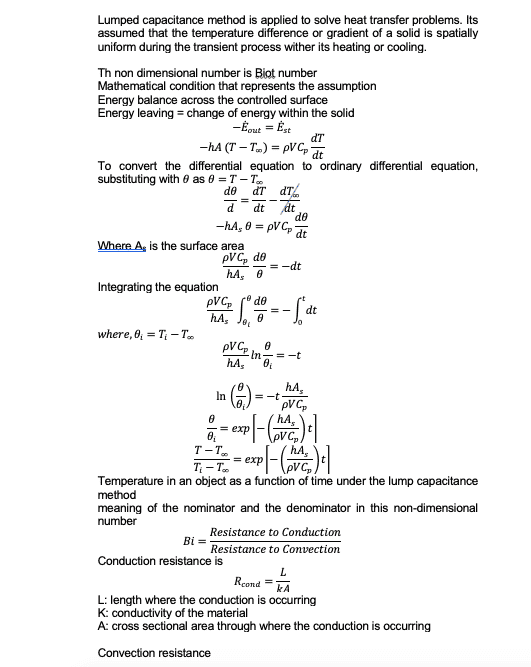
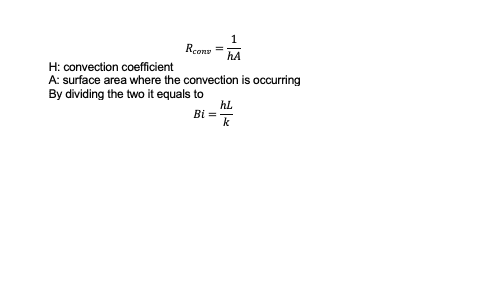
The Lumped Capacitance method in heat transfer problems is applicable when the Biot number (Bi) is significantly less than one (Bi << 1). This condition indicates that the external thermal resistance dominates over the internal thermal resistance, allowing for simplified analysis. The method relies on the assumption that temperature gradients within the object are negligible, which is mathematically represented by the relationship $$\frac{1}{h} >> \frac{L}{k}$$. Here, L represents the characteristic length, k is the thermal conductivity, and h is the convective heat transfer coefficient.
PREREQUISITES
- Understanding of the Lumped Capacitance method in heat transfer
- Familiarity with the Biot number and its significance
- Knowledge of thermal conductivity (k) and convective heat transfer coefficient (h)
- Basic principles of heat transfer and thermal resistance
NEXT STEPS
- Study the derivation and applications of the Biot number in heat transfer analysis
- Explore the implications of the Lumped Capacitance method in transient heat conduction problems
- Learn about alternative methods for analyzing heat transfer in systems with significant temperature gradients
- Investigate the impact of varying thermal properties on the validity of the Lumped Capacitance method
USEFUL FOR
Students and professionals in mechanical engineering, thermal engineering, and anyone involved in heat transfer analysis who seeks to understand the conditions for applying the Lumped Capacitance method effectively.