Where Did I Go Wrong? Solving Admittance in a Basic AC Circuit

Click For Summary

Discussion Overview

The discussion revolves around solving for the admittance in a basic AC circuit, focusing on the calculations and methods used to arrive at the correct answer. Participants explore various approaches to the problem, including the use of admittance and impedance, and the correct application of series and parallel combinations of these quantities.

Discussion Character

  • Technical explanation
  • Debate/contested
  • Mathematical reasoning

Main Points Raised

  • One participant describes their method for calculating admittance, detailing a step-by-step approach that involves converting between impedance and admittance.
  • Another participant suggests that the calculations could be simplified by using only admittance values, noting that admittances in series add like impedances in parallel.
  • Several participants point out that the values given in the schematic are in Siemens, indicating that they should be treated as admittances rather than impedances.
  • There is confusion regarding the addition of admittances in series versus parallel, with some participants asserting that they should be combined differently based on their configuration.
  • One participant expresses frustration with their understanding of complex numbers and their application in AC circuit calculations, indicating a need for further study in this area.
  • A later reply provides a formula for combining admittances in series, but there is still uncertainty about the calculations and the resulting values.
  • Another participant successfully finds the correct answer after switching between impedances and admittances, acknowledging that their initial approach was flawed.

Areas of Agreement / Disagreement

Participants do not reach a consensus on the best method for solving the problem, as there are multiple competing views on the use of admittance versus impedance and how to correctly combine them. The discussion remains unresolved regarding the most efficient approach to the calculations.

Contextual Notes

Some participants express confusion over the arithmetic of complex numbers and the implications for their calculations. There are also mentions of specific values and units that may not have been fully clarified, leading to potential misunderstandings in the calculations.

Who May Find This Useful

Students preparing for exams in electrical engineering or physics, particularly those focusing on AC circuit analysis and the use of complex numbers in calculations.

dcrisci
Messages
45
Reaction score
0
Okay so I have been working on a problem for practice for an exam and this one question is really pissing me off. I can't find what I am doing wrong and I've redone it about five times.

The question is asking for the admittance of the circuit and the answer is given as 2.29 S at an angle of -42.2 degrees (don't know how to make the phasor symbol)

Picture of the circuit
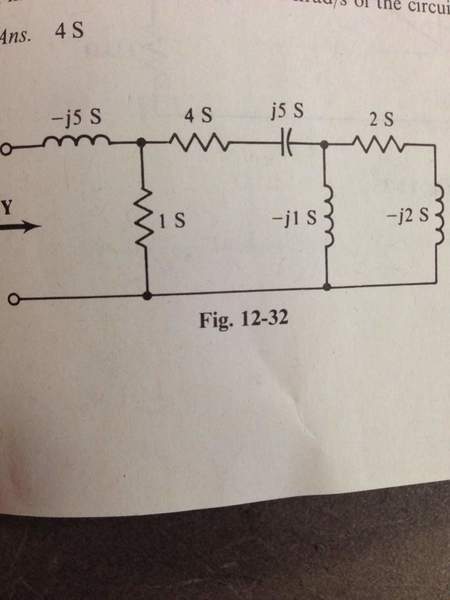
ImageUploadedByPhysics Forums1397593176.086373.jpg


Picture of my solution
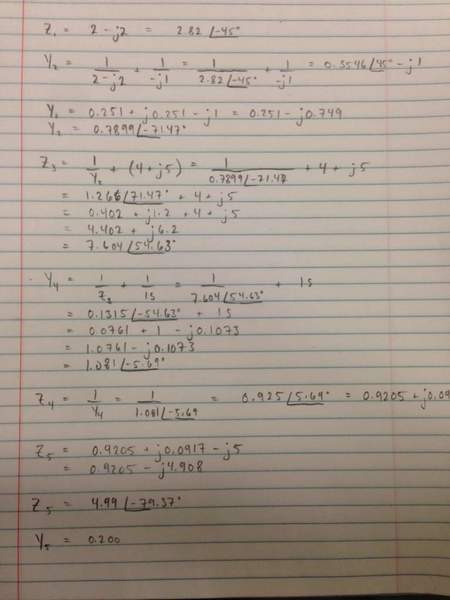
ImageUploadedByPhysics Forums1397593207.584845.jpg


I realize my answer is not the same but I have no clue where I am going wrong with this. I began from the right side of the circuit doing the following:
1. Calculate the impedance of the inductor and resistor in series
2. Calculate the admittance of part 1 and the second inductor since they are in parallel
3. Convert part 2 into impedance
4. Calculate impedance of part 3 added with the capacitor and resistor
5. Calculate the admittance of part 4 added with the parallel resistor
6. Convert part 5 to impedance, add this impedance with the final inductor
7. Convert back to admittance to find out the answer is wrong
 
Physics news on Phys.org
dcrisci said:
Okay so I have been working on a problem for practice for an exam and this one question is really pissing me off. I can't find what I am doing wrong and I've redone it about five times.

The question is asking for the admittance of the circuit and the answer is given as 2.29 S at an angle of -42.2 degrees (don't know how to make the phasor symbol)

Picture of the circuit
View attachment 68683

Picture of my solution
View attachment 68684

I realize my answer is not the same but I have no clue where I am going wrong with this. I began from the right side of the circuit doing the following:
1. Calculate the impedance of the inductor and resistor in series
2. Calculate the admittance of part 1 and the second inductor since they are in parallel
3. Convert part 2 into impedance
4. Calculate impedance of part 3 added with the capacitor and resistor
5. Calculate the admittance of part 4 added with the parallel resistor
6. Convert part 5 to impedance, add this impedance with the final inductor
7. Convert back to admittance to find out the answer is wrong

Can you show your calculated results for the steps?

You know that you can do the whole thing with admittance values, right? No particular need to convert back and forth from admittance to impedance. Admittances in series add like impedances in parallel.
 
My calculated values should be in the one picture, is it not showing for anyone other than me? I figured I could have done it with only admittance I was only following an example that was very similar
 
dcrisci said:
My calculated values should be in the one picture, is it not showing for anyone other than me? I figured I could have done it with only admittance I was only following an example that was very similar

My apologies, I somehow managed to ignore the second attachment. I'll have a look.
 
Okay, right off the bat when you calculate your Z1, you're adding two admittances as though they were impedances. The values given on the schematic for the components in question are in Siemens, so they are admittances and must be added as such. How do admittances in series add?
 
gneill said:
Okay, right off the bat when you calculate your Z1, you're adding two admittances as though they were impedances. The values given on the schematic for the components in question are in Siemens, so they are admittances and must be added as such. How do admittances in series add?

sorry I got caught up with other studying. Now that I am back to circuits..

Okay so I don't know how I didn't think of that the whole time (the units being Siemens), Let me try this again and get back to you.
 
ImageUploadedByPhysics Forums1397669687.482058.jpg


I am still having a problem with it. I can't seem to get it right and don't know what I am doing wrong.

This time around I was trying to only use admittances so when adding the parallel components I added them as (1/G1) + (1/G2) and then I thought this would give me units of impedance so I took the inverse of this answer.

Also sorry for the messy work I have some chicken scratch writing.
 
dcrisci said:
View attachment 68715

I am still having a problem with it. I can't seem to get it right and don't know what I am doing wrong.

This time around I was trying to only use admittances so when adding the parallel components I added them as (1/G1) + (1/G2) and then I thought this would give me units of impedance so I took the inverse of this answer.
That's the right idea, but it's not reflected in your calculation of Y1 where it seems you've just added the admittances of the 2 S resistor and -j2 S inductor. They should be combined as you've described above.

You'll probably find it convenient to leave the admittances in rectangular form through most of the calculations, except perhaps where polar form (magnitude/angle) might make performing a division easier.
Also sorry for the messy work I have some chicken scratch writing.
Believe me, I've seen a lot worse :smile:
 
gneill said:
That's the right idea, but it's not reflected in your calculation of Y1 where it seems you've just added the admittances of the 2 S resistor and -j2 S inductor. They should be combined as you've described above.

You'll probably find it convenient to leave the admittances in rectangular form through most of the calculations, except perhaps where polar form (magnitude/angle) might make performing a division easier.
Believe me, I've seen a lot worse :smile:
I don't understand why it would be like that for the 2 S resistor and -j2 S inductor, aren't the two in series so the admittances should just combine as a normal sum?

Edit: would I technically need to convert the two into their relative impedances to add them as if they were series?
 
Last edited:
  • #10
dcrisci said:
I don't understand why it would be like that for the 2 S resistor and -j2 S inductor, aren't the two in series so the admittances should just combine as a normal sum?

No No No No No! Conductances and admittances add via a normal sum when they are in parallel. When they are in series they add like resistors do in parallel, namely:
$$Y_{series} = \frac{1}{\frac{1}{Y1} + \frac{1}{Y2}+ ... + \frac{1}{Yn}}$$
You spelled it out in a previous post, so I thought you had that well in hand.
 
  • #11
Okay so if I'm using that formula I seem to get the same answer when adding the first two admittances. I just felt like the 2 - j2 S was all wrong and don't like seeing it here as well

ImageUploadedByPhysics Forums1397686269.202340.jpg
 
  • #12
The series "addition" of 2 S and -j2 S should yield (1 - j) S. You can use the shortcut formula for two components:
$$Y = \frac{Y1 \cdot Y2}{Y1 + Y2}$$
$$Y = \frac{(2) (-j2)}{(2) + (-2j)}$$

and carry out the algebra to reduce it.

EDIT: Oops. Fixed the sign on the "sum". The -j2 S would make the imaginary component of the "sum" negative too. So 2S and -j2 S in series yields (1 - j) S.
 
Last edited:
  • #13
gneill said:
The series "addition" of 2 S and -j2 S should yield (1 + j) S. You can use the shortcut formula for two components:
$$Y = \frac{Y1 \cdot Y2}{Y1 + Y2}$$
$$Y = \frac{(2) (-j2)}{(2) + (-2j)}$$

and carry out the algebra to reduce it.

Yeah I just got so confused trying to use this. My professor barely covered using complex numbers so I don't really know what I am doing. I just tried googling it and understand it is something to do with rationalizing it but I am just way too lost.
 
  • #14
You'll find that the basics of complex number arithmetic are essential for dealing with the math of AC circuits. It's something you'll need to spend some time on mastering.

There are online complex number calculators that you can find with a web search. They can help you to check your math while you're practicing.
 
  • #15
Wooooo got it but I had to switch between impedances and admittances. I'm sure this way is longer than how you were trying to get me to approach it but nonetheless I finally got the correct answer. I think my problem with initially trying it this way was that I was forgetting that 1/jA = -j(1/A)

Here is how I went about it all

ImageUploadedByPhysics Forums1397690360.118203.jpg


I converted the admittances to impedances in the beginning as well.
 
  • #16
Yup. That's certainly one way to go about it. The result looks fine. Lot's of brain sweat involved though :smile:
 
  • #17
gneill said:
Lot's of brain sweat involved though :smile:

You sir have no idea! haha
I have been going at this one for a while now so it feels great to get it right finally.
Thank you for your help!
 

Similar threads

  • · Replies 26 ·
Replies
26
Views
3K
  • · Replies 2 ·
Replies
2
Views
2K
  • · Replies 7 ·
Replies
7
Views
2K
  • · Replies 12 ·
Replies
12
Views
2K
  • · Replies 22 ·
Replies
22
Views
3K
  • · Replies 2 ·
Replies
2
Views
2K
  • · Replies 3 ·
Replies
3
Views
1K
  • · Replies 2 ·
Replies
2
Views
2K
  • · Replies 5 ·
Replies
5
Views
3K
  • · Replies 3 ·
Replies
3
Views
3K