Where Does a Bar on a Fulcrum First Tip When a Person Walks Across It?

  • Thread starter Thread starter JohnnyLaws
  • Start date Start date
  • Tags Tags
    Forces Torque
Join the discussion
Ask a follow-up here, or get your own question answered by working scientists, mathematicians and engineers — people, not an autocomplete.
Real named experts · corrections over time · the nuance an AI answer skips
2 replies · 1K views
JohnnyLaws
Messages
10
Reaction score
0
Homework Statement
We have a 4-meter-long uniform bar weighing 100 kg, and a person weighing 75 kg is walking across it. The statement specifies a stationary point C situated 2.5 meters away from the origin where the bar can rotate. The question is: 'What distance can this person move away while keeping the bar in equilibrium?'
Relevant Equations
I believe that I should set all torques equal to 0 and forces too but I don't know How to draw this specific Free body Diagram. On the other hand I don't know why I need point C.
So here is my equations:
Ra = reaction in A
Rx = reaction in person
Wb = bar's weight
Wp = Person's weight

Forces:
Ra+Rx+Wb+Wp = 0
Ra+Rx-100-75 = 0

Torques:

0*Ra+x*Rx-2*100-x*75 = 0
I think that explained all in "Relevant equations".
Here is the image of this exercise:
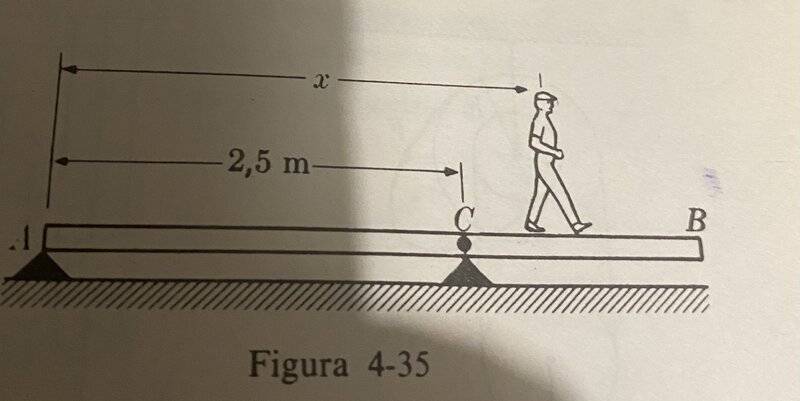
a.JPG

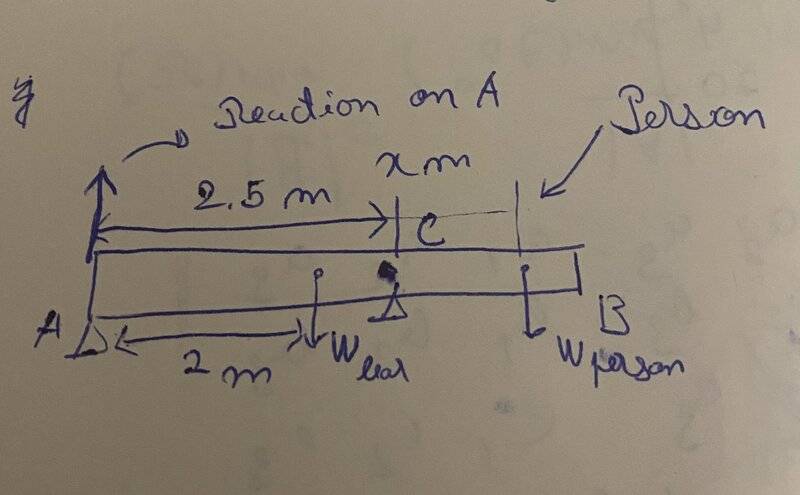
This is my Free Body Diagram:
b.JPG
 
Last edited by a moderator:
on Phys.org
JohnnyLaws said:
... but I don't know How to draw this specific Free body Diagram.
Simply represent all the known and unknown possible forces acting on the bar.
For example,
Rx = reaction in person
is a real force, but it is not acting on the bar; therefore, it is not interesting regarding resolving the balance of the beam.

Please, see:
https://courses.lumenlearning.com/suny-osuniversityphysics/chapter/5-7-drawing-free-body-diagrams/

Balance bar.png


JohnnyLaws said:
On the other hand I don't know why I need point C.
Please note that:

*The support A only restrains the bar end from moving downwards, but it lets the end go upwards.

*The support C is a pivot, which retrains any movement of the point C, except rotation on the plane of the paper.

*The problem is asking you about the maximum distance that the man can move his weight to the right without inducing the above rorartion.
 
Reply
  • Like
Likes   Reactions: MatinSAR and JohnnyLaws