Where Does the Electric Field Cancel Between Two Unequal Charges?

Click For Summary

Homework Help Overview

The discussion revolves around determining the point at which the electric field strength is zero between two isolated point charges, -7μC and +2μC, positioned at a fixed distance apart. Participants explore the implications of the charges' magnitudes and their effects on the electric field.

Discussion Character

  • Exploratory, Conceptual clarification, Assumption checking

Approaches and Questions Raised

  • Participants discuss the concept of electric fields generated by point charges and question how to determine the point of cancellation without specific distance values. Some suggest that understanding the physics can lead to identifying the correct point, while others express confusion about the calculations involved.

Discussion Status

There is an ongoing exploration of the problem, with some participants offering insights into the nature of electric fields and the relative strengths of the charges. While one participant suggests a specific answer, others are still grappling with the underlying concepts and calculations, indicating a productive but unresolved discussion.

Contextual Notes

Participants note the absence of distance measurements and express concern about how to approach the problem with limited numerical information. The discussion includes attempts to visualize the electric field interactions and the implications of charge magnitudes.

calculator20
Messages
47
Reaction score
0
Two isolated point charges -7μC and +2μC are at a fixed distance apart. At which point is is it possible for the electric field strength to be zero?
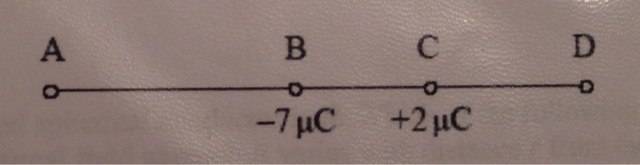
ImageUploadedByPhysics Forums1391411189.234661.jpg


I don't know where to start with only 2 numbers and no distances. I know that E= kQ/r^2
 
Physics news on Phys.org
Well ... if the two charges were equal, same charge, which point has zero field?
"Half way between them." right? You don't need distances to answer the question.

It kinda looks like they want you to pick point A or point D. That makes it easier.
One point is to the left and the there to the right - only one could plausibly have a zero field.
You get to do it either by understanding the physics or by doing the algebra with the distance being D.
 
Thanks for your help but I still don't understand. The answer is D but I can't see how you would know that with no numbers apart from the charges. I've tried calculating E using sample distances and get no where near zero. I want to understand the physics and the algebra but neither are making sense as yet.
 
calculator20 said:
. The answer is D but I can't see how you would know that with no numbers apart from the charges. I've tried calculating E using sample distances and get no where near zero. I want to understand the physics and the algebra but neither are making sense as yet.

Here's the idea:

Think about the negative charges as ''pullers'' and positive as ''pushers'' (owing to their electric field lines). Now, since -7μC has a greater magnitude, its pulling strength (or electric field strength) is higher than the pushing strength of 2μC, right?

So, to check the zero field intensity, position a charge in the points A and D and try to find out the position such that the pushing strength of 2μC just overcomes/balances the pulling strength of -7μC keeping in mind that the farther you go, lesser your field strength becomes.
 
Thank you, that's a really helpful way to picture it. I can see how it would be solved as a multiple choice question without calculations now. Thanks.
 
calculator20 said:
Two isolated point charges -7μC and +2μC are at a fixed distance apart. At which point is is it possible for the electric field strength to be zero?

View attachment 66245

I don't know where to start with only 2 numbers and no distances. I know that E= kQ/r^2
You can establish precisely where the field strength will be zero by expressing it in terms of the distance d between the charges (i.e., scaling to the distance between the charges).
 

Similar threads

Replies
4
Views
4K
  • · Replies 2 ·
Replies
2
Views
2K
  • · Replies 3 ·
Replies
3
Views
2K
Replies
6
Views
2K
Replies
11
Views
4K
  • · Replies 5 ·
Replies
5
Views
2K
  • · Replies 32 ·
2
Replies
32
Views
4K
  • · Replies 1 ·
Replies
1
Views
2K
  • · Replies 5 ·
Replies
5
Views
2K
  • · Replies 2 ·
Replies
2
Views
2K