Where Does the Traveling Twin Lose Time in the Twin Paradox?

Click For Summary

Discussion Overview

The discussion revolves around the twin paradox in special relativity, specifically focusing on where the traveling twin loses time during their journey. Participants explore various perspectives on clock synchronization, the effects of acceleration, and the implications of different inertial frames on time measurement.

Discussion Character

  • Exploratory
  • Technical explanation
  • Debate/contested

Main Points Raised

  • Some participants propose that the traveling twin's time loss can be understood through clock comparisons made with stationary clocks placed along the traveler's path, synchronized with the home clock.
  • Others argue that the relativity of simultaneity complicates the determination of when and where the clocks differ during the trip.
  • A participant suggests that acceleration impacts the perceived time difference when evaluated from the traveling twin's frame, indicating that the definition of simultaneity is crucial to understanding the time difference.
  • Another viewpoint emphasizes that while acceleration does not directly affect clock rates, it is necessary for the traveler to follow a non-straight path through spacetime, which complicates the analysis.
  • Concerns are raised about Einstein's claim that during the turnaround, the home clock runs faster than the traveler's clock, suggesting a potential conflict with the idea that acceleration does not affect clock rates.
  • Some participants note that all clock comparisons are frame-dependent, and the implications of acceleration can vary based on the chosen frame of reference.

Areas of Agreement / Disagreement

Participants do not reach a consensus on the effects of acceleration on clock rates or the implications of different frames of reference. Multiple competing views remain regarding the interpretation of time loss in the twin paradox.

Contextual Notes

Limitations include the dependence on definitions of simultaneity, the complexity introduced by acceleration, and the varying interpretations of clock readings based on different inertial frames.

CKH
Messages
194
Reaction score
7
Some thoughts about the twin paradox (with a new question/paradox at the end):

Beginners, like myself, when confronting the twin paradox often want to know where it is that the traveling twin loses so much time. A frustrated poster trying to explain the paradox posted this:

He's been given many answers and he rejects every one because he wants an answer that fits his preconceived notion that the traveling twin's clock must lose time at a particular point in the trip.

Still, the beginner is persistent in wanting to know where these clocks differ along the trip and by how much. There is no single answer due to the relativity of simultaneity but there are some approaches.

To answer this question, one approach is to explain what each twin sees (e.g. with a powerful telescope) on the other's clock. In this case a Doppler effect occurs in the clocks readings due to relative motion. Thus this description of the relationship between the clocks has a complicating factor: the delays in the readings by each twin of the other's clock are changing due to the the changing distance between the twins.

But there is another way of viewing the relationship between the clocks.

In the simple twin paradox, one twin stays at home and the other travels to a distant destination and back again at a substantial fraction of the speed of light. We can assume that the traveling twin accelerates to a fixed speed almost instantaneously when he leaves, when he turns around and that he stops quickly when he returns home. The traveling twin moves with constant velocity on the long outbound and inbound legs of the journey.

With this scenario in mind, here's another clock comparison method:

Prior to the trip, a number of clocks are placed at intervals along the path that the traveler will take to the destination.

All of these clocks along the path to the destination are placed so that they are stationary wrt the home clock. That is, all these clocks are at rest in the same inertial frame with the home clock.

Using Einstein's clock synchronization method, we synchronize all of these clocks with the home clock.

The clocks along the traveler's path then represent "home clock time" in the home clock's inertial frame. Since this frame is inertial throughout the trip we know that the established synchronization of these clocks with the home clock persists throughout, in the home frame.

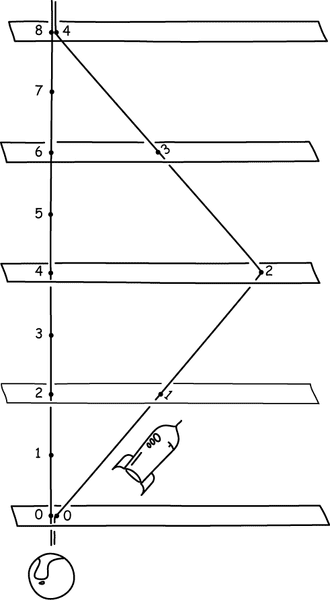
The traveler can read these distributed "home clocks" during his trip and compare them with the readings with his own clock. Then he has an answer to how and where he is losing time relative to the home clock. The comparison is illustrated in this diagram linked from http://www.pitt.edu/~jdnorton/teaching/HPS_0410/chapters_2013_Jan_1/spacetime_tachyon/index.html (sorry for the size):
Twin_2.png


Copyright John D. Norton. January 2001, September 2002; July 2006; February 3, 2007; January 23, September 24, 2008; January 21, 2010; February 1, 2012.

In the diagram the rocket twin travels at 86.6% the speed of light resulting in a time dilation factor of 1/2. The straight vertical path is the home clock's path over time (the home clock's worldline). The dogleg is the traveler's worldline. Each is marked with the proper time in years on each of the twin's clocks. The horizontal planes show the positions of the home clocks (imagine the line of clocks) and of the traveler at different times in the home frame.

The travel reads the "home time" using the clocks placed along the plane. The traveler finds the following correspondence between home time and the time on the own clock (as shown in the diagram):

Clock readings in years
Home Traveler
0 0
2 1
4 2
6 3
8 4

When the traveler returns he can show the home twin the above record, so the home twin can know in his own frame how old the traveler was when he was a certain age.

There is no mystery about where these clocks get out of sync from this perspective. They do it uniformly along the entire trip.

Acceleration does not directly affect the clocks, it is the speed of the traveler and the time over which he travels with that speed that determines the age gap. The above clock comparison exactly reflects the time dilation of the traveling twin which is constant throughout the trip.

Note that the traveling twin could, instead of traveling far away, make small circles around home at the same speed for the same amount of time and the clock results would be the same. So it appears that it has little to do with how far away he travels.

Acceleration does not affect the age difference directly but the acceleration is necessary to follow any non-straight path through flat spacetime.

The twin paradox is "why can't we just reverse the role of the home and traveler in the diagram, such that the traveler is considered stationary and the home clock is considered to move, so that the traveler gets older instead"? We cannot because the traveler's path through spacetime cannot be made a straight line in any such diagram. It is a dogleg in all inertial frames, while the path of the home clock is straight in all inertial frames.

Caveats:

1) There is no unique way to compare the clock readings, some choice of inertial frame must be made.

2) The above correspondence of clock readings is meaningful only in the home frame. When the travel reads one of the distance home clocks, he cannot conclude that this is the "current" reading on the home clock in his own frame. Remote clocks have different readings in different frames.

3) This comparison of clocks is possible because space is flat in SR and the home clock remains at rest in the same inertial frame. In more general cases such simple comparison of clocks may not be possible.

4) Einstein has analyzed this paradox using the acceleration and distance of the traveler at turn around. He claimed that, during turn around, the home clock (at home) runs much faster than the travelers clock due to the distance and the degree of the traveler's acceleration.

Question:
At least superficially, 4) is in conflict with the claim that "acceleration does not affect clock rates". Has anyone seen an analysis that demonstrates an equivalence of the two approaches? Otherwise can someone clarify why acceleration does not affect relative clock rates, while Einstein appears to claim it does?
 
  • Like
Likes   Reactions: PhoebeLasa
Physics news on Phys.org
CKH said:
4) Einstein has analyzed this paradox using the acceleration and distance of the traveler at turn around. He claimed that, during turn around, the home clock (at home) runs much faster than the travelers clock due to the distance and the degree of the traveler's acceleration.
That depends on your way to track time. If you apply "simultaneous" to the frame of the traveling twin, and evaluate it at each moment during the acceleration, then you will note a huge impact of acceleration on the time difference defined in that way.
In the same way, you can win or lose one day relative to the Andromeda galaxy just by starting walking towards or away from it.
 
mfb said:
That depends on your way to track time. If you apply "simultaneous" to the frame of the traveling twin, and evaluate it at each moment during the acceleration, then you will note a huge impact of acceleration on the time difference defined in that way.

Yes, as I noted a couple of times in the post: all such clock comparisons are frame dependent. It is just another view of the situation. It has the benefit that the home clock's planes of equal time are fixed. Also, such a clock comparison can be directly observed, if you have a suitable spacecraft , plenty of clocks and plenty of time.

In the same way, you can win or lose one day relative to the Andromeda galaxy just by starting walking towards or away from it.

Yes in the walkers frame, but not in Andromeda's frame (the stationary one). The home clock view is simple. The traveler's view is not simple because he accelerates.

I'm interested in a response to the question at the bottom.
 
CKH said:
4) Einstein has analyzed this paradox using the acceleration and distance of the traveler at turn around. He claimed that, during turn around, the home clock (at home) runs much faster than the travelers clock due to the distance and the degree of the traveler's acceleration
Do you have a reference for this?
 
CKH said:
Question:
At least superficially, 4) is in conflict with the claim that "acceleration does not affect clock rates". Has anyone seen an analysis that demonstrates an equivalence of the two approaches? Otherwise can someone clarify why acceleration does not affect relative clock rates, while Einstein appears to claim it does?

This mis-states Einstein's argument. He treated the effect as due to 'gravity of a special sort' - pseudo-gravity is what most would call it. The effect on clock rates of gravity or pseudo-gravity is not due to the acceleration it is due to potential difference. It happens that potential for such a field is acceleration times distance. Thus, again, the acceleration, per se, is not the issue. For example, if a twin accelerated at 10 g in +x for a microsecond, then 10 g in --x direction for a microsecond, and continued doing this for an hour, their clock time compared to a stationary twin would be negligibly smaller. Because the distance was never large, the potential difference was never large.

As to equivalence, it is easy to formally argue the equivalence of approaches. Einstein's approach is formally equivalent to integrating proper time along the two twin world lines in Fermi-Normal coordinates for the traveling twin. But this is just a coordinate transform from inertial cartesian coordinates (producing a more complex representation of the metric). Any invariant computed with the metric remains unchanged. The proper time between two crossing of world lines, along each, is such an invariant. Thus the two methods, in every case, must come out identically.
 
  • Like
Likes   Reactions: Mentz114
CKH said:
4) Einstein has analyzed this paradox using the acceleration and distance of the traveler at turn around. He claimed that, during turn around, the home clock (at home) runs much faster than the travelers clock due to the distance and the degree of the traveler's acceleration.

Question:
At least superficially, 4) is in conflict with the claim that "acceleration does not affect clock rates".
No it isn't. The clock rate of the clock undergoing the proper acceleration is not affected by the proper acceleration, that is what the clock hypothesis says.

What 4 refers to, are variable clock rates at different positions in non-inertial coordinates. So it's not the proper acceleration, but position and properties of a arbitrary coordinate chart that define the distant clock rates. Using a different simultaneity convention might yield a different distant clock rate.
 
PAllen said:
This mis-states Einstein's argument.
Do you have a reference for this? I don't know what you guys are talking about.
 
DaleSpam said:
Do you have a reference for this? I don't know what you guys are talking about.
Search for paradox to find this discussion in:

http://en.wikisource.org/wiki/Dialog_about_objections_against_the_theory_of_relativity
 
PAllen said:
This mis-states Einstein's argument. He treated the effect as due to 'gravity of a special sort' - pseudo-gravity is what most would call it.

I deliberately misstated it because I think that, as stated by Einstein, the appeal to the equivalence principle is circular. That is, the effects of pseudo gravity that he invokes are actually derived from the analysis of an accelerated frame using SR to begin with.

The effect on clock rates of gravity or pseudo-gravity is not due to the acceleration it is due to potential difference. It happens that potential for such a field is acceleration times distance. Thus, again, the acceleration, per se, is not the issue. For example, if a twin accelerated at 10 g in +x for a microsecond, then 10 g in --x direction for a microsecond, and continued doing this for an hour, their clock time compared to a stationary twin would be negligibly smaller. Because the distance was never large, the potential difference was never large.

Yes, but then isn't the effect on clock rates dependent on the product of acceleration and distance, so acceleration does matter? Give that, how can we make the broad statement that "acceleration has no effect on clock rates"? Perhaps it is always true for two clocks at a common event, but otherwise not true in general?

Einstein's approach is formally equivalent to integrating proper time along the two twin world lines in Fermi-Normal coordinates for the traveling twin. But this is just a coordinate transform from inertial cartesian coordinates (producing a more complex representation of the metric). Any invariant computed with the metric remains unchanged. The proper time between two crossing of world lines, along each, is such an invariant. Thus the two methods, in every case, must come out identically.

Thanks. It will likely be quite some time before I'm able to understand that.

When you look at the problem using "home time" (as in the OP), acceleration appears to have nothing to do with the clock differences.

When you look at the problem from the traveler's frame, you see that it is precisely the traveler's acceleration (and distance from home) that is causing the simultaneous values on the home clock to rapidly change at turn around.

(On the other hand the traveler's rapid acceleration when he leaves and rapid deceleration when he returns has very little effect because the distance from the home clock is small.)
 
  • #10
A.T. said:
No it isn't. The clock rate of the clock undergoing the proper acceleration is not affected by the proper acceleration, that is what the clock hypothesis says.

Then I think the statement of the clock hypothesis needs to precisely state in what sense the clock rate is unaffected. From the article Proper TIme in the wiki:

In relativity, proper time is the elapsed time between two events as measured by a clock that passes through both events. The proper time depends not only on the events but also on the motion of the clock between the events. An accelerated clock will measure a smaller elapsed time between two events than that measured by a non-accelerated (inertial) clock between the same two events. The twin paradox is an example of this effect.

Hence it seems that the clock hypothesis should stipulate that the rates are the same at the same event.

Using a different simultaneity convention might yield a different distant clock rate.

Can you suggest a different simultaneity convention for the traveler?
 
  • #11
CKH said:
Yes, but then isn't the effect on clock rates dependent on the product of acceleration and distance, so acceleration does matter? Give that, how can we make the broad statement that "acceleration has no effect on clock rates"? Perhaps it is always true for two clocks at a common event, but otherwise not true in general?
In an inertial frame it has no effect. For coordinates in which a non-inertial trajectory is at coordinate rest, it depends on the way you set up the coordinates. There is no preferred way to set such coordinates (as there is for inertial coordinates). If you set them up in a particular way, you find clock rates are affected by position as well as speed. For the traveling twin as the origin of such coordinates, the home twin's clock runs faster due to it's position. Neither clock's rate is affected by coordinate acceleration. The traveling twin is not accelerating in these coordinates. The coordinate acceleration of the home twin plays no role in its clock rate (its speed does, though).

Thus, in neither coordinates does acceleration play any role at all clock rates.

CKH said:
Thanks. It will likely be quite some time before I'm able to understand that.

When you look at the problem using "home time" (as in the OP), acceleration appears to have nothing to do with the clock differences.

When you look at the problem from the traveler's frame, you see that it is precisely the traveler's acceleration (and distance from home) that is causing the simultaneous values on the home clock to rapidly change at turn around.

(On the other hand the traveler's rapid acceleration when he leaves and rapid deceleration when he returns has very little effect because the distance from the home clock is small.)

Not really, see above. The traveling twin is not accelerating at all in 'his' coordinates. The home twin's acceleration in these coordinates plays no part in his clock rate. You are mixing descriptions from different coordinates.
 
  • Like
Likes   Reactions: harrylin
  • #12
CKH said:
Can you suggest a different simultaneity convention for the traveler?

Radar simultaneity, used by the traveling twin, would produce a very different description of the home twins clock rate over their two histories. There are infinitely many choices possible.
 
  • #13
CKH said:
Can you suggest a different simultaneity convention for the traveler?

You have already done so. Your entire OP is a description of how the traveler will interpret his observations using the simultaneity convention of the "home" frame. Your table of corresponding values of traveler clock time vs. home clock time only makes sense if the traveler is using the simultaneity convention of the home frame.

For example, when the traveler passes the home clock reading "2" and his own clock reads "1", if he concludes that he has "lost" 1 unit of time compared to the home twin, he is implicitly assuming that the reading of "2" on the home clock he just passed is simultaneous with the reading of "2" on the home twin's clock. But if he were to use the simultaneity convention of his own rest frame at that instant, that would not be the case; the reading of "2" on the home clock he just passed would be simultaneous with an event on the home twin's worldline where the home twin's clock read much less than "1".
 
  • #14
PAllen said:
Radar simultaneity, used by the traveling twin, would produce a very different description of the home twins clock rate over their two histories. There are infinitely many choices possible.

But in the link that you posted above, it seemed clear that Einstein thought that there was only one simultaneity perspective for the traveler. He didn't seem to think that some kind of choice of simultaneity "convention" had to be made.
 
  • #15
PhoebeLasa said:
But in the link that you posted above, it seemed clear that Einstein thought that there was only one simultaneity perspective for the traveler. He didn't seem to think that some kind of choice of simultaneity "convention" had to be made.
Well, that was 1918 in a non-technical presentation. Einstein had general covariance as a founding principle of GR, which means any coordinates are equally valid. Also, this is the ONLY place in his writings he analyzed the twin paradox this way.
 
  • #16
I get the sense that you already know this, but the "loss of time" occurs globally and not at a specific point in space-time. This is more evident in the case of gravity, where you can have a difference in time between two participants without acceleration. If closed time-like curves exist, you can go back in time over the course of a journey, but there is no one point where you can say this is where/when you go back in time.
 
  • #17
PeterDonis said:
Your entire OP is a description of how the traveler will interpret his observations using the simultaneity convention of the "home" frame. Your table of corresponding values of traveler clock time vs. home clock time only makes sense if the traveler is using the simultaneity convention of the home frame.

Yes (that was explicitly stated multiple times). When the traveler reads a "remote home clock" along his trip, what he is allowed to say is "this is the current time on the home clock in the home clock's inertial frame". I think that interpretation is OK. So what we actually see in this case, is what the traveler's clock reads at any given time in the home frame.

In this perspective on the twins, we take advantage of the constancy of the home frame to say something meaningful about the corresponding times on the traveler's clock in the home frame.
 
  • #18
CKH said:
Yes (that was explicitly stated multiple times).

Then do you agree that this counts as an alternative simultaneity convention for the traveler? If not, why not? If so, it seems odd that you asked for people to suggest a different simultaneity convention for the traveler, when you had already given one; that's why I took the trouble to point it out.
 
  • #19
Khashishi said:
I get the sense that you already know this, but the "loss of time" occurs globally and not at a specific point in space-time. This is more evident in the case of gravity, where you can have a difference in time between two participants without acceleration. If closed time-like curves exist, you can go back in time over the course of a journey, but there is no one point where you can say this is where/when you go back in time.
Yes, I know well. I never liked the Einstein 1918 analysis (pseudo-gravity) as a way to understand the twin paradox. To me, Doppler is best to understand what your measure, and metric is best for more general understanding, in particular that it doesn't make any more sense to talk about 'where the clock difference is' than it is talk about which part of a longer line is the 'extra length'.

However, since Einstein's 1918 approach was brought in, I wanted to make sure it was accurately presented rather than misconstrued to say acceleration affects proper time (clock rates).
 
Last edited:
  • #20
PAllen said:
Search for paradox to find this discussion in:

http://en.wikisource.org/wiki/Dialog_about_objections_against_the_theory_of_relativity
Thanks that is helpful. I had read that previously, but forgotten about it. Personally, I don't consider this to be an actual analysis, just a rough description of a possible analysis. It is not surprising that reading such a description someone could be left confused.

None of the analysis is actually worked out to show 1) how the reference frame of the accelerating clock is defined and 2) how the gravitational potential in that frame leads to the correct value for time dilation. If that were done, then I think it would be clear that there is no conflict involved. Especially since any mathematical analysis must show that it is not the acceleration, but something else (e.g. the potential) which determines the time dilation.
 
  • #21
PAllen said:
Yes, I know well. I never liked the Einstein 1918 analysis (pseudo-gravity) as a way to understand the twin paradox.
Einstein's use of pseudo gravity is circular. You should be able to make the same argument as in the 1918 paper, substituting the traveler's "acceleration" for "pseudo-gravity". I'm interested in how that description works (if it works).

PAllen said:
To me, Doppler is best to understand what your measure, and metric is best for more general understanding, in particular that it doesn't make any more sense to talk about 'where the clock difference is' than it is talk about which part of a longer line is the 'extra length'.

Yes the doppler method is always applicable.

It makes sense to talk about time differences as well as spatial distances whenever you specify the coordinates used. There are two worldlines with fixed relationships in spacetime. What they look like at the "same time" just depends on how you choose your slice that defines "same time". It's not like clock differences and distance differences are undefinable, it's just that they are contextual.

So rather than not talk about "a time difference" it all, we can ask what it looks like in different frames. (As you can with your preferred doppler method.) We're not surprised that we get different answers, we expect that.

Rethinking the statement "acceleration does not affects proper time (clock rates)", I guess it means this:
Regardless of the acceleration of two clocks, their respective rates depend only on their current relative velocity.​
 
Last edited:
  • #22
PeterDonis said:
Then do you agree that this counts as an alternative simultaneity convention for the traveler? If not, why not? If so, it seems odd that you asked for people to suggest a different simultaneity convention for the traveler, when you had already given one; that's why I took the trouble to point it out.

Bad me. I was fishing but caught the only the same fish as before (radar). I'm still struggling with this "conventionality".

Here's my problem with the idea of conventions. We have a convention for individual inertial frames that is not really a convention (is there any other choice)? Based on that, we can ask about non-inertial cases. It seems legitimate to claim that at every point on a (smooth) wordline, there is an MCIF that we can choose in which the origin is the point on the worldline and constant spatial orientation . We can always assign the proper time at that point on worldline to the MCIF. The MCIF so defined is unique and has a well-defined hyperplane of simultaneity.

Thus it appears that SR already defines a convention that is perfectly justified. If we have some other convention, it likely contradicts this "natural" choice. So what's confusing me is why this freedom of choice arises and how much freedom there is?

In the case of radar, in an inertial frame, it is the same as Einstein's convention. That would appear to be a constraint on any simultaneity convention. What other rules apply to inventing simultaneity conventions?
 
  • #23
DaleSpam said:
Especially since any mathematical analysis [like Einstein's] must show that it is not the acceleration, but something else (e.g. the potential) which determines the time dilation.

Is there potential without acceleration? How is potential acquired/determined (without the circular use of pseudo-gravity please)? Perhaps the so-called potential is nothing other than relative velocity in reality?

All we have is an inertial twin and a twin far away who is moving away at high speed and has just begun to (de)accelerate.
 
  • #24
CKH said:
We have a convention for individual inertial frames that is not really a convention (is there any other choice)?

Sure there is. Nothing requires us to use an inertial frame. Nothing requires us to use a frame at all. It is true that, if you want to use an inertial frame, and if you are in globally flat spacetime, and if you have picked a particular inertial worldline that you want to be "at rest" in your chosen frame, then you don't have a choice about how to construct the frame; it's defined for you by the choices I just listed. But nothing requires you to make those choices. You can describe the same physics using other frames, or not even using frames at all.

CKH said:
It seems legitimate to claim that at every point on a (smooth) wordline, there is an MCIF that we can choose in which the origin is the point on the worldline and constant spatial orientation

Yes (with some complications in a general curved spacetime about what "constant spatial orientation" means, but I don't think those are important for this discussion). But each such MCIF is, in general, a different inertial frame. You can't combine them to make a single "non-inertial frame". You can't combine them at all. You have to either pick one, or switch between them as desired, depending on what physics you are trying to describe.

CKH said:
We can always assign the proper time at that point on worldline to the MCIF. The MCIF so defined is unique and has a well-defined hyperplane of simultaneity.

Sure, in the sense that any inertial frame has a well-defined hyperplane of simultaneity. But again, you have already chosen to (a) use an inertial frame, (b) pick a particular worldline (the inertial worldline that happens to be tangent to your general smooth worldline at the chosen point) to be at rest in your inertial frame. (And, if you want the frame to be globally usable, you have to be in flat spacetime.) So you've just picked a particular way of uniquely specifying an inertial frame. You're free to do that, but nothing requires you to.

CKH said:
it appears that SR already defines a convention that is perfectly justified.

Justified once you've, once again, (a) chosen to use an inertial frame, and (b) chosen a particular inertial worldline that you want to be at rest in the frame. But nothing requires you to make those choices.

CKH said:
If we have some other convention, it likely contradicts this "natural" choice.

The choice is only "natural" given the prior choices I have described. Nothing requires you to make those prior choices.

CKH said:
what's confusing me is why this freedom of choice arises and how much freedom there is?

As much freedom as you want, as long as what you end up with is a valid simultaneity convention See below.

CKH said:
In the case of radar, in an inertial frame, it is the same as Einstein's convention.

Yes.

CKH said:
That would appear to be a constraint on any simultaneity convention.

No, it isn't. For example, the traveling twin in your scenario is perfectly free to pick the home twin's simultaneity convention, as I said in a previous post. That convention obviously does not match the Einstein convention for the traveling twin's rest frame.

CKH said:
What other rules apply to inventing simultaneity conventions?

The rules are simple (and they are not "other" rules, since, as above, the Einstein constraint is not a requirement):

(1) The convention must not assign two different times to the same event;

(2) The convention must not assign the same time to two events that are not spacelike separated.

(3) The convention must give a monotonic time ordering to events along any timelike or null curve, and the ordering must be oriented the same (i.e., it must pick the same direction as "future") along every such curve.

Any simultaneity convention that meets the above requirements is acceptable.
 
  • #25
CKH said:
Hence it seems that the clock hypothesis should stipulate that the rates are the same at the same event.
Or that the instantaneous rate of a clock is not affected by its instantaneous proper acceleration.

If a car goes at constant speed between two points, steering has an effect on the total distance accumulated, even if steering doesn't have any effect on the instantaneous rate the distance is accumulated at.
 
  • #26
CKH said:
Bad me. I was fishing but caught the only the same fish as before (radar). I'm still struggling with this "conventionality".

Here's my problem with the idea of conventions. We have a convention for individual inertial frames that is not really a convention (is there any other choice)?

My stance on this is that you do have a choice in your definition of simultaneity if you use, for instance, Lagrangian methods, but you don't really have a choice if you want to use Newton's laws as they are taught in high school. Comments (especially how to use something less awkward and more precise than "as taught in high school) are welcome.

Based on that, we can ask about non-inertial cases. It seems legitimate to claim that at every point on a (smooth) wordline, there is an MCIF that we can choose in which the origin is the point on the worldline and constant spatial orientation . We can always assign the proper time at that point on worldline to the MCIF. The MCIF so defined is unique and has a well-defined hyperplane of simultaneity.

In the absence of gravity , i.e.in flat space time, this is true. A slightly modified version of this construct can be made to work in curved space-time, but it requires some adjustments to do so. There's even a name for this construct, it's called using Fermi Normal coordinates. I will use that term, or the abbreviation FNC, to describe this construct henceforth in this post. But there are a few important points to make about this as a coordinate system.

The first and most obvious point is that after you've stitched together different inertial frames into a unified coordinate system, Newton's laws no longer work properly, so the stitched together version (which I am again calling Fermi Normal coordinates, FNC for short) is not an inertial frame, even though you stitched these coordinates together from things that were inertial frames.

For instance, a body at rest is supposed to stay at rest, but if your reference observer is accelerating, and you use Fermi Normal coordinates a body at rest in an inertial frame of reference will not remain at rest in FNC.

So, if you use FNC, you can't use Newtons laws unmodified. Thus if one's motivation is to try to stick with physics as it's been taught in high school, this motivation has already been compromised. Also, it's not entirely clear to me how to define the correct pseudo-forces using what I've been calling "high school methods". There may be a way to do so, but for instance the simple prescription of applying a constant pseudo-force equal to the acceleration of the reference observer won't work (it may approximately work near the worldline of the observer, but it won't work in general for abitrary points). So this is also an obstacle to the application of the idea.

So one winds up having to make some modifications to physics as taught in high school to use FNC, extensions that are not obvioiusly well defined, or documented in textbooks, even in flat space-time. The problem becomes even more severe in non-flat space-time (which is unfamiliar territory to SR, but needed if one desires to move on to GR).

The second point is that FNC are well defined in a small region around the worldline of the reference observer, but may not assign unique coordinates outside that region. The problem comes in when the different hyperplanes of simultaneity uniquely defined at each point on the intersect at some point away from the worldline. At the point of intersection, one event can be assigned multiple time coordinates. Thus, the coordinates thus defined are not unique, the problem is serious enough that all the textbooks I've seen describe FNC as not covering all of space-time, but only some local region, the region where the hypersurfaces of simultaneity do not intersect.

Thus it appears that SR already defines a convention that is perfectly justified. If we have some other convention, it likely contradicts this "natural" choice. So what's confusing me is why this freedom of choice arises and how much freedom there is?

The conventions you suggest are indeed very useful in a local context, but they become very restricting as you attempt to move far away from the worldline, and ultimately become unsatisfactory. Probably the biggest issue is the second one, the fact that after the hypersurfaces intersect, the coordinates are not well defined because they are not unique.

That said, under the proper circumstances (near the worldline of the observer), you'll find quite few authors who talk about physics in terms of the FNC (Nikolic comes to mind, as do some sections of MTW), and I find them useful myself. But they aren't a panacea, or a universal solution to all problems. I hope I've explained some of the difficulties and drawbacks that they have.

If you look at papers like the radar coordinate D&G papers with the above in mind, you may see the motivation for not sticking to the FNC concept better if you keep the above difficulties in mind.
 
  • #27
If you accept that whatever motion the space twin is subject to the Earth twin is the reciprocal of, both move equally relative to the other, therefore both age equally.
 
  • #28
CKH said:
How is potential acquired/determined (without the circular use of pseudo-gravity please)?
The potential is acquired/determined from the time-time component of the metric: ##g_{00}=2U-1##.

Since Einstein's description is not mathematically rigorous I am not clear about what "pseudo-gravity" is nor why you would consider it to be circular. However, there is certainly nothing circular about using the metric since it is always part of the mathematical structure of spacetime (pseudo-Riemannian manifold).
 
Last edited:
  • #29
PAllen said:
that was 1918 in a non-technical presentation.
This is a good point. This reference is essentially a pop-sci reference. So despite the fact that it is from Einstein, it is not really a reference suitable for PF.

I think we can go ahead and discuss it, while recognizing that it is on a "Brian Greene" level. When this reference is in conflict with the scientific literature then this reference is out.
 
  • #30
A.T. said:
Or that the instantaneous rate of a clock is not affected by its instantaneous proper acceleration.

Yes, my first statement with "at the same event" was too restrictive. I fixed it at the end of post #21 with a clearer statement.

If a car goes at constant speed between two points, steering has an effect on the total distance accumulated, even if steering doesn't have any effect on the instantaneous rate the distance is accumulated at.

Yes. But you can see how the statement "acceleration has no effect on the outcome" cannot be true without qualification, since in the absence of acceleration. the accumulated distance cannot be longer. Thus acceleration does have an effect. The effect that it has cannot be ascribed to instantaneous clock rates. The effect results not from the magnitude of acceleration but from the changes in velocities that result from acceleration. (I hope that doesn't sound like gobbledegook).
 

Similar threads

  • · Replies 43 ·
2
Replies
43
Views
5K
  • · Replies 4 ·
Replies
4
Views
1K
  • · Replies 14 ·
Replies
14
Views
2K
  • · Replies 13 ·
Replies
13
Views
3K
  • · Replies 115 ·
4
Replies
115
Views
9K
  • · Replies 31 ·
2
Replies
31
Views
3K
  • · Replies 137 ·
5
Replies
137
Views
11K
  • · Replies 21 ·
Replies
21
Views
3K
  • · Replies 122 ·
5
Replies
122
Views
9K
  • · Replies 2 ·
Replies
2
Views
3K