Discussion Overview
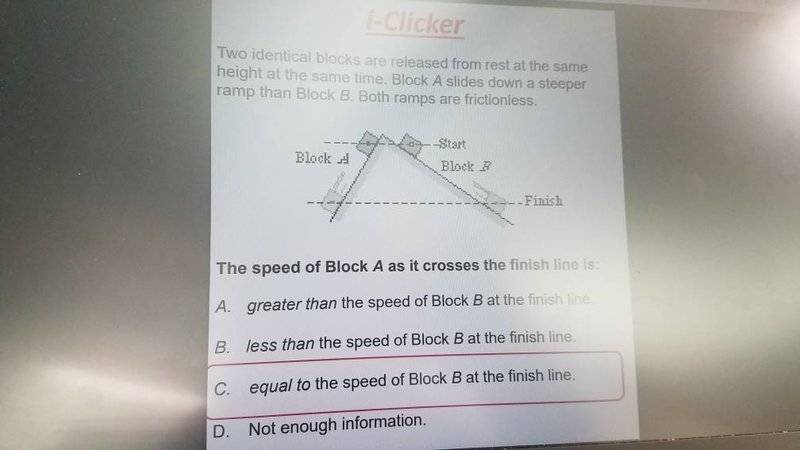
The discussion revolves around the question of why two objects reach the same speed at the finish line despite potentially differing paths and distances traveled. It explores concepts related to net work, kinetic energy, and the forces acting on the objects, particularly in the context of a frictionless ramp.
Discussion Character
- Technical explanation
- Conceptual clarification
- Debate/contested
Main Points Raised
- Some participants assert that the speed will be the same at the finish line, but this does not imply that the objects will arrive simultaneously, as one object travels a longer distance.
- There is a suggestion that the net work done on both objects is the same, leading to the conclusion that their kinetic energies must also be the same, resulting in equal final velocities.
- Participants discuss the role of gravity as the primary force doing work on the objects, especially in the context of a frictionless ramp.
- One participant questions whether gravity is the only force acting on the objects and acknowledges the presence of a normal force, which they initially believe does no work.
- Another participant clarifies that the normal force does not do work because it does not have a component in the direction of the displacement.
- There is a discussion about the conditions under which forces do work, emphasizing that it depends on the force's component parallel to the displacement rather than force equilibrium.
Areas of Agreement / Disagreement
Participants generally agree that the speed at the finish line will be the same for both objects due to the net work being equal, but there is some uncertainty regarding the role of different forces and the conditions under which they do work. The discussion remains somewhat unresolved regarding the implications of these forces.
Contextual Notes
There are limitations in the discussion regarding the assumptions about forces acting on the objects and the specific conditions of the ramp setup. The participants do not fully resolve the implications of the normal force and its contribution to the net work.