Why does a 3-phase system need fewer conductors than single phase?

Join the discussion
Registration is free. Ask a follow-up in this thread, or start your own.
15 replies · 2K views
Raghav Gupta
Messages
1,010
Reaction score
76
They say 3 phase system requires less conductor then single phase why that is so if we consider diagram below?
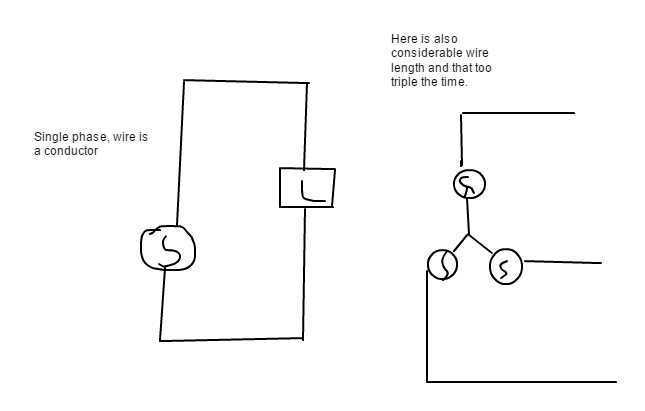
Snapshotpf.jpg

Also why here current going out when neutral is there in form of earthing
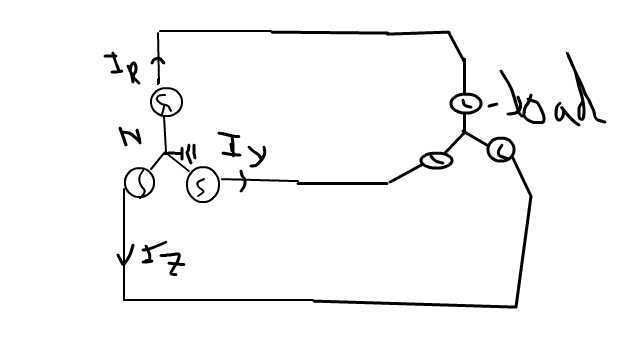
Snapshot2pf.jpg
 
Engineering news on Phys.org
A single phase line 1km long and rated for 1MW of power, requires 2km of wire. 1km going out plus 1km return.

A three phase line 1km long and rated 3MW of power p, requires 3km of wire. Three times the power but only 1.5 times as much wire.
 
anorlunda said:
A single phase line 1km long and rated for 1MW of power, requires 2km of wire. 1km going out plus 1km return.

A three phase line 1km long and rated 3MW of power p, requires 3km of wire. Three times the power but only 1.5 times as much wire.
Why current should return?
russ_watters said:
More wires, but the amperage is lower.
If the amperage is lower power would be less as P=i2r
 
Raghav Gupta said:
Why current should return?
You showed it properly in your diagram...
If the amperage is lower power would be less as P=i2r
That's power loss due to resistance. It doesn't have anything to do with the power requirement of the load.
 
russ_watters said:
You showed it properly in your diagram...

That's power loss due to resistance. It doesn't have anything to do with the power requirement of the load.
So we should have in general more wires which 3 phase system has to lower the amperage?
 
Raghav Gupta said:
So we should have in general more wires which 3 phase system has to lower the amperage?
That is one benefit, yes. A 100 kW load at 480V is 208 Amps in single phase and 120 amps in 3-phase. So you can use much thinner wires, costing less overall even though you have an extra wire.
 
russ_watters said:
A 100 kW load at 480V is 208 Amps in single phase and 120 amps in 3-phase.

How you have calculated that?
P= V I
So I =P/V, here I= 100kW/480 in both cases?
 
Raghav Gupta said:
How you have calculated that?
P= V I
So I =P/V, here I= 100kW/480 in both cases?
Three phase power is P= √3 * V* I
 
  • Like
Likes   Reactions: Raghav Gupta
Raghav Gupta said:
Also why here current going out when neutral is there in form of earthing
snapshot2pf-jpg.92130.jpg
Okay now only this query in my first post remains.
 
Raghav Gupta said:
Okay now only this query in my first post remains.
The neutral and Earth may be connected, but they are not the same: the neutral carries current, but the Earth should not be.
 
russ_watters said:
The neutral and Earth may be connected, but they are not the same: the neutral carries current, but the Earth should not be.
I am not able to understand this. What I mean is why the flow of current is not in opposite direction in diagram?
Earth will eventually pull all of current toward it.
 
Raghav Gupta said:
I am not able to understand this. What I mean is why the flow of current is not in opposite direction in diagram?
A big advantage of 3 phase power is that you don't need any "return" wire. With a balanced load, the 3 currents cancel at the load's star-point; so even if you did have a neutral wire connected, there will be only a small current (ideally zero) in the neutral.

3 currents equal in magnitude but phased 120° apart, sum to zero.
 
NascentOxygen said:
A big advantage of 3 phase power is that you don't need any "return" wire. With a balanced load, the 3 currents cancel at the load's star-point; so even if you did have a neutral wire connected, there will be only a small current (ideally zero) in the neutral.

3 currents equal in magnitude but phased 120° apart, sum to zero.
So in case of unbalanced loads this three phase is not good as compared to single phase?
Why then we are connecting neutral wire in balanced load three phase supply?
Can we have neutral wire in case of single phase also?

What my main query is that when current is generated from three phase supply, why it is not pulled back by neutral wire (earthing) instead of going to loads.?
Snapshot2pf2.jpg
 
Raghav Gupta said:
What my main query is that when current is generated from three phase supply, why it is not pulled back by neutral wire (earthing) instead of going to loads.?

Your beliefs about earthing are incorrect. It does not suck down the power. All the earthing does is to establish a reference voltage, and to provide some safety in short-circuit conditions. In normal operation, nothing changes earthed or not-earthed.
 
If a 3φ load is unbalanced, the star point will not be at zero volts; this may or may not be tolerable, it depends on the load/s and/or the degree of unbalance. The neutral wire serves to take the imbalance current, and fixes the star-point at zero. Even for a perfectly balanced load, the neutral wire may still be used for safety: should one of the loads fault then with no neutral the resultant voltage change could cause damage to the other loads.