Why Does a Complex Exponential Vanish at Infinity?

Join the discussion
Ask a follow-up here, or get your own question answered by working scientists, mathematicians and engineers — people, not an autocomplete.
Real named experts · corrections over time · the nuance an AI answer skips
7 replies · 5K views
Waxterzz
Messages
82
Reaction score
0
Hi,

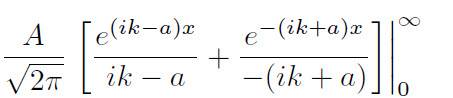
BhEN5Ms.jpg


The two terms should vanish at infinity according to the Quantum textbook of Griffiths, but I don't see how?

I mean a complex exponential is a periodic function so how can it vanish at infinity?

If you split up the first term

exp(ikx) * exp(-ax)

Take the limit of infinity of this expression

lim exp(ikx) is not defined
limit exp(-ax) turns zero

But 0 * an undefined limit is still undefined, right?

So help me out, please.
 
Last edited:
Physics news on Phys.org
Waxterzz said:
But 0 * an undefined limit is still undefined, right?
Wrong :-p. ##0 \times \infty## is undefined, but ##0 \times a## where ##|a| < \infty## is always 0.
 
  • Like
Likes   Reactions: 1 person
DrClaude said:
Wrong :-p. ##0 \times \infty## is undefined, but ##0 \times a## where ##|a| < \infty## is always 0.

but

lim (exp(ik-a)*x) to infinity equals lim exp (ikx) times lim exp(-ax) so it is ∞ * 0 ?
 
Waxterzz said:
Hi,

BhEN5Ms.jpg


The two terms should vanish at infinity according to the Quantum textbook of Griffiths, but I don't see how?

I mean a complex exponential is a periodic function so how can it vanish at infinity?

If you split up the first term

exp(ikx) * exp(-ax)

Take the limit of infinity of this expression

lim exp(ikx) is not defined
limit exp(-ax) turns zero

But 0 * an undefined limit is still undefined, right?

So help me out, please.

How do you think [itex]e^{-ax} \cos(kx)[/itex] behaves as [itex]x \to \infty[/itex]?

If [itex]\lim_{x \to \infty} f(x)[/itex] and [itex]\lim_{x \to \infty} g(x)[/itex] exist, then it follows that [tex] \lim_{x \to \infty} f(x)g(x) = \left(\lim_{x \to \infty} f(x) \right)\left(\lim_{x \to \infty} g(x) \right).[/tex] However, even if one or both of [itex]\lim_{x \to \infty} f(x)[/itex] and [itex]\lim_{x \to \infty} g(x)[/itex] do not exist, it might still be the case that [itex]\lim_{x \to \infty} f(x)g(x)[/itex] exists.
 
  • Like
Likes   Reactions: 1 person
Waxterzz said:
lim (exp(ik-a)*x) to infinity equals lim exp (ikx) times lim exp(-ax) so it is ∞ * 0 ?

$$
0 \leq \left| e^{i k x} \right| \leq 1
$$
 
  • Like
Likes   Reactions: 1 person
DrClaude said:
$$
0 \leq \left| e^{i k x} \right| \leq 1
$$

So lim exp (ikx) does not exist , but lim exp( |ikx|) does?

But how make it work in lim (exp(ik-a)x)

Do you know where this rule can be found or what this rule can be called?

DrClaude said:
Wrong :-p. ##0 \times \infty## is undefined, but ##0 \times a## where ##|a| < \infty## is always 0.
But then you've already calcultated lim exp (-ax) that turns zero and lim exp (ikx) does not become a number?

I really don't get it.

If you calculate the limit as a whole (lim exp(ik-a)), you don't get a * 0 or you do?
 
DrClaude said:
$$
0 \leq \left| e^{i k x} \right| \leq 1
$$

http://en.wikipedia.org/wiki/Absolute_convergence

So because of that absolute value (the norm?) that is always 1 it converges? I think I got it.

e^ikx converges? |e^ikx| = 1 right ? e^ikx * e^-ikx = e ^ (ikx-ikx) = e^0 = 1 right

but why is the limit not defined?

Wait, because it's periodic. Limit is not defined, but the max and min stays fixed. And that's why when you multiply with a function that goes to zero at infinity the product of the two functions also does?

God, I was too tired to make sense out of anything I think.
 
Sorry, I should've been more clear. Indeed
$$
\lim_{x \rightarrow \infty} e^{i k x} = \textrm{undefined}
$$
but ##0 \leq \left| e^{i k x} \right| \leq 1##, which means it is finite. I use the absolute value since the result is complex, but the important thing is that ##e^{i k x}## stays bounded even as ##x \rightarrow \infty##.

Therefore, since
$$
\lim_{x \rightarrow \infty} e^{-a x} = 0
$$
you have
$$
\lim_{x \rightarrow \infty} e^{i k x} e^{-a x} = 0
$$
The fact that the limit of the first term is undefined doesn't affect the fact that the product of something finite with zero will always be zero.
 
  • Like
Likes   Reactions: shinobi20