Why does acceleration increase by less as angle of slope increases?

Click For Summary

Homework Help Overview

The discussion revolves around the acceleration of a solid sphere as it rolls down an inclined plane, specifically examining why acceleration increases by less as the angle of the slope increases. Participants explore the relationship between acceleration and the angle of inclination, referencing concepts from physics such as friction and air resistance.

Discussion Character

  • Exploratory, Conceptual clarification, Mathematical reasoning, Assumption checking

Approaches and Questions Raised

  • Participants suggest calculating the derivative of acceleration with respect to the angle of inclination and discuss the implications of the gradient of the resulting graph. Questions arise regarding the influence of factors like air resistance and friction on acceleration.

Discussion Status

The discussion is active, with participants providing insights into the mathematical relationships involved and questioning the assumptions underlying the problem. Some guidance has been offered regarding the derivative and its significance, but there is no explicit consensus on the underlying reasons for the observed behavior of acceleration.

Contextual Notes

Participants note the importance of understanding the role of friction in the acceleration equation and highlight the distinction between the angle and its sine in the context of the problem. There is also mention of previous discussions related to similar topics, indicating a broader context of inquiry.

Jojo-11
Messages
5
Reaction score
0
Homework Statement
why does acceleration of a solid sphere increase by less as the angle of incline increases?
Relevant Equations
a = 5mgsin𝛳/7
This is true considering the rotational inertia of a solid sphere is (2/5)mr^2
My only guess is that this is due to air resistance. Below an example of the predicted graph:
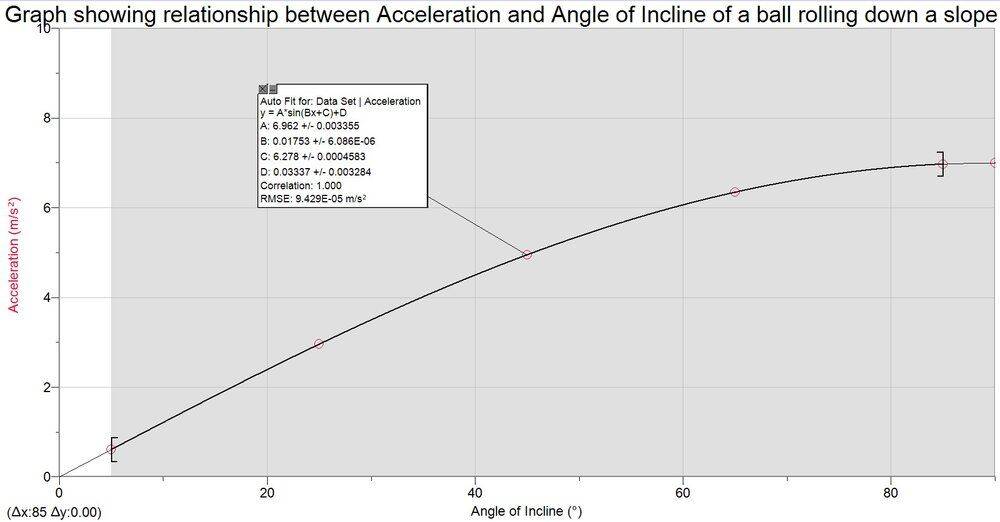
Screenshot 2020-10-26 142628.jpg
 
Physics news on Phys.org
Well, why don't you work out ##\frac{da}{d\theta}## and see how then consider how the gradient varies with ##\theta##?
 
Last edited by a moderator:
etotheipi said:
Well, why don't you work out ##\frac{da}{d\theta}## and see how then consider how the gradient varies with ##\theta##?

[Also, it's curious to see that your leading coefficient is ##5/7##, since for a solid sphere on a ramp it will be ##5/9##. We had a thread about this a short while ago, and determined that if the solid sphere instead rolled down a V-shaped track, the leading coefficient would be ##5/7##. I wondered... are you using a V-shaped track?]

That's interesting. I am not using a v-shaped track, just a flat ramp. I'm new to this platform, where can I find the thread?
 
It's a derivative! Are you familiar with calculus, and do you know how to find the derivative of ##\sin{\theta}## with respect to ##\theta##?
 
etotheipi said:
It's a derivative! Are you familiar with calculus, and do you know how to find the derivative of ##\sin{\theta}## with respect to ##\theta##?

I'm afraid I have gone too far down a rabbit hole. I could work it out for each angle and plot it on a graph and find the slope but I'm not sure how to do so otherwise.
 
Okay. What you would have ended up with is$$a = \frac{5}{7}g\sin{\theta} \implies \frac{da}{d\theta} = \frac{5}{7} g \cos{\theta}$$Here ##\frac{da}{d\theta}## is the rate of change of ##a## w.r.t ##\theta##, i.e. the gradient of the graph you posted. Notice that as ##\theta## gets closer to ##90^o##, ##\cos{\theta}## get closer to zero, i.e. the gradient gets smaller and your curve gets flatter and flatter! This is the more precise way of saying that "equal increments in ##\theta## give diminishing returns in ##a## as ##\theta## gets larger".
 
Last edited by a moderator:
  • Like
Likes   Reactions: Jojo-11
The m should be dropped from the above, of course. It would appear in a calculation of net force, but not acceleration.
 
  • Like
Likes   Reactions: etotheipi
  • #10
etotheipi said:
Okay. What you would have ended up with is$$a = \frac{5}{7}mg\sin{\theta} \implies \frac{da}{d\theta} = \frac{5}{7} mg \cos{\theta}$$Here ##\frac{da}{d\theta}## is the rate of change of ##a## w.r.t ##\theta##, i.e. the gradient of the graph you posted. Notice that as ##\theta## gets closer to ##90^o##, ##\cos{\theta}## get closer to zero, i.e. the gradient gets smaller and your curve gets flatter and flatter! This is the more precise way of saying that "equal increments in ##\theta## give diminishing returns in ##a## as ##\theta## gets larger".

I can see that but is there an explanation behind why the ball accelerates by less at the same increments for greater angles like increased air resistance or friction or is this just a given and we don’t know?
 
  • #11
Jojo-11 said:
I can see that but is there an explanation behind why the ball accelerates by less at the same increments for greater angles like increased air resistance or friction or is this just a given and we don’t know?

Not really. That expression for acceleration is derived by considering friction, but that only really changes the leading coefficient of the term and not the general form of ##\alpha g \cos{\theta}##.

And of course, there is no ##m## in that expression for acceleration, as @jbriggs444 rightly points out :wink:
 
  • Like
Likes   Reactions: jbriggs444
  • #12
Consider the acceleration of a block of mass, ##m##, sliding down an inclined plane (angle θ w.r.t. the horizontal).

The graph of acceleration vs. angle of inclination looks very much like yours.
 
  • #13
Jojo-11 said:
Homework Statement:: why does acceleration of a solid sphere increase by less as the angle of incline increases?
a = 5mgsin𝛳/7
The answer is right there in your equation: sin(θ), not θ.
What does a graph of y=sin(x) look like?
 

Similar threads

  • · Replies 4 ·
Replies
4
Views
2K
  • · Replies 32 ·
2
Replies
32
Views
3K
  • · Replies 5 ·
Replies
5
Views
2K
  • · Replies 97 ·
4
Replies
97
Views
6K
  • · Replies 8 ·
Replies
8
Views
8K
  • · Replies 18 ·
Replies
18
Views
3K
Replies
2
Views
1K
  • · Replies 14 ·
Replies
14
Views
5K
  • · Replies 4 ·
Replies
4
Views
8K
Replies
2
Views
13K