Why does Griffiths use a vector to explain angular frequency of rotation?

Click For Summary

Discussion Overview

The discussion revolves around the use of vector representation for angular frequency in the context of a spherical shell with uniform surface charge that is spinning. Participants are examining the derivation of the velocity vector associated with angular velocity and its implications for calculating the vector magnetic potential at a point in space, as presented in Griffiths' "Introduction to Electrodynamics." The scope includes theoretical understanding and mathematical reasoning related to angular velocity and vector calculus.

Discussion Character

  • Technical explanation
  • Mathematical reasoning
  • Debate/contested

Main Points Raised

  • One participant questions how Griffiths derives the velocity vector from the angular velocity vector, seeking clarification on the transition from a spinning sphere to the expression for angular velocity.
  • Another participant asserts that the definition of angular velocity implies that the velocity of a point at position vector r is given by the cross product of angular velocity and the position vector.
  • Further discussion reveals that understanding angular velocity may require familiarity with vector manipulation, including dot and cross products.
  • A participant mentions that classical mechanics typically covers angular velocity, but suggests that one can learn electrodynamics independently of classical mechanics.
  • Another participant describes their attempts to derive the vector magnetic potential in spherical coordinates and expresses confusion over the book's solution, particularly regarding the components of the angular velocity vector in spherical coordinates.
  • There is a discussion about the conversion of angular velocity from rectangular to spherical coordinates, with one participant detailing their calculations and expressing uncertainty about the discrepancy with the book's answer.

Areas of Agreement / Disagreement

Participants express differing levels of understanding regarding the concepts of angular velocity and its application in the problem. There is no consensus on the clarity of the derivation or the correctness of the approaches taken to solve the problem.

Contextual Notes

Some participants note limitations in their background knowledge of vector calculus and angular velocity, suggesting that additional resources may be necessary to fully grasp the concepts discussed. The discussion also highlights the potential for confusion when transitioning between different coordinate systems.

yungman
Messages
5,741
Reaction score
291
This is an example from the book and it is not a homework. There is one part of the step I just don't get. This is the question on page 236 of Griffiths "Introduction to Electrodynamics":

Example 5.11

A spherical shell, of radius R, carrying a uniform surface charge [itex]\rho[/itex], is set spinning at angular velocity [itex]\omega[/itex]. Find vector magnetic potential it produces at a point r.
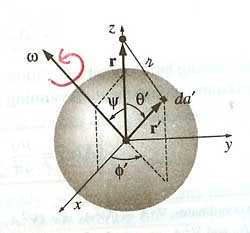
2n01mw5.jpg


The book setup so the point is on the z axis and let the sphere spin on axis in the xz plane where the axis of spin make an angle [itex]\psi[/itex] with the +ve z axis. The equation used is:

[tex]\vec A \;=\; \frac {\mu_0}{4\pi} \int_{s'} \frac {\rho \vec v }{\sqrt { R^2 +r^2 -2Rrcos \theta'}} dv'[/tex]

[tex]\vec v \;=\; \vec {\omega} \;X\; \vec r \;' \;\hbox { where }\; \vec {\omega} =\hat x [\omega \;sin (\psi)] + \hat z [\omega \;cos (\psi)][/tex] (1)

I don't understand how the book arrive to (1)

My question is how do you go from a sphere spinning on the axis at direction of [itex]( \omega sin \psi, 0, \omega cos \psi )[/itex] to just a vector of [itex]\omega[/itex]?

Can anyone explain to me how they arrive the velocity vector [itex]\vec v[/itex]?

Thanks
 
Last edited:
Physics news on Phys.org
hi yungman! :smile:

(have an omega: ω :wink:)
yungman said:
My question is how do you go from a sphere spinning on the axis at direction of [itex]( \omega sin \psi, 0, \omega cos \psi )[/itex] to just a vector of [itex]\omega[/itex]?

but that's the definition of angular velocity …

if the angular velocity of a body is the vector ω, then the velocity of a point at position vector r is ω x r :wink:


tiny-tim said:
hi yungman! :smile:

(have an omega: ω :wink:)


but that's the definition of angular velocity …

if the angular velocity of a body is the vector ω, then the velocity of a point at position vector r is ω x r :wink:


Hi Tiny-Tim, thanks for the info. I search through books that cover the first three semesters calculus including multi-variables, ODE, PDE, Advance calculus and Vector calculus. I only find one example on angular velocity. No wonder I am so loss on this. I don't even have a book for this.

I got the info on Wikipedia. What class is the angular velocity taught? I thought I have enough math background for the Griffiths' book after I study PDE!

Thanks for your time.

Alan
 
yungman said:
What class is the angular velocity taught?

i've no idea, but i think you need an elementary book on manipulating vectors (dot and cross products etc) :smile:


yungman said:
I got the info on Wikipedia. What class is the angular velocity taught?

Classical mechanics. But I believe you can learn electrodynamics before classical mechanics, so it doesn't really matter the order.

For instantaneous rotation about a fixed axis, a (skew-symmetric) operator takes a point in the fixed frame and maps it to the velocity in the fixed frame:

[tex]\left(\begin{array}{c}<br /> \dot{q_1}\\<br /> \dot{q_2}\\<br /> \dot{q_3}<br /> \end{array}<br /> \right)<br /> =<br /> <br /> \left(<br /> \begin{array}{ccc}<br /> 0 & -\omega_3 & \omega_2\\<br /> \omega_3 & 0 & -\omega_1 \\<br /> -\omega_2 & \omega_1 & 0<br /> \end{array}<br /> \right)<br /> <br /> \left(\begin{array}{c}<br /> q_1\\<br /> q_2 \\<br /> q_3<br /> \end{array}<br /> \right)[/tex]

Or as noted: [tex]\dot{\vec{q}}=\vec{\omega} \mbox{x} \vec{q}[/tex]
 
Last edited:


tiny-tim said:
i've no idea, but i think you need an elementary book on manipulating vectors (dot and cross products etc) :smile:

I find it in one of the vector calculus book ( not the regular calculus book used in the first semister classes). It only show as an example, not even in regular chapter! Two other vector calculus books don't even have this. It is very easy once I know the definition and derivation.

Thanks


I have a second question from this same problem. I followed and worked out all the way to get A at the point both inside and outside of the rotating charged sphere |R>r| and |r>R| resp.

The book than want to get the more general solution where they let [itex]\vec {\omega}[/itex] be on the z-axis and the point be any random point (x,y,z). I cannot verify what the book's answer. Please help. From calculation as in my original post where the point [itex]P_{\vec r}[/itex] is on the z-axis and the [itex]\vec {\omega}[/itex] is in the xz plane making angle [itex]\psi[/itex] with the z-axis as shown in post #1:

[tex]\vec A_{(\vec r)} = -\hat y \frac {R^4 \omega \rho_s \mu_0 sin \psi }{3r^2} \;\hbox { for r bigger than R.}[/tex] (3)

[tex]\vec A_{(\vec r)} = -\hat y \frac {R r \omega \rho_s \mu_0 sin \psi }{3} \;\hbox { for R bigger than r.}[/tex] (4)


[tex]\vec{\omega} \;X\; \vec r \;=\; -\hat y r \omega sin \psi[/tex]

Substitude into (3) & (4)

[tex]\vec A_{(\vec r)} = \frac {R^4 \rho_s \mu_0 }{3r^2} (\vec{\omega} \;X\; \vec r) \;\hbox { for r bigger than R.}[/tex] (5)

[tex]\vec A_{(\vec r)} = \frac {R \rho_s \mu_0 }{3} (\vec{\omega} \;X\; \vec r) \;\hbox { for R bigger than r.}[/tex] (6)

The above is in rectangular coordinates, the answer is consistance with the book so it is correct. The next step is where I get lost. The book want to derive the formulas for the point P in any position with [itex]\vec \omega[/itex] on z-axis. The book gave this as answer:

[tex]\vec A_{(r,\theta, \phi)} \;=\; \hat {\phi}\; \frac {R^4 \rho_s \mu_0 \omega sin \theta}{3r^2} \;\hbox { for r bigger than R.}[/tex] (7)

[tex]\vec A_{(r,\theta, \phi)} \;=\; \hat {\phi}\; \frac {R \rho_s \mu_0 \omega r sin \theta}{3} \;\hbox { for R bigger than r.}[/tex] (8)


Below is what I tried to do and I just cannot get the answer of the book's example:

From (5) & (6), the vector position is only contained in [itex](\vec {\omega} \;X\; \vec r)[/itex]. So I just have to calculate this cross product in spherical coordinates with [itex]\vec {\omega}[/itex] on z-axis and [itex]\vec r_{(R,\theta,\phi)} = (r_R, r_{\theta}, r_{\phi})[/itex].

To convert [itex]\vec{\omega} = \hat z \omega[/itex] in rectangular coordinates to spherical coordinates, I use:

[tex]\hat R =\hat x sin \theta cos \phi \;+\; \hat y sin \theta sin \phi \;+\; \hat z cos \theta, \;\;\;\hat {\theta} =\hat x cos \theta cos \phi \;+\; \hat y cos \theta sin \phi \;-\; \hat z sin \theta, \;\;\;\hat {\phi} =-\hat x sin \phi \;+\; \hat y cos \phi[/tex]

To find each of the magnitude of each components of [itex]\vec{\omega}[/itex] in spherical coordiantes:

[tex]\omega_R \;=\; \vec {\omega} \cdot \hat R = \omega cos \theta, \;\;\;\omega_{\theta} \;=\; \vec {\omega} \cdot \hat {\theta} = -\omega sin \theta, \;\;\;\omega_{\phi} \;=\; \vec {\omega} \cdot \hat {\phi} = 0[/tex]

[tex]\vec {\omega}_{(x,y,z)}= \hat z {\omega} \;\Rightarrow\; \theta =0 \;\Rightarrow\; sin \theta =0,\;\; cos \theta =1[/tex]

[tex]\Rightarrow \; \vec {\omega} _{(R,\theta,\phi)} \;=\; \hat R \omega, \;\;\hbox { and from above }\; \vec r_{(R,\theta,\phi)} = (r_R, r_{\theta}, r_{\phi})[/tex]

[tex]\vec {\omega}_{(R,\theta,\phi)} \;X\; \vec r_{(R,\theta,\phi)} \;= -\;\hat {\theta} \omega r_{\phi} \;+\;\hat {\phi} \omega r_{\theta}[/tex]

As you can see, I have all three components instead of what the book's answer that only contain the [itex]\hat {\phi}[/itex] component in (7) & (8).

What did I do wrong? I double check my work on the conversion already. Please help.

Thanks

Alan
 
Last edited:

Similar threads

  • · Replies 9 ·
Replies
9
Views
1K
  • · Replies 12 ·
Replies
12
Views
4K
  • · Replies 42 ·
2
Replies
42
Views
7K
Replies
1
Views
1K
  • · Replies 2 ·
Replies
2
Views
6K
  • · Replies 3 ·
Replies
3
Views
2K
  • · Replies 1 ·
Replies
1
Views
2K
  • · Replies 17 ·
Replies
17
Views
3K
  • · Replies 6 ·
Replies
6
Views
2K
  • · Replies 17 ·
Replies
17
Views
2K