Nicholas Lee
- 27
- 1
I am getting my head around energy bands in electrons, valence bands, and conduction bands, but its complicated to understand.
But If if I ask the question this way it is more simple to me.
Photons pass through the material because they don't have sufficient energy to excite a glass electron to a higher energy level.
Energy levels exist together in regions known as energy bands.
In between these bands are regions, known as band gaps, where energy levels for electrons don't exist at all.
Some materials have larger band gaps than others.
In glass, or a diamond the material is solid but light can transmission through, no problem.
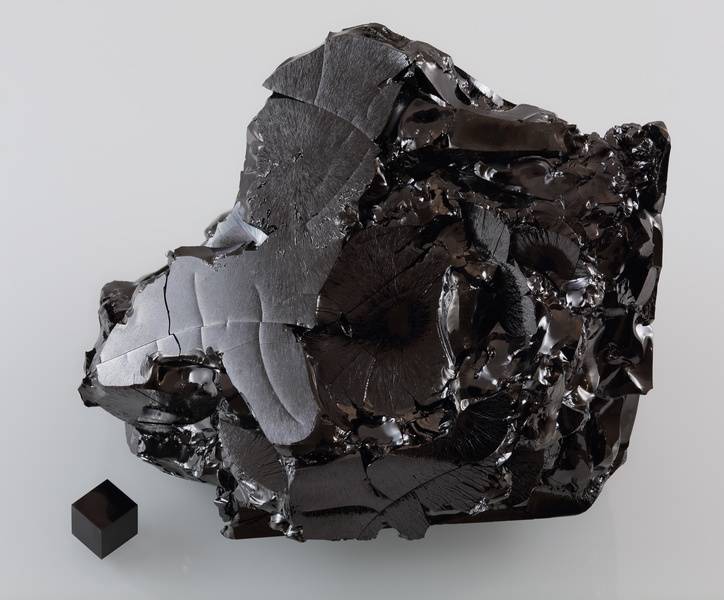
In a solid carbon block in the picture below, light gets absorbed.
So a object being amorphous (noncrystalline) does not effect transmission, its the energy.
If an electron is in the first energy level, it must have exactly -13.6 eV of energy. If it is in the second energy level, it must have -3.4 eV of energy.
Let's say the electron wants to jump from the first energy level, n = 1, to the second energy level n = 2. The second energy level has higher energy than the first, so to move from n = 1 to n = 2, the electron needs to gain energy. It needs to gain (-3.4) - (-13.6) = 10.2 eV of energy to make it up to the second energy level.
If it is in the second energy level, it must have -3.4 eV of energy.
Let's say the electron wants to jump from the first energy level, n = 1, to the second energy level n = 2. The second energy level has higher energy than the first, so to move from n = 1 to n = 2, the electron needs to gain energy. It needs to gain (-3.4) - (-13.6) = 10.2 eV of energy to make it up to the second energy level.
If it takes 10 eV to move the electron in shell 2 , in the glass, and the iron block, then why does the glass electron not get excited when hit by a photon.
Why is the carbon electron absorbing, I understand its a solid, and dense, but so is glass, and the diamond just as much.
I am almost sure its the energy, or the electrons not the amount of electrons in the shells of the carbon because carbons has 2 electrons in shell 1, and 4 electrons in shell two, silicone which is mostly what glass is made from has two electrons in shell 1,and 8 in shell 2, and 4 in shell 3.
So with silicone having more electrons it cannot be the reason for absorption, so its the energy of the electrons right
So it cannot be the amount of electrons I think just the energy of electrons, but can you explain why the energy levels are different for some electrons.
So an object being transparent cannot really be about how many electrons in its shells right,
BUT, every electron is every atom needs 10.2 eV of energy to make it up to the second energy shell level, to leave the ground state, doesn't it.
This is why I am confused, if glass electrons do not need 10 eV to move to the next shell level why is this.
Thank you for your help, remember I am still learning, sorry if some things are not accurate.
But If if I ask the question this way it is more simple to me.
Photons pass through the material because they don't have sufficient energy to excite a glass electron to a higher energy level.
Energy levels exist together in regions known as energy bands.
In between these bands are regions, known as band gaps, where energy levels for electrons don't exist at all.
Some materials have larger band gaps than others.
In glass, or a diamond the material is solid but light can transmission through, no problem.
In a solid carbon block in the picture below, light gets absorbed.
So a object being amorphous (noncrystalline) does not effect transmission, its the energy.
If an electron is in the first energy level, it must have exactly -13.6 eV of energy. If it is in the second energy level, it must have -3.4 eV of energy.
Let's say the electron wants to jump from the first energy level, n = 1, to the second energy level n = 2. The second energy level has higher energy than the first, so to move from n = 1 to n = 2, the electron needs to gain energy. It needs to gain (-3.4) - (-13.6) = 10.2 eV of energy to make it up to the second energy level.
If it is in the second energy level, it must have -3.4 eV of energy.
Let's say the electron wants to jump from the first energy level, n = 1, to the second energy level n = 2. The second energy level has higher energy than the first, so to move from n = 1 to n = 2, the electron needs to gain energy. It needs to gain (-3.4) - (-13.6) = 10.2 eV of energy to make it up to the second energy level.
If it takes 10 eV to move the electron in shell 2 , in the glass, and the iron block, then why does the glass electron not get excited when hit by a photon.
Why is the carbon electron absorbing, I understand its a solid, and dense, but so is glass, and the diamond just as much.
I am almost sure its the energy, or the electrons not the amount of electrons in the shells of the carbon because carbons has 2 electrons in shell 1, and 4 electrons in shell two, silicone which is mostly what glass is made from has two electrons in shell 1,and 8 in shell 2, and 4 in shell 3.
So with silicone having more electrons it cannot be the reason for absorption, so its the energy of the electrons right
So it cannot be the amount of electrons I think just the energy of electrons, but can you explain why the energy levels are different for some electrons.
So an object being transparent cannot really be about how many electrons in its shells right,
BUT, every electron is every atom needs 10.2 eV of energy to make it up to the second energy shell level, to leave the ground state, doesn't it.
This is why I am confused, if glass electrons do not need 10 eV to move to the next shell level why is this.
Thank you for your help, remember I am still learning, sorry if some things are not accurate.