Why does surface charge density change for an inner surface?

Join the discussion
Ask a follow-up here, or get your own question answered by working scientists, mathematicians and engineers — people, not an autocomplete.
Real named experts · corrections over time · the nuance an AI answer skips
2 replies · 2K views
Ascendant78
Messages
327
Reaction score
0
Rather than try to explain what I am talking about, I am going to link to an image of it below. My question is in regards to the negative value I marked in the answer (the one for the surface charge density for the inside of the outer shell). While I get the concept that it would be negative in this type of scenario, I don't know exactly why? I am assuming it has something to do with the positive charge facing outwards and the surface area being analyzed facing inwards, but I am curious about how this pops up in the math so that I will know on more complicated problems that won't be so obvious?
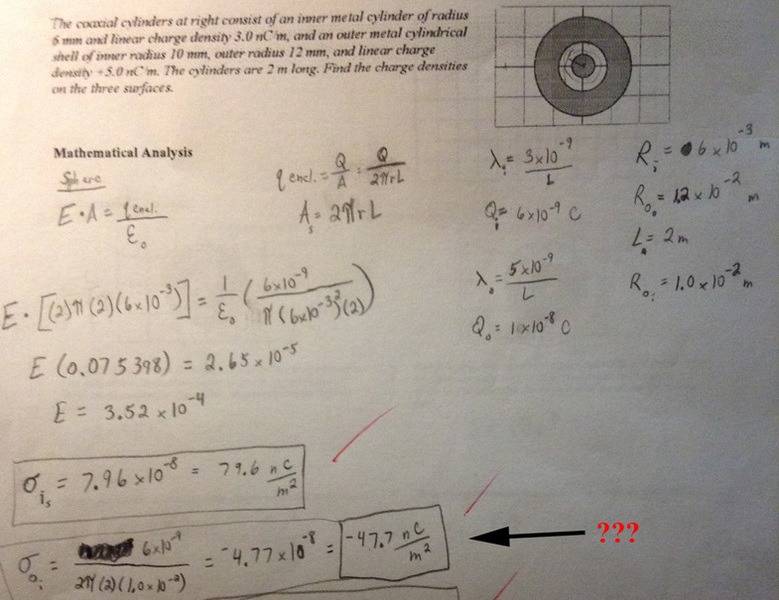
photo.jpg
 
Physics news on Phys.org
The change in sign arises because the direction of the surface normal is reversed, which is conventionally represented by a change of sign in the area.

Claude.
 
Claude Bile said:
The change in sign arises because the direction of the surface normal is reversed, which is conventionally represented by a change of sign in the area.

Claude.

Oh, thank you. What was confusing me was that I thought it meant that the charge was actually different at that point, which was the part that was throwing me off. I wasn't understanding at what point the charge would shift from negative to positive, but now I see that I was looking at it wrong.

So if I understand you correctly, the only reason the sign changes at that point for the charge isn't because the charge itself is changing, but simply because the coordinate system causes it to based off the comparison of the surface area and the charge, right?