Why Does the Tension in the Lower Rope Not Depend on Mass M1?

  • Thread starter Thread starter tizzful
  • Start date Start date
  • Tags Tags
    Tension
Click For Summary
SUMMARY

The discussion centers on calculating the tension in two ropes supporting two masses, M1 and M2, which are accelerating upwards. The tension in the lower rope (T2) is determined solely by the weight of M2, expressed as T2 = M2g, and does not depend on M1. For the upper rope (T1), the correct formula when the system is accelerating is T1 = (M1 + M2)a + (M1 + M2)g, accounting for the total forces acting on M1 and M2. The participants emphasize the importance of applying Newton's second law correctly to derive these tensions.

PREREQUISITES
  • Understanding of Newton's second law (F=ma)
  • Knowledge of gravitational force (W=mg)
  • Familiarity with tension in strings and ropes in physics
  • Ability to analyze forces acting on objects in motion
NEXT STEPS
  • Study the application of Newton's second law in multi-body systems
  • Learn about tension in strings and its dependence on mass and acceleration
  • Explore equilibrium conditions versus dynamic conditions in physics
  • Investigate the effects of different mass configurations on tension calculations
USEFUL FOR

Students studying physics, particularly those focusing on mechanics, as well as educators and tutors looking to clarify concepts related to tension and forces in accelerating systems.

tizzful
Messages
14
Reaction score
0
Two Hanging Masses (TENSION) :)

Homework Statement


Two blocks with masses M1 and M2 hag one under the other. For this problem take the positive direction to be upward and use g for the magnitude of the acceleration due to gravity. The blocks are now accelerating upwads (due to the tension in the strings) with acceleration of magnitude a. find the tension in the lower and upper rope.
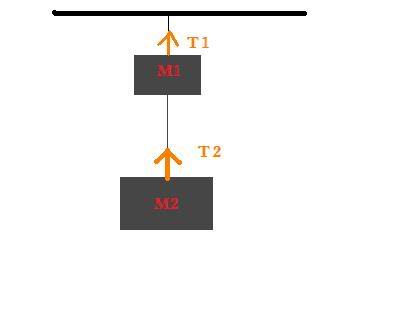
Tension.jpg


Homework Equations


F=ma
W=mg


The Attempt at a Solution


I found the tension in the lower and upper rope when it was stationary and therefore in equilibrium.
T2=M2g
T1=M1g
Then to find the tension when accelerating I just used
T2=Ma+Mg
T1=Ma+M1g+M2g

For some reason it says that the tension in rope 2 does not depend on the variable M1... So I'm just really lost now on which direction to take..
Thanks in advance
 
Physics news on Phys.org
Welcome to PF>

While acceleration T2 is the normal force arising only due to the weight of M2.
Hence T2 does not depend on variable M1.
 
Oh thank you! That clears up the first one but I'm still stuck on the T1 when accelerating. Would I just go T1=(M1+M2)a + (M1+M2)g?
 
Yes becoz the total downward force acting on T1 while acceleration is the sum of the weights of M1 and M2.
 
tizzful said:
I found the tension in the lower and upper rope when it was stationary and therefore in equilibrium.
T2=M2g
T1=M1g
That would be correct for M2 but not for T1 (three forces act on M1). In any case, the equilibrium situation is not relevant to this problem.
Then to find the tension when accelerating I just used
T2=Ma+Mg
T1=Ma+M1g+M2g
Carefully apply Newton's 2nd law to each mass. Start by identifying all the forces that act on each mass. (Hint: three forces act on M1.)

(The diagram is misleading because it does not show all the tension forces acting on the masses.)


first, solve for the T2.
T2=M1(g)
then, for T1,
since T1 is carrying the M2,
ΣF=ma
substitute ΣF to T2 + M1(g) -T1
so,
T2 + M1(g) -T1= ma (at rest)
T2 + M1(g) -T1= 0
T1=T2 + M1(g)
 

Similar threads

  • · Replies 4 ·
Replies
4
Views
2K
  • · Replies 10 ·
Replies
10
Views
3K
Replies
16
Views
2K
  • · Replies 5 ·
Replies
5
Views
3K
  • · Replies 7 ·
Replies
7
Views
4K
  • · Replies 3 ·
Replies
3
Views
3K
  • · Replies 5 ·
Replies
5
Views
5K
  • · Replies 33 ·
2
Replies
33
Views
3K
  • · Replies 7 ·
Replies
7
Views
8K
Replies
11
Views
3K