Why Does Zin Calculation Differ in Single Stub Matching?

  • Thread starter Thread starter baby_1
  • Start date Start date
  • Tags Tags
    Network
Click For Summary
SUMMARY

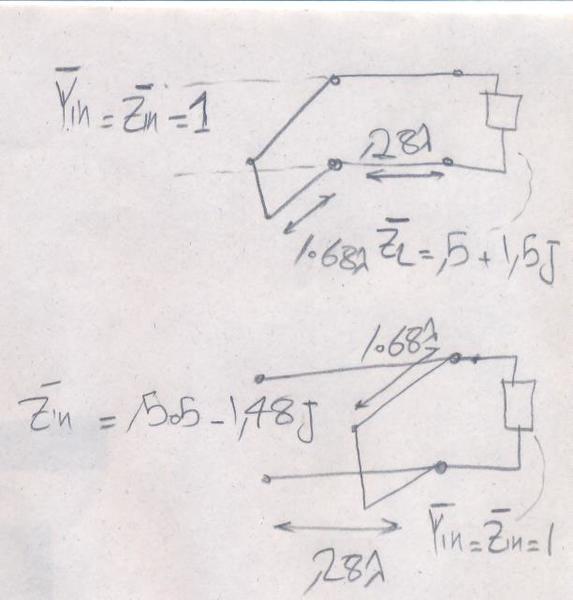
The forum discussion focuses on the discrepancies in Zin calculation during single stub matching, specifically when matching a load of zl = 0.5 + 1.5i to a normalized line with Z0 = 50. The user utilized both a Smith chart and analytical methods but encountered a mismatch in results, with the calculated Zin yielding 0.5 - j1.5 instead of the expected 0.5 + j1.5. This indicates a potential misunderstanding in the application of the Smith chart or the calculation process involved in single stub matching.

PREREQUISITES
  • Understanding of single stub matching techniques
  • Familiarity with Smith chart usage
  • Knowledge of complex impedance and normalization
  • Basic principles of transmission line theory
NEXT STEPS
  • Study the principles of single stub matching in RF design
  • Learn advanced Smith chart techniques for impedance matching
  • Explore the calculation of Zin in transmission lines
  • Review complex impedance calculations and their implications
USEFUL FOR

RF engineers, electrical engineering students, and professionals involved in impedance matching and transmission line analysis will benefit from this discussion.

baby_1
Messages
159
Reaction score
16
Hello
As you see this problem with single stub matching
I matched zl=.5+1.5i to a normalized line (Z0=50)(I did it with smith chart and analytically) but as you see in the second picture as I calculate Zin it doesn't get me the same result (.5+1.5j).
2390138400_1435297056.jpg
what is my wrong?
 
Engineering news on Phys.org
baby_1 said:
Hello
As you see this problem with single stub matching
I matched zl=.5+1.5i to a normalized line (Z0=50)(I did it with smith chart and analytically) but as you see in the second picture as I calculate Zin it doesn't get me the same result (.5+1.5j).
2390138400_1435297056.jpg
what is my wrong?
In the first picture the load is 0.5 + j1.5 and in the second it is 0.5 - j1.5.
 

Similar threads

  • · Replies 4 ·
Replies
4
Views
3K
Replies
5
Views
10K
  • · Replies 19 ·
Replies
19
Views
4K
  • · Replies 5 ·
Replies
5
Views
3K
  • · Replies 30 ·
2
Replies
30
Views
5K
  • · Replies 8 ·
Replies
8
Views
3K
Replies
7
Views
2K
Replies
1
Views
926
  • · Replies 32 ·
2
Replies
32
Views
4K
  • · Replies 4 ·
Replies
4
Views
3K