Why doesn't a charge repel a magnetic field in this example?

Click For Summary

Discussion Overview

The discussion revolves around the behavior of an electron in a magnetic field, specifically addressing why an electron does not repel the magnetic field despite having its own magnetic field. Participants explore the implications of the electron's motion and the interaction of magnetic fields in various contexts, including conductors and loops of wire.

Discussion Character

  • Exploratory
  • Technical explanation
  • Debate/contested

Main Points Raised

  • Some participants assert that an electron trapped in a magnetic field travels in a circular path, with its own magnetic field circulating in a similar direction, raising questions about the interaction between the two fields.
  • There is a suggestion that if the electron had a parallel component to its velocity, it would spiral rather than maintain a circular path.
  • One participant notes that in the case of a loop of wire, the magnetic field inside opposes the external field, leading to the conclusion that the electron does not experience a net force.
  • Another participant mentions that the electron's magnetic field has opposite fields above and below it, which may cancel out, suggesting a lack of net force acting on the electron.
  • It is proposed that the effect of a particle's field on itself is typically neglected unless multiple particles are involved, which would require considering their interactions.
  • One participant posits that the electron did work against its own field when accelerated, implying that energy is stored in its magnetic field.
  • A later reply indicates that the magnetic field of the electron is reinforced on one side, allowing it to curve without experiencing net repulsion.

Areas of Agreement / Disagreement

Participants express various viewpoints regarding the interaction of the electron's magnetic field with external magnetic fields, and there is no consensus on the nature of the forces acting on the electron or the implications of its motion.

Contextual Notes

Participants discuss the complexities of magnetic interactions, including the dependence on the configuration of fields and the assumptions made about the electron's behavior. The discussion highlights the unresolved nature of these interactions and the conditions under which different behaviors may be observed.

Samson4
Messages
242
Reaction score
15
The example:
An electron is trapped in a magnetic field. The electron travels along a circle in a clockwise path. It's my understanding that there is a magnetic field around the electron also circulating in a clockwise direction perpendicular to it's path. Now if this electron was in a conductor, the conductor would have a magnetic field opposing the original magnetic field. So, why doesn't the electron?
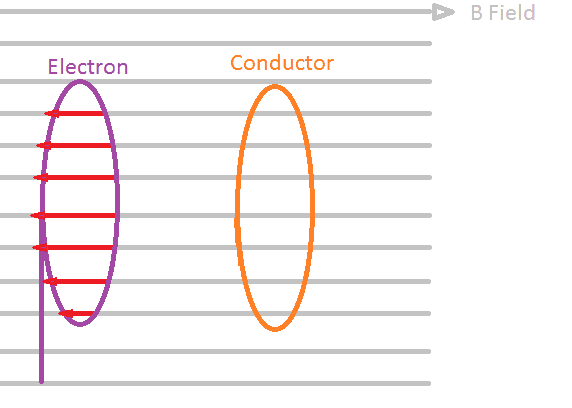
Untitled.png
 
Physics news on Phys.org
Samson4 said:
The example:
An electron is trapped in a magnetic field. The electron travels along a circle in a clockwise path. It's my understanding that there is a magnetic field around the electron also circulating in a clockwise direction perpendicular to it's path. Now if this electron was in a conductor, the conductor would have a magnetic field opposing the original magnetic field. So, why doesn't the electron?

View attachment 111533
Does not the electron perform a spiral as a result of what you are saying?
 
tech99 said:
Does not the electron perform a spiral as a result of what you are saying?
It will spiral if it has a parallel component to it's velocity.
 
Samson4 said:
The example:
An electron is trapped in a magnetic field. The electron travels along a circle in a clockwise path. It's my understanding that there is a magnetic field around the electron also circulating in a clockwise direction perpendicular to it's path. Now if this electron was in a conductor, the conductor would have a magnetic field opposing the original magnetic field. So, why doesn't the electron?

View attachment 111533
For the case of the loop of wire, the magnetic field inside the loop points in the opposite direction to that outside it. So overall, I don't think it has a force on it.
The single electron does seem to have a resultant force causing it to spiral, because it is acting like a loop edge-on to the magnetic field.
 
  • Like
Likes   Reactions: ORF
tech99 said:
For the case of the loop of wire, the magnetic field inside the loop points in the opposite direction to that outside it. So overall, I don't think it has a force on it.
The single electron does seem to have a resultant force causing it to spiral, because it is acting like a loop edge-on to the magnetic field.
On my second point, I don't think I am correct here. The electron has opposite fields above and below it, so presumably these cancel.
 
Normally, you neglect the effect of a particle's field on itself. If you had more than one electron, then you would have to consider the effect of the electrons' fields on each other.
 
  • Like
Likes   Reactions: Samson4
I think the electron did work against its own field when it was accelerated to its present velocity and this energy is now mostly stored in its magnetic field.
 
  • Like
Likes   Reactions: Samson4
I see now that the magnetic field of the electron is reinforced on 1 side, according to the left hand rule. This makes since for the electron to curve away from that side without experiencing a net repulsion.
 

Similar threads

  • · Replies 5 ·
Replies
5
Views
2K
  • · Replies 7 ·
Replies
7
Views
3K
  • · Replies 12 ·
Replies
12
Views
1K
  • · Replies 2 ·
Replies
2
Views
2K
  • · Replies 23 ·
Replies
23
Views
5K
  • · Replies 5 ·
Replies
5
Views
1K
  • · Replies 1 ·
Replies
1
Views
1K
  • · Replies 2 ·
Replies
2
Views
2K
  • · Replies 1 ·
Replies
1
Views
2K
  • · Replies 22 ·
Replies
22
Views
2K