Why incompressible flow does not satisfy energy equation?

Click For Summary
SUMMARY

The discussion clarifies that incompressible flow does satisfy the energy equation, contrary to some misconceptions. While incompressible flows can decouple the energy equation from mass and momentum conservation equations, they can still be relevant under conditions of significant viscous heating or external heat transfer. The conversation also highlights the existence of three flow regimes: incompressible, variable-density, and compressible, with variable-density flows being a nuanced category that may still exhibit incompressibility in certain contexts. The participants emphasize the importance of understanding these distinctions in fluid dynamics.

PREREQUISITES
  • Understanding of fluid dynamics principles
  • Familiarity with the continuity and momentum equations
  • Knowledge of energy balance equations in fluid mechanics
  • Concept of variable-density flows versus incompressible flows
NEXT STEPS
  • Research the implications of viscous heating on incompressible flow
  • Study the characteristics of variable-density flows in fluid dynamics
  • Explore the relationship between temperature variations and viscosity in fluids
  • Investigate the distinctions between subsonic and supersonic compressible flows
USEFUL FOR

Fluid dynamics students, mechanical engineers, and researchers focusing on flow regimes and energy equations in incompressible and compressible fluids.
aerograce
Messages
63
Reaction score
1
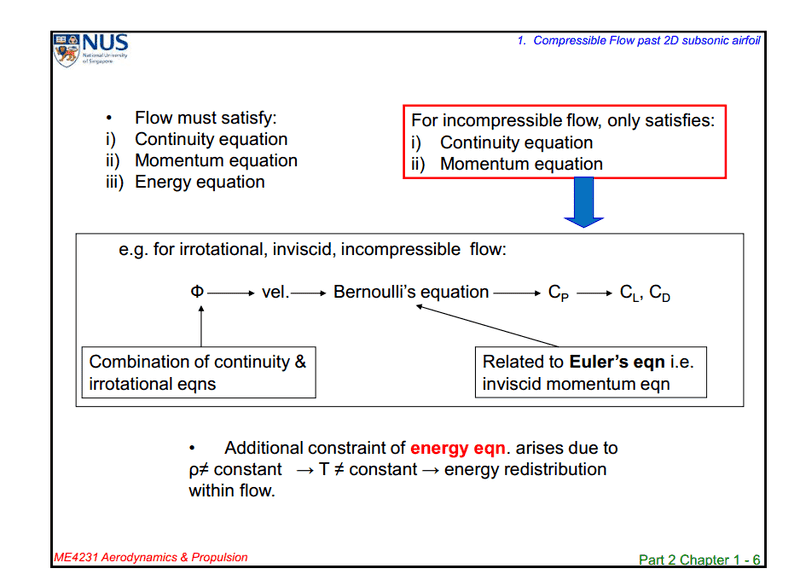
I encountered this statement on my lecture notes today,
upload_2017-4-18_21-22-30.png

I don't understand why compressible flow needs to have another constraint of energy equation while incompressible flow only satisfies continuity and momentum equation. And how is this energy equation related to the speed of sound?
 
Physics news on Phys.org
aerograce said:
I encountered this statement on my lecture notes today,
View attachment 195483
I don't understand why compressible flow needs to have another constraint of energy equation while incompressible flow only satisfies continuity and momentum equation. And how is this energy equation related to the speed of sound?
I don't know what the speaker is referring to. Incompressible flow of a Newtonian Fluid certainly does satisfy the thermal energy balance equation as well as the mechanical energy balance equation.
 
My guess is that whoever made the slides was simply being inexact with their language. Incompressible flows absolutely do satisfy the energy equation. However, for an incompressible flow, the energy equation is entirely decoupled from the mass and momentum conservation equations, so you can solve the entire velocity and pressure fields without ever touching the energy equation. That's one of the major advantages of treating a flow as incompressible. So, for an incompressible flow, while it does still satisfy the energy equation, we can entirely ignore it unless we specifically care about the temperature field.
 
boneh3ad said:
My guess is that whoever made the slides was simply being inexact with their language. Incompressible flows absolutely do satisfy the energy equation. However, for an incompressible flow, the energy equation is entirely decoupled from the mass and momentum conservation equations, so you can solve the entire velocity and pressure fields without ever touching the energy equation. That's one of the major advantages of treating a flow as incompressible. So, for an incompressible flow, while it does still satisfy the energy equation, we can entirely ignore it unless we specifically care about the temperature field.
Yes. As you say, if there is significant viscous heating and/or direct external heat transfer to the fluid, the viscosity of the fluid can change, and this then couples to the equation of motion. So, under these circumstances, the energy balance equation can have a significant effect on the fluid mechanics, even for an incompressible fluid.
 
Chestermiller said:
Yes. As you say, if there is significant viscous heating and/or direct external heat transfer to the fluid, the viscosity of the fluid can change, and this then couples to the equation of motion. So, under these circumstances, the energy balance equation can have a significant effect on the fluid mechanics, even for an incompressible fluid.

There was a fair bit of discussion about this a few months back and whether this truly qualifies as being incompressible or not. Different authors will treat the question differently. Personally, for exactly this reason, I'd argue for there being essentially three flow regimes: incompressible, variable-density, and compressible (or I guess four regimes if you split compressible into subsonic and supersonic). Not everyone agrees with me, though.
 
boneh3ad said:
There was a fair bit of discussion about this a few months back and whether this truly qualifies as being incompressible or not. Different authors will treat the question differently. Personally, for exactly this reason, I'd argue for there being essentially three flow regimes: incompressible, variable-density, and compressible (or I guess four regimes if you split compressible into subsonic and supersonic). Not everyone agrees with me, though.
I'm confused. Viscous dissipation is a completely different phenomenon than compressibility/incompressibility (which I'm sure you know).
 
Chestermiller said:
I'm confused. Viscous dissipation is a completely different phenomenon than compressibility/incompressibility (which I'm sure you know).

Yes, I was referring to your comment about how if you have large temperature gradients (for example) then the equations can remain coupled. That's a situation where the kinematics can remain incompressible in a certain sense but the density can still vary in space (or viscosity). Often those are called "variable-density flows" to distinguish them from truly incompressible flows. Depending on your definition of "incompressible", they may or may not still fall within that umbrella.
 
boneh3ad said:
Yes, I was referring to your comment about how if you have large temperature gradients (for example) then the equations can remain coupled. That's a situation where the kinematics can remain incompressible in a certain sense but the density can still vary in space (or viscosity). Often those are called "variable-density flows" to distinguish them from truly incompressible flows. Depending on your definition of "incompressible", they may or may not still fall within that umbrella.
I wasn't referring to the effect of temperature on density. I was referring to the effect of temperature variations on viscosity variations, which, in turn, couples to the fluid dynamics.
 
Chestermiller said:
I wasn't referring to the effect of temperature on density. I was referring to the effect of temperature variations on viscosity variations, which, in turn, couples to the fluid dynamics.

Right, but the end result is effectively the same. It's not a situation I confront often, as it would be much more likely to be meaningful in liquids (whereas variable-density is a lot more meaningful in gases), but the effects on the governing equations ought to be quite similar.
 
  • #10
boneh3ad said:
Right, but the end result is effectively the same. It's not a situation I confront often, as it would be much more likely to be meaningful in liquids (whereas variable-density is a lot more meaningful in gases), but the effects on the governing equations ought to be quite similar.
Yeah. The overwhelming bulk of my experience has been with liquids.
 

Similar threads

  • · Replies 18 ·
Replies
18
Views
2K
Replies
20
Views
6K
  • · Replies 17 ·
Replies
17
Views
4K
Replies
0
Views
2K
  • · Replies 16 ·
Replies
16
Views
3K
  • · Replies 48 ·
2
Replies
48
Views
5K
  • · Replies 5 ·
Replies
5
Views
2K
  • · Replies 48 ·
2
Replies
48
Views
6K
  • · Replies 73 ·
3
Replies
73
Views
16K
  • · Replies 8 ·
Replies
8
Views
9K