Why Is Current Divided by sqrt(3) in 3-Phase AC Mains?

  • Context: Engineering 
  • Thread starter Thread starter thatsmessedup
  • Start date Start date
  • Tags Tags
    Ac Figure Mains Terms
Click For Summary
SUMMARY

The discussion clarifies the division of line current (Is) by sqrt(3) in 3-phase AC mains systems, particularly in delta-connected loads. The transformer provides 3-phase power, typically described in line-to-line or Y-connected terms. To convert the current from line to phase in a delta configuration, the current Is is divided by sqrt(3) after calculating the line current using the formula 120 kVA / 230 V. This relationship is further supported by analyzing phase diagrams and understanding the voltage and current relationships in 3-phase systems.

PREREQUISITES
  • Understanding of 3-phase AC systems
  • Knowledge of delta and Y (wye) connections
  • Familiarity with transformer operation and calculations
  • Basic grasp of electrical phase diagrams
NEXT STEPS
  • Study the principles of 3-phase power calculations
  • Learn about transformer connections and their impact on current and voltage
  • Explore phase diagrams in electrical engineering
  • Investigate the implications of power factor in AC circuits
USEFUL FOR

Electrical engineers, students studying power systems, and professionals involved in designing or analyzing 3-phase AC circuits will benefit from this discussion.

thatsmessedup
Messages
27
Reaction score
0
Homework Statement
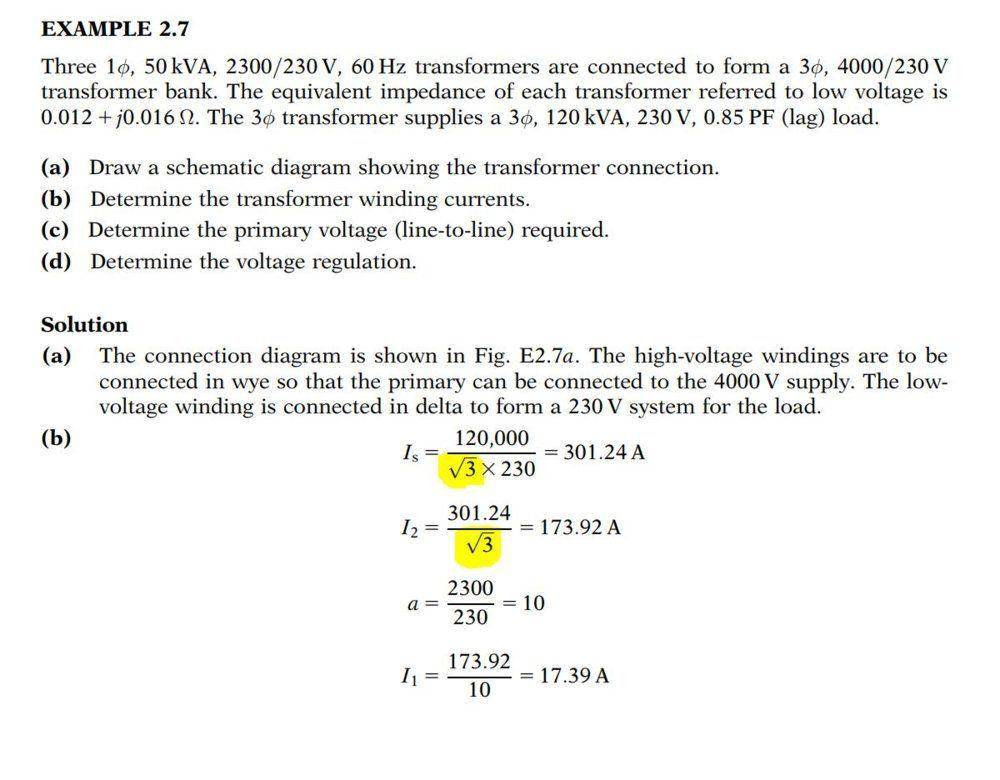
EXAMPLE 2.7
Three 1φ, 50 kVA, 2300=230 V, 60 Hz transformers are connected to form a 3φ, 4000=230 V
transformer bank. The equivalent impedance of each transformer referred to low voltage is
0:012 + j0:016 Ω. The 3φ transformer supplies a 3φ, 120 kVA, 230 V, 0:85 PF (lag) load.
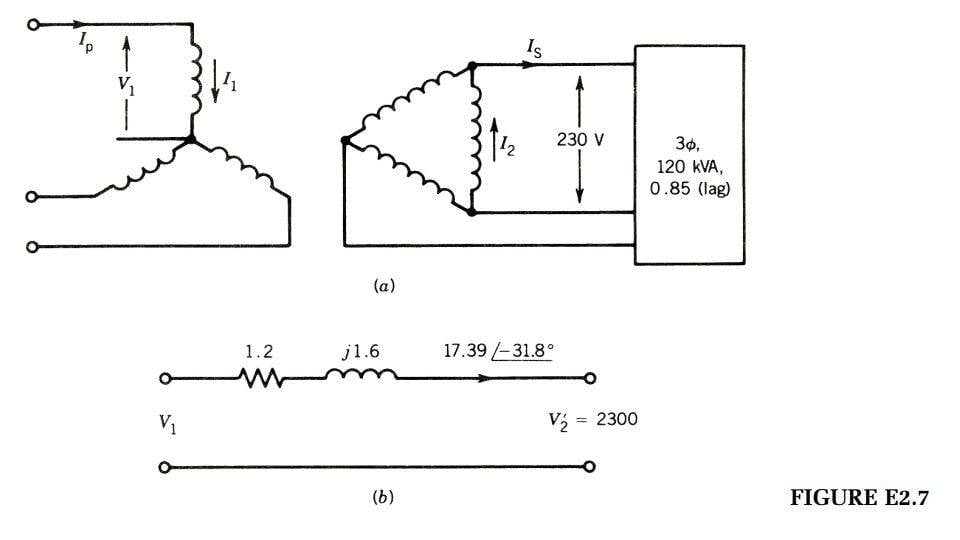
(a) Draw a schematic diagram showing the transformer connection.
(b) Determine the transformer winding currents.
(c) Determine the primary voltage (line-to-line) required.
(d) Determine the voltage regulation
Relevant Equations
Please see attached
In this example I am thoroughly confused on why Is is divided by sqrt(3). My understanding is that the transformer supplies 3 phase (which is always described in line to line or Y connected). So the current in the winding should be 120[KVA]/230[V] then multiplied by sqrt(3) to convert it to delta line current. Then I2 would be Is divided by sqrt(3) to get the phase current.

Where are the appropiate formulas or diagrams that will make this problem make more sense?
Thanks!
1.JPG

2.7a.JPG


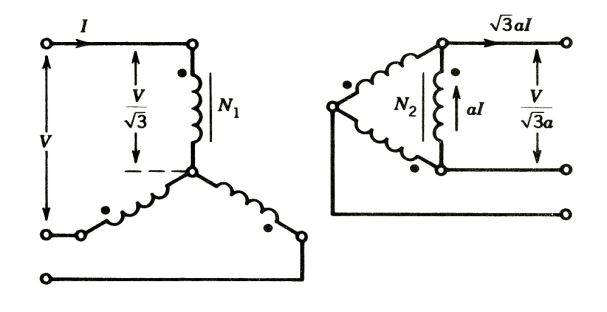
This is where I am seeing that I should multiply sqrt(3) to get the delta line current. (exuding the a because I am not going from one transformer to the other)
Capture.JPG
 

Attachments

  • 2.7a.JPG
    2.7a.JPG
    25.8 KB · Views: 372
Last edited by a moderator:
Physics news on Phys.org
If you draw three delta-connected resistances representing the load, in place of that rectangle, and calculate the current in each resistance of that load, it's 120kVA ÷ 3 ÷ 230V

But Is in the diagram is the sum of two of these currents. Is is the line current of a delta-connected load having that value of phase current.
 
  • Like
Likes   Reactions: thatsmessedup
thatsmessedup said:
In this example I am thoroughly confused on why Is is divided by sqrt(3).

(My understanding is that the transformer supplies 3 phase (which is always described in line to line or Y connected). So the current in the winding should be 120[KVA]/230[V] then multiplied by sqrt(3) to convert it to delta line current. Then I2 would be Is divided by sqrt(3) to get the phase current.)

This is where I am seeing that I should multiply sqrt(3) to get the delta line current. (exuding the a because I am not going from one transformer to the other)
View attachment 257931
The reason is, as you suggest, the same as for the voltages in the primary. If you look at the phase diagrams, you can see the relation.
1583140231161.png

So, looking only at magnitudes,
## V = V1 \cos {30} + V2 \cos {30} = V1 \sqrt 3 \, \text { or } V1 = \frac {V}{\sqrt3}##
Similarly ## I = I1 \cos {30} + I2 \cos {30} = I1 \sqrt 3 ##
 
  • Like
Likes   Reactions: thatsmessedup

Similar threads

  • · Replies 2 ·
Replies
2
Views
6K
  • · Replies 8 ·
Replies
8
Views
2K
Replies
3
Views
3K
  • · Replies 1 ·
Replies
1
Views
2K
Replies
13
Views
4K
  • · Replies 4 ·
Replies
4
Views
2K
  • · Replies 3 ·
Replies
3
Views
1K
  • · Replies 8 ·
Replies
8
Views
4K
Replies
2
Views
4K
  • · Replies 1 ·
Replies
1
Views
2K