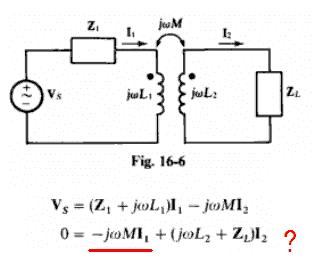
Why is the Inducted Voltage Negative in Book B's Dot Convention?

Click For Summary

Discussion Overview

The discussion revolves around the dot convention in magnetically coupled circuits, specifically addressing the negative sign of the inducted voltage in a particular equation from book B compared to book A. Participants explore the implications of the dot convention on the direction of current and the resulting voltage signs.

Discussion Character

  • Debate/contested
  • Technical explanation
  • Mathematical reasoning

Main Points Raised

  • One participant questions why the inducted voltage in book B is negative, suggesting that according to the dot convention, a positive inducted voltage should appear when current enters the dot.
  • Another participant asserts that both books are correct and explains that the sign of the equation can be altered without affecting the overall validity, attributing the negative sign to the application of KVL in a clockwise direction.
  • A participant seeks clarification on whether their understanding, represented in an image, is correct and questions the implications of reversing the current direction and changing the position of the dot.
  • Another participant points out mistakes in the participant's equations, specifically regarding the sign of the "jwM" term.
  • Subsequent responses indicate a progression in understanding, with one participant confirming the correctness of the modified equations.

Areas of Agreement / Disagreement

Participants express differing views on the interpretation of the dot convention and the resulting signs of the equations. There is no consensus on the correct application of the convention, as some participants challenge the interpretations and calculations presented by others.

Contextual Notes

Participants reference specific equations and their derivations, but the discussion includes unresolved questions about the implications of changing current directions and dot positions, as well as the correctness of the signs in the equations.

degs2k4
Messages
72
Reaction score
0
Hello,

I have a doubt regarding dot convention in magnetically coupled circuits.

In book A, the following is stated:
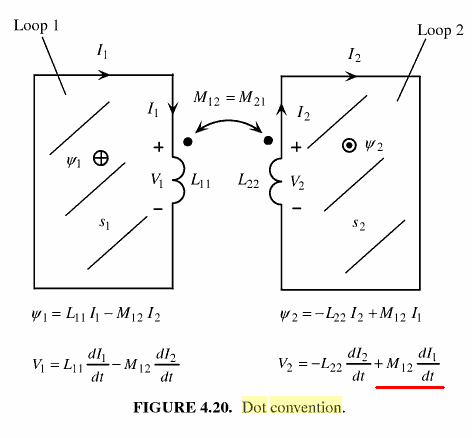
152lrnr.png


But in book B, this is stated:
2uqhnib.png


In book B, why the inducted voltage of the second mesh (-j w M I1) has that negative sign ? According to dot convention, it is supposed that when the current enters into the dot, a positive inducted voltage appears in the dot of the second mesh right ?

Thanks!
 
Last edited:
Engineering news on Phys.org
Both books are correct. You seem to be concerned that the RHS of the questioned equation is negated, but what does it matter given that the LHS of said equation is zero! Change all the signs on both sides of the equation if you like, but it won't make any real difference.

BTW, that equation (2nd equation book B) comes from applying KVL in a clockwise direction around the secondary circuit. The equation that you seem to be expecting would come from applying KVL in a counter-clockwise direction, which ultimately would of course give the exact same equation.
 
Last edited:
uart said:
BTW, that equation (2nd equation book B) comes from applying KVL in a clockwise direction around the secondary circuit. The equation that you seem to be expecting would come from applying KVL in a counter-clockwise direction, which ultimately would of course give the exact same equation.

Thanks for your response.

OK, I think I understand it now... My idea about this is represented in the image below, is it correct?
moe1j.jpg


Just to check the last doubts, if the current of the second part were inverse, the equations would be ok like this?
25gvvom.jpg


And if the dot of the second part were at the bottom instead at the top...
dfe9s.jpg


Would this be correct ? (I am doubting whether I should change the sign of the rest of the equation or not, since the current direction has changed now)
 
degs2k4 said:
Thanks for your response.

OK, I think I understand it now... My idea about this is represented in the image below, is it correct?
moe1j.jpg


Just to check the last doubts, if the current of the second part were inverse, the equations would be ok like this?
25gvvom.jpg


And if the dot of the second part were at the bottom instead at the top...
dfe9s.jpg


Would this be correct ? (I am doubting whether I should change the sign of the rest of the equation or not, since the current direction has changed now)

Nope, there's lot's of mistakes there. The sign of the "jwM" term is opposite to what it should be in all of the last three equations.
 
uart said:
Nope, there's lot's of mistakes there. The sign of the "jwM" term is opposite to what it should be in all of the last three equations.

Thanks for your reply again. I was very confused, but I modified it again. Do you think it is correct now?

24nr811.jpg


And,
317io3d.png


Thanks in advance...
 
Do you think it is correct now?
Yep, you've got it. :)
 
Oh great! Thank you very much! :)
 

Similar threads

  • · Replies 8 ·
Replies
8
Views
16K
Replies
1
Views
3K
  • · Replies 5 ·
Replies
5
Views
5K
  • · Replies 6 ·
Replies
6
Views
3K
  • · Replies 1 ·
Replies
1
Views
1K
  • · Replies 1 ·
Replies
1
Views
2K
  • · Replies 10 ·
Replies
10
Views
6K
Replies
2
Views
3K
  • · Replies 9 ·
Replies
9
Views
4K
Replies
2
Views
3K