Why is the tension in a falling chain not equal to ρgy?

Join the discussion
Ask a follow-up here, or get your own question answered by working scientists, mathematicians and engineers — people, not an autocomplete.
Real named experts · corrections over time · the nuance an AI answer skips
4 replies · 2K views
Rikudo
Messages
120
Reaction score
26
Homework Statement
A chain with length L is held stretched out on a frictionless horizontal
table, with a length y0 hanging down through a hole in the table. The
chain is released. As a function of time, find the length that hangs down
through the hole (don’t bother with t after the chain loses contact with
the table).
Relevant Equations
F = dp/dt
Firstly, There is something I want to clarify. When the system starts moving, parts of the chain that still lies on the table, which have mass
## \frac {(L- y_0)M} {L}##, will be pulled by the force that the hanging chain's weight exert,right?

If yes, then :
As far as I know, the formula ##F= ma## is originally created from ##F= m\,\frac {dv} {dt} + v\, \frac {dm}{dt}##, which can be used only if there is no change in mass.
So, as I have stated in the first paragraph, the mass that is pulled by hanging chain will continue to change after the system starts moving. Then, why the book still use ##F = ma## although the mass is not constant?
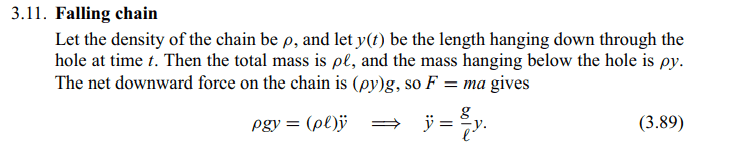
classicaltextbook.pdf - Profile 1 - Microsoft​ Edge 06_09_2021 18_42_52 (2).png
 
Reply
  • Like
Likes   Reactions: Delta2
on Phys.org
haruspex said:
The book is setting m as ##\rho l##, which is the mass of the whole chain.
so, all parts of the chain is pulled by ##\rho gy## (which is the hanging chain's weight exert)? Why does this force
(##\rho gy##) do not pulls the lying chain only? (as what i have stated in the first paragraph before)
 
Rikudo said:
so, all parts of the chain is pulled by ##\rho gy## (which is the hanging chain's weight exert)? Why does this force
(##\rho gy##) do not pulls the lying chain only? (as what i have stated in the first paragraph before)
You can view it that way that it pulls only the hanging chain, but soon you 'll realize that it is equivalent with pulling the whole chain as long as you make the simplifying assumption that all parts of the chain are moving with the same velocity(and thus same acceleration) for every time t.

To see it, split the chain into a hanging part ##m_{hanging}=\rho g y## and non hanging (or lying in the table) ##m_{table}=\rho g(l-y)## and consider the internal forces between the two parts which form a Newton 3rd law pair. Then write Newton's 2nd law (in the form of variable mass) for each part separately, you will get two equations. Add the two equations and the term ##\frac{dm_{hanging}}{dt}v## from one equation will cancel with the term ##\frac{dm_{table}}{dt}v## from the other equation because $$\frac{dm_{hanging}}{dt}=-\frac{dm_{table}}{dt}$$. Also the Newton 3rd law pair will cancel on the otherside of the equations and all you'll be left with is the equation that your book gives which is the same as considering the weight of the hanging chain being applied to the whole chain.
 
Rikudo said:
Why does this force (ρgy) do not pulls the lying chain only?
Because the tension in the chain at the hole is not ρgy.
That would have been the tension there before it was released, but on release it reduces immediately. Otherwise, there would be no net force on the hanging part, and it would not move.
Delta2 said:
a hanging part ##m_{hanging}=ρg##y and non hanging (or lying in the table) ##m_{table}=ρg(l−y)##
You mean ##m_{hanging}=ρy## and non hanging ##m_{table}=ρ(l−y)##.
 
Reply
  • Like
Likes   Reactions: Delta2