Jhenrique said:
How compute the voltage of a circuit if the voltage of the source is different of the sink? Also, how compute the voltage, the current, resistance, etc, of a circuit when we have various sources and sinks distributed by circuit and all with different voltage!?
Voltages are always measured between two points - any time that I say that something is at X volts, I mean it is at X volts relative to something else. When I say that something is "a 6V battery", I'm saying that the positive terminal of the battery is always 6V higher than the negative terminal.
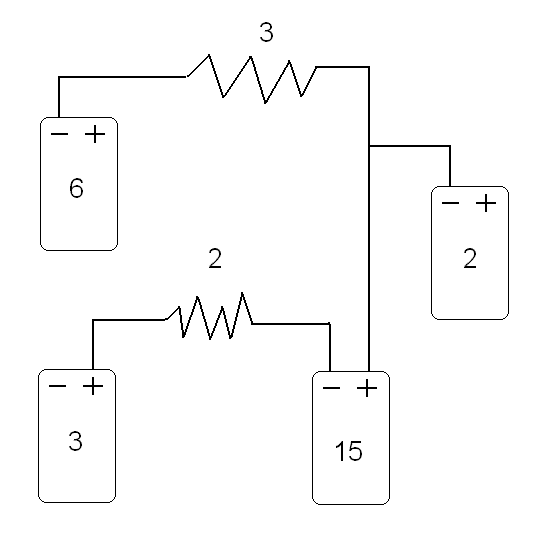
In your diagram, no current is flowing, the resistors aren't doing anything, and if you were to poke around with a voltmeter (which has TWO probes - voltages are measured between two points):
- If I put one probe of the voltmeter anywhere on the wire between the two, six, and fifteen volt batteries, and the other probe anywhere on the wire between the three-volt and fifteen-volt battery, the voltmeter will read 15 volts.
- If I leave the first probe where it is, but touch the second probe to the negative terminal of the 3V battery, the voltmeter will read 18 volts.
- The difference between the terminal of the three volt battery and the positive terminal of the six volt battery will be nine volts.
Check these, understand why, and try working out a few more yourself... You just need to be careful about when to add and when to subtract, and for that you just need to remeber that the voltage at the negative terminal is always less than at the positive terminal.