OliskaP
- 38
- 7
I have some trouble fully understanding the PLL block diagram shown below in the figure. The PLL circuit is used to generate currents (i alpha and i beta) which are in phase with the positive fundamental sequence of the voltage.
I am using the book "Instantaneous Power Theory and Applications to Power Condition" which I found as a pdf on the web.
The authors write:
The author also write that the frequency [itex]\omega[/itex] has to be equal to the system frequency and the current and voltages has to be orthogonal to reach a stable point of operation.
Why must [itex]\omega[/itex] be equal to system frequency to reach a stable point of operation?I would appreciate if someone help me fully understood how this circuit works
EDIT: I forgot to write 2pi/3 at the left bottom block, i wrote pi/3.
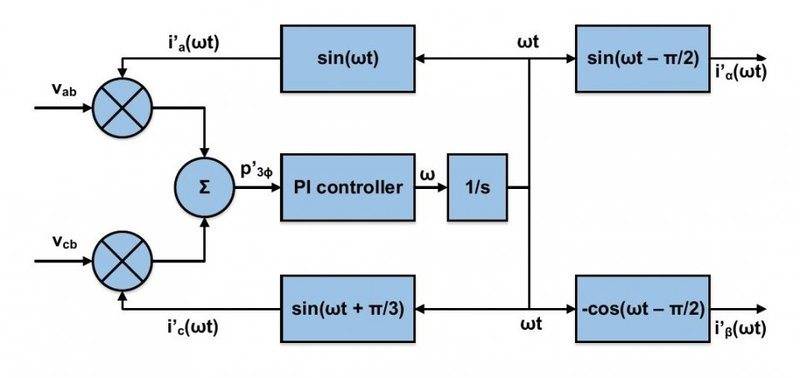
I am using the book "Instantaneous Power Theory and Applications to Power Condition" which I found as a pdf on the web.
The authors write:
- The only way for the PLL to reach a stable point is if the input to the PI controller in steady state has an average value of zero.
The author also write that the frequency [itex]\omega[/itex] has to be equal to the system frequency and the current and voltages has to be orthogonal to reach a stable point of operation.
Why must [itex]\omega[/itex] be equal to system frequency to reach a stable point of operation?I would appreciate if someone help me fully understood how this circuit works
EDIT: I forgot to write 2pi/3 at the left bottom block, i wrote pi/3.