Why not transmit electricity in 4-phase?

  • Thread starter Thread starter GregValcourt
  • Start date Start date
  • Tags Tags
    Electricity
Click For Summary

Discussion Overview

The discussion revolves around the feasibility and efficiency of transmitting electricity using a four-phase system compared to traditional three-phase systems. Participants explore mathematical, technical, and practical aspects of phase transmission, including potential advantages and drawbacks of higher phase orders.

Discussion Character

  • Debate/contested
  • Technical explanation
  • Mathematical reasoning

Main Points Raised

  • Some participants propose that generating in four-phase and converting to two-phase for transmission could be beneficial, suggesting that even-numbered phases might reduce losses.
  • Others argue that three-phase systems effectively cancel out currents, reducing magnetic radiation, and that the cost of insulators increases with additional phases.
  • A participant presents a mathematical demonstration claiming that the sum of three sine waves at 120 degrees apart equals zero, supporting the argument for three-phase systems.
  • Some participants challenge the assertion that three phases do not cancel out, with one admitting to an error in their previous calculations.
  • There is a claim that high phase order transmission has been studied extensively, but the benefits do not justify the costs associated with additional phases.
  • One participant asserts that three-phase systems require less copper than one or two-phase systems for the same power transmission, citing historical studies by utility companies.
  • Another participant questions the copper requirements for various phase systems, suggesting that more phases might not reduce copper needs and could even increase them.
  • A later reply discusses the implications of maintaining constant wire diameter versus constant power and losses in the context of phase systems.
  • One participant shares a computation indicating that while three-phase systems require 75% of the copper needed for one-phase systems, four-phase systems do not provide a copper savings compared to one-phase systems.
  • There is mention of high voltage direct current (HVDC) as an alternative for long-distance power transmission.

Areas of Agreement / Disagreement

Participants express differing views on the efficiency and practicality of four-phase versus three-phase systems, with no consensus reached on the superiority of one approach over the other. The discussion remains unresolved regarding the copper requirements and overall benefits of higher phase orders.

Contextual Notes

Some claims rely on specific assumptions about power loss, wire diameter, and the mathematical properties of sine waves. The discussion includes references to external sources and computations that have not been universally accepted or verified by all participants.

GregValcourt
Messages
4
Reaction score
0
Or even better, generate in 4-Phase, convert to two-phase for transmission. Even number phases cancel out nicely (contrary to popular belief, 3-phase does not actually cancel out). 2-phase might be convertible back to four phase for the purpose of industrial motors.

Forgive me for speaking out of ignorance, I'm not an electrician or engineer. Mathematically, an even number of phases seems better for transmission (in terms of loss).

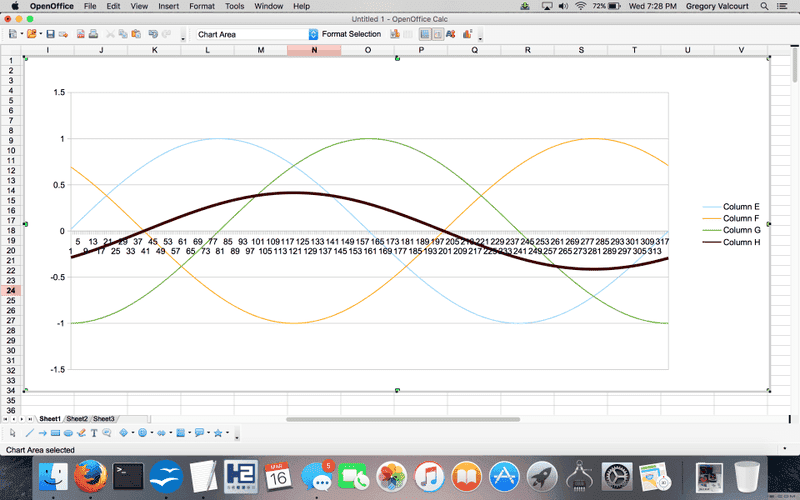
Mathematical graph of 3 sine waves 120 degrees apart, with resultant wave:

Screen Shot 2016-03-16 at 7.28.25 PM.png
 

Attachments

  • Screen Shot 2016-03-16 at 7.28.25 PM.png
    Screen Shot 2016-03-16 at 7.28.25 PM.png
    44.7 KB · Views: 507
Last edited:
Engineering news on Phys.org
Those 3 sine waves don't look 120 degrees apart to me.
 
  • Like
Likes   Reactions: GregValcourt
The sum of the instantaneous currents in all three phases should always be close to zero. That reduces the magnetic radiation from the transmission line.

Given a minimum of three phases and by using transformers, any number of other phase combinations can be generated. For a simple example see; https://en.wikipedia.org/wiki/Scott-T_transformer

The sum of cross sections of conductors in a transmission line is independent of the number of phases, but the cost of insulators is 33% higher for a 4 phase line than for a 3 phase line.
 
Here's why 3-phase cancels:
$$\sin(x-120)+\sin x+\sin(x+120)=\sin x\cos (-120)+\cos x\sin (-120)+\sin x+\sin x\cos 120+\cos x\sin 120$$

$$=-\sin x\cos 60+-\cos x\sin 60+\sin x-\sin x\cos 60+\cos x\sin 60$$
$$=-\sin x\cos 60+\sin x-\sin x\cos 60
=-\tfrac{1}{2}\sin x+\sin x-\tfrac{1}{2}\sin x=0$$

Picking up on the obaservation of @Averagesupernova, the blue and green curves in the graph are 90 degrees out of phase, not 120.
 
  • Like
Likes   Reactions: GregValcourt and cabraham
OP, you really blew it when you said three phases don't add to zero. Ignoring that, high phase order transmission has been studied many times. The short answer is that the added benefits do not outweigh the added costs.

Google the phrase high phase order transmission.

md_0JroGSTJ51.jpg
 
  • Like
Likes   Reactions: mheslep and cabraham
Settled science. Single phase requires 2 wires. Two phase requires 3 wires. Three phase also needs 3 wires, 4 phase needs 4. Computing losses, you will find that to transmit a given amount of power from point A to point B with a given loss, 3 phase requires only 75% the copper area/weight as 1 or 2 phase. Increasing to 4 phase or more does not reduce copper needed, I can look it up later, but more phases may even need more copper than with 3 phases.

Three phase is optimum regarding maximum power ability, for a given amount of loss, with minimum copper consumed. The utility companies have studied this issue since the late 19th century. If a different number of phases is really better, it would have been done decades ago.

Claude
 
  • Like
Likes   Reactions: CalcNerd and jim hardy
cabraham said:
I can look it up later, but more phases may even need more copper than with 3 phases.
I believed that the total section of copper needed remained the same for 3PH and above, while the number, mass and cost of insulators increased.
If anything I would expect total copper mass to fall slightly for more phases due to the skin effect not fully utilising the centre of thick conductors needed for 3PH.
Can you give a reference to the weight of copper needed for polyphase lines of three and above ?
 
From the first paragraph here: https://en.wikipedia.org/wiki/Polyphase_system

"A major advantage of three phase power transmission (using three conductors, as opposed to a single phase power transmission, which uses two conductors), is that, since the remaining conductors act as the return path for any single conductor, the power transmitted by a balanced three phase system is three times that of a single phase transmission but only one extra conductor is used. Thus, a 50% / 1.5x increase in the transmission costs achieves a 200% / 3.0x increase in the power transmitted."
 
Wikipedia is incorrect here. I will find or recompute, then post. Here is the conclusion, I know this is right. For transmitting power from A to B, same amount using 1-phase & 3-phase, with equal power lost in transmission, a 3-ph system uses 75% the copper of 1-ph, as well as 2-ph.
 
  • Like
Likes   Reactions: Averagesupernova
  • #10
The Electrician said:
hus, a 50% / 1.5x increase in the transmission costs achieves a 200% / 3.0x increase in the power transmitted."

cabraham said:
For transmitting power from A to B, same amount using 1-phase & 3-phase, with equal power lost in transmission, a 3-ph system uses 75% the copper of 1-ph, as well as 2-ph.

Can't you both be right?
  • The Electrician holds wire diameter constant and increases the power transmitted, holding watts/(mile*phase) constant.
  • Cabraham holds power and losses constant and decreases wire diameter.
Edit: By the way, high phase order transmission is interesting not only because of losses, but also because of series reactance.
 
  • Like
Likes   Reactions: nsaspook
  • #11
Here is a 2-page computation for copper needed re 1-phase, 3-ph, and 4-ph transmission. Here is the synopsis. The generated power is 1.000 watt per unit, the power loss in cables in 0.010 watts per unit, and the load power is 0.990 watts per unit. These values were held constant for comparison purposes. Also, maximum line to line voltages were fixed at 1.0 volts per unit.

The result is what I seem to recall. The copper requirement for 1-phase is set at 100% as the reference. A 3-phase system requires just 75% the copper of 1-phase, a considerable savings. But, a 4-phase system did not improve on the 75% figure. Actually it came in at 100%, identical to 1 phase. I remember computing the general relation for any number of phases, i.e. "n-phase". For any value of "n" other than 3, the result is the same, the same amount of copper, i.e. 100%, is needed. If n=3, then 75% of the copper weight is needed.

I'm not surprised, because if 4 phases, or 5, 6, 10, whatever, saved on copper usage, the power companies & others would have quickly done it. I've heard of 6, 12, 24, & even 36 phase power employed. But it's advantage is usually very low ac ripple after rectification negating the need for large smoothing capacitors. But for long distance power transmission, 3 phase is pretty much the only game in town. Comments/feedback/questions welcome. Best regards.

Claude
 

Attachments

  • Like
Likes   Reactions: mheslep
  • #12
cabraham said:
...But for long distance power transmission, 3 phase is pretty much the only game in town. Comments/feedback/questions welcome. Best regards.

Claude

Or HVDC.
 
  • #13
Averagesupernova said:
Those 3 sine waves don't look 120 degrees apart to me.

Your right, I must have did something wrong when building the spreadsheet. The second time I did it, 3-phase does cancel out.
 

Similar threads

  • · Replies 1 ·
Replies
1
Views
2K
  • · Replies 20 ·
Replies
20
Views
3K
  • · Replies 12 ·
Replies
12
Views
5K
Replies
1
Views
5K
  • · Replies 15 ·
Replies
15
Views
2K
Replies
7
Views
5K
  • · Replies 69 ·
3
Replies
69
Views
9K
Replies
2
Views
10K
  • · Replies 1 ·
Replies
1
Views
7K
Replies
10
Views
15K