Why specific latent heat of vaporisation > fusion?

Click For Summary
SUMMARY

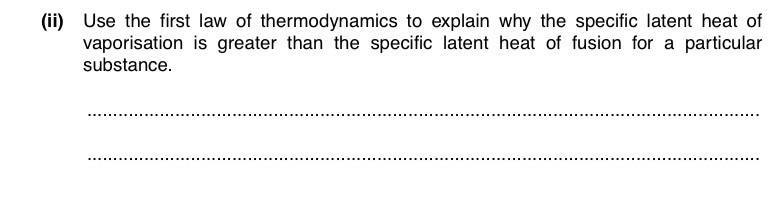
The discussion centers on the comparison of specific latent heat of vaporization and fusion, emphasizing that the change in volume during vaporization is significantly greater than during fusion. The first law of thermodynamics is applied, specifically the equation ΔU=q+W, to analyze the internal energy changes. The key insight is that the work done on the system during vaporization is negative, represented as W = -pΔV, which contributes to a greater increase in internal energy for vaporization compared to fusion.

PREREQUISITES
  • Understanding of the first law of thermodynamics
  • Familiarity with concepts of latent heat
  • Knowledge of internal energy and work in thermodynamic systems
  • Basic principles of phase changes in matter
NEXT STEPS
  • Study the implications of the first law of thermodynamics in various thermodynamic processes
  • Explore the differences in molecular behavior during phase changes, particularly between vaporization and fusion
  • Learn about the calculations involved in determining latent heat for different substances
  • Investigate real-world applications of latent heat in engineering and environmental science
USEFUL FOR

Students in physics or engineering, educators teaching thermodynamics, and professionals in fields requiring a deep understanding of phase transitions and energy transformations.

Janiceleong26
Messages
276
Reaction score
4
1. Homework Statement
image.jpg


Homework Equations


First law of thermodynamics, ΔU=q+W

The Attempt at a Solution


Ok so, I know that when liquid evaporates, the change in volume is much greater than that when solid melts. And for both cases, distance of separation of atoms increases too, so PE increases, and hence, internal energy increases.
So, ΔU=mL+ pΔV
L=(ΔU-pΔV) /m
But how do we know that the term (ΔU-pΔV) is greater for vaporisation than that of fusion?
 
Physics news on Phys.org
Janiceleong26 said:

Ok so, I know that when liquid evaporates, the change in volume is much greater than that when solid melts.
Well, that is in fact the main essence of the answer.

Janiceleong26 said:
So, ΔU=mL+ pΔV
There is a sign problem here. The work done on the system ##W## should be ## - p \Delta V## - do you see why?
 
Fightfish said:
Well, that is in fact the main essence of the answer.There is a sign problem here. The work done on the system ##W## should be ## - p \Delta V## - do you see why?
Ahh I see why now. Yup, because it's work done by system.
Thanks !
 

Similar threads

  • · Replies 7 ·
Replies
7
Views
4K
Replies
1
Views
3K
  • · Replies 3 ·
Replies
3
Views
3K
  • · Replies 3 ·
Replies
3
Views
2K
  • · Replies 3 ·
Replies
3
Views
15K
  • · Replies 2 ·
Replies
2
Views
2K
  • · Replies 12 ·
Replies
12
Views
7K
  • · Replies 8 ·
Replies
8
Views
1K
  • · Replies 4 ·
Replies
4
Views
4K
Replies
3
Views
2K