Work done on the system through a piston?

Click For Summary

Discussion Overview

The discussion revolves around the concept of work done on a system through a piston in the context of thermal physics. Participants explore the signs of work during the expansion and compression of gas, examining the implications of force direction and displacement in these processes.

Discussion Character

  • Conceptual clarification
  • Debate/contested
  • Mathematical reasoning

Main Points Raised

  • One participant expresses confusion about the signs of work done on the system during expansion and compression, noting that the formula W = F·d suggests positive work when force and displacement are in the same direction.
  • Another participant proposes that in the case of compression, the fluid does negative work as it exerts an outward force while the displacement is inward.
  • A participant questions whether they are doing positive work when pushing or pulling the piston in equilibrium with the atmosphere, suggesting that the work done should be positive regardless of the direction of volume change.
  • Further clarification is provided by comparing the situation to a car jack, where the direction of force and motion can lead to positive or negative work depending on the context of movement.
  • One participant concludes that the explanation resolves their confusion, indicating that the understanding of work done in these scenarios can vary based on the specific conditions of force and motion.

Areas of Agreement / Disagreement

Participants do not reach a consensus on the signs of work done during expansion and compression, with multiple competing views presented regarding the roles of the fluid and the person applying force.

Contextual Notes

Participants express uncertainty about the definitions of work in different contexts, particularly regarding the equilibrium state of the piston and the implications of force direction on work sign. The discussion highlights the complexity of these concepts without resolving the underlying ambiguities.

Who May Find This Useful

Readers interested in thermal physics, particularly those grappling with the concepts of work, force, and displacement in systems involving pistons and gases.

betelgeuse91
Messages
31
Reaction score
0
I am stuck on like the first page of thermal physics. It seems like the signs of the work done on the system are opposite when the volume is expanded and compressed. But when I imagine myself pushing or pulling the piston, I get confused from W = \textbf{F}\cdot \textbf{d}
This work will be positive as the direction of the force and the direction of the displacement of the piston will be the same regardless of the change in volume.

What am I missing?
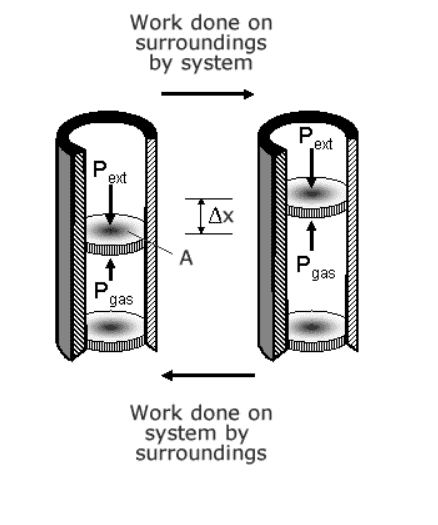
yiwBXz2.png

(I got the image from http://www.splung.com/content/sid/6/page/work)
 

Attachments

  • yiwBXz2.png
    yiwBXz2.png
    11.6 KB · Views: 1,209
Physics news on Phys.org
betelgeuse91 said:
What am I missing?
In the one case it's the fluid that's doing the positive work and in the other it's you, the pusher. So then the fluid does negative work: it exerts a force outwards but the displacement is inward.
 
BvU said:
In the one case it's the fluid that's doing the positive work and in the other it's you, the pusher. So then the fluid does negative work: it exerts a force outwards but the displacement is inward.

If I consider a piston in equilibrium with atmosphere such that it won't move unless I push it or pull it. This case, whichever way I do, won't I be doing positive work? From above formula for work.
 
Correct.
 
betelgeuse91 said:
If I consider a piston in equilibrium with atmosphere such that it won't move unless I push it or pull it. This case, whichever way I do, won't I be doing positive work? From above formula for work.
BvU said:
Correct.

Then either case I am doing positive work. But the above and other text says when volume expands, external work done on the system is negative and vice versa (so the signs of work I do for compression and expansion of gas are opposite). How does this work?
 
betelgeuse91 said:
I am stuck on like the first page of thermal physics. It seems like the signs of the work done on the system are opposite when the volume is expanded and compressed. But when I imagine myself pushing or pulling the piston, I get confused from W = \textbf{F}\cdot \textbf{d}
This work will be positive as the direction of the force and the direction of the displacement of the piston will be the same regardless of the change in volume.

I think you are confused about the direction of the forces...bear with me...

Consider a car jack/lift and define up as positive...

When you raise the car the force applied by the jack is in the same direction as the motion eg both upwards. No problem with that. The work done by the jack s positive.

When you lower the car slowly at constant velocity the jack still applies an upward force on the car but the direction of motion is downwards. The work done by the jack is negative.

Its similar with a piston in a syringe...

If you let the gas push the piston out slowly at constant velocity you will still be applying a push force on the plunger eg opposite to the direction of motion. So the work you do will be negative.

You could pull the piston really fast. But there will be a net force on the piston that causes it to accelerate. You would have to take into account the work done accelerating the piston. Both you and the gas would do positive work.
 
  • Like
Likes   Reactions: BvU
CWatters said:
I think you are confused about the direction of the forces...bear with me...

Consider a car jack/lift and define up as positive...

When you raise the car the force applied by the jack is in the same direction as the motion eg both upwards. No problem with that. The work done by the jack s positive.

When you lower the car slowly at constant velocity the jack still applies an upward force on the car but the direction of motion is downwards. The work done by the jack is negative.

Its similar with a piston in a syringe...

If you let the gas push the piston out slowly at constant velocity you will still be applying a push force on the plunger eg opposite to the direction of motion. So the work you do will be negative.

You could pull the piston really fast. But there will be a net force on the piston that causes it to accelerate. You would have to take into account the work done accelerating the piston. Both you and the gas would do positive work.

This solved the mystery for me... Thank you so much.
 

Similar threads

  • · Replies 5 ·
Replies
5
Views
2K
  • · Replies 8 ·
Replies
8
Views
4K
  • · Replies 5 ·
Replies
5
Views
2K
  • · Replies 15 ·
Replies
15
Views
3K
  • · Replies 9 ·
Replies
9
Views
3K
  • · Replies 1 ·
Replies
1
Views
2K
  • · Replies 1 ·
Replies
1
Views
2K
  • · Replies 77 ·
3
Replies
77
Views
6K
  • · Replies 5 ·
Replies
5
Views
2K
  • · Replies 5 ·
Replies
5
Views
4K