Piston in a tube connected to a vessel filled with air

Click For Summary
SUMMARY

The discussion centers on the dynamics of a piston in a tube connected to a vessel filled with air, where the air behaves as an ideal gas under the condition that the product PV^ζ remains constant. The equation of motion for the piston is derived from the relationship between pressure and volume, specifically using the formula P = P0 (V0/V)^γ. The user seeks clarification on the term [([V][/0]/[V[/y])[/ζ] and the forces acting on the piston from the vessel, indicating a need for deeper understanding of gas laws and piston dynamics.

PREREQUISITES
  • Understanding of ideal gas laws, specifically PV = nRT
  • Familiarity with the concept of adiabatic processes and the constant PV^γ
  • Basic knowledge of differential equations related to motion
  • Experience with fluid mechanics principles, particularly forces on pistons
NEXT STEPS
  • Study the derivation of the ideal gas law and its applications in piston systems
  • Research the principles of adiabatic processes and how they apply to gas behavior
  • Explore the mathematical modeling of piston motion using differential equations
  • Investigate the forces acting on pistons in fluid systems, including pressure differentials
USEFUL FOR

Students and professionals in physics, mechanical engineering, and fluid dynamics who are interested in understanding the behavior of pistons and gases in confined systems.

Ben Harris
Messages
4
Reaction score
1
Hi there, i have been working with a problem the past few days and have a hard time with some of the assumptions being made.
The problem involves a piston in a tube which is connected to a vessel filled with air.
The air behaves as an ideal gas to which the product PV^ζ is a constant.
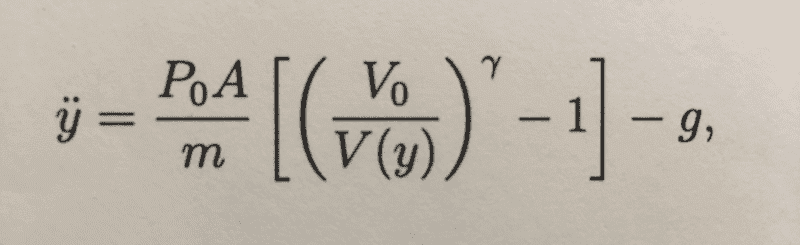
The piston is released from y=0 at t=0 and we are asked to show that the equation of motion for the piston can be expressed as the attached photo shows:
upload_2019-2-3_20-57-39.png


V(y) is gas volume when piston is at y position. There is no friction.

I don't understand what the [([V][/0]/[V[/y])[/ζ] is and how it came to be like this.

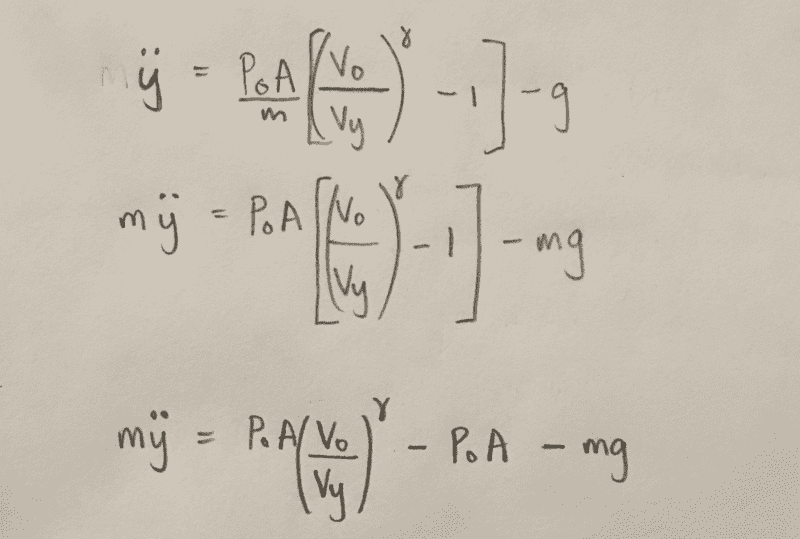
this is where i am at with it:
upload_2019-2-3_21-3-12.png


if you could provide some insight to what the force on the piston from the vessel involves it would be much appreciated.

Thank you :)
 

Attachments

  • upload_2019-2-3_20-57-39.png
    upload_2019-2-3_20-57-39.png
    35.6 KB · Views: 475
  • upload_2019-2-3_21-3-12.png
    upload_2019-2-3_21-3-12.png
    60.5 KB · Views: 541
Physics news on Phys.org
Since ##PV^{\gamma} = const## then $$P_0V_0^{\gamma} = PV^{\gamma} \rightarrow P = P_0 \left( \frac {V_0}{V} \right) ^{\gamma}$$
 
Last edited:
  • Like
Likes   Reactions: Ben Harris

Similar threads

  • · Replies 3 ·
Replies
3
Views
2K
  • · Replies 9 ·
Replies
9
Views
4K
  • · Replies 33 ·
2
Replies
33
Views
4K
Replies
49
Views
4K
  • · Replies 8 ·
Replies
8
Views
3K
  • · Replies 45 ·
2
Replies
45
Views
7K
Replies
8
Views
2K
  • · Replies 5 ·
Replies
5
Views
2K
  • · Replies 67 ·
3
Replies
67
Views
6K
  • · Replies 22 ·
Replies
22
Views
6K