Working out the current and voltage in a circuit

Click For Summary

Homework Help Overview

The discussion revolves around calculating current and voltage in a circuit involving multiple cells connected in various configurations. The original poster is specifically focused on understanding the implications of connecting 12 cells in series versus parallel arrangements, and how these configurations affect the overall current and voltage outputs.

Discussion Character

  • Exploratory, Assumption checking, Problem interpretation

Approaches and Questions Raised

  • Participants explore different configurations of cells (series vs. parallel) and their impact on current and voltage. Questions arise regarding the assumptions made about internal resistance and how it affects the total current. There is a discussion about trial and error in finding the optimal arrangement to achieve a desired current of 5 amps.

Discussion Status

The conversation is ongoing, with participants providing hints and suggestions for further exploration of circuit configurations. Some participants have shared their calculations and results, while others are questioning the relationships between voltage, current, and resistance in different setups. There is no explicit consensus, but several productive lines of inquiry are being pursued.

Contextual Notes

Participants are working under the constraints of a homework assignment, which may limit the information available or the methods they can employ. There is an emphasis on understanding the relationships between the components in the circuit rather than simply arriving at a solution.

Bolter
Messages
262
Reaction score
31
Homework Statement
Calculate the circuit's current and pd across a component
Relevant Equations
Ohm's law
Here are a few problems I have been trying which are shown below

Screenshot 2020-01-23 at 20.46.44.png

Screenshot 2020-01-23 at 20.42.58.png

Screenshot 2020-01-23 at 20.43.02.png

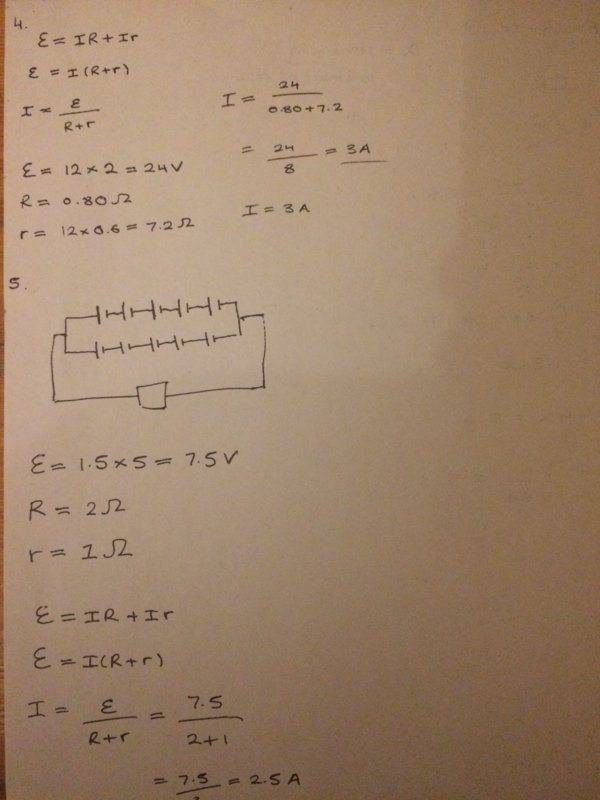
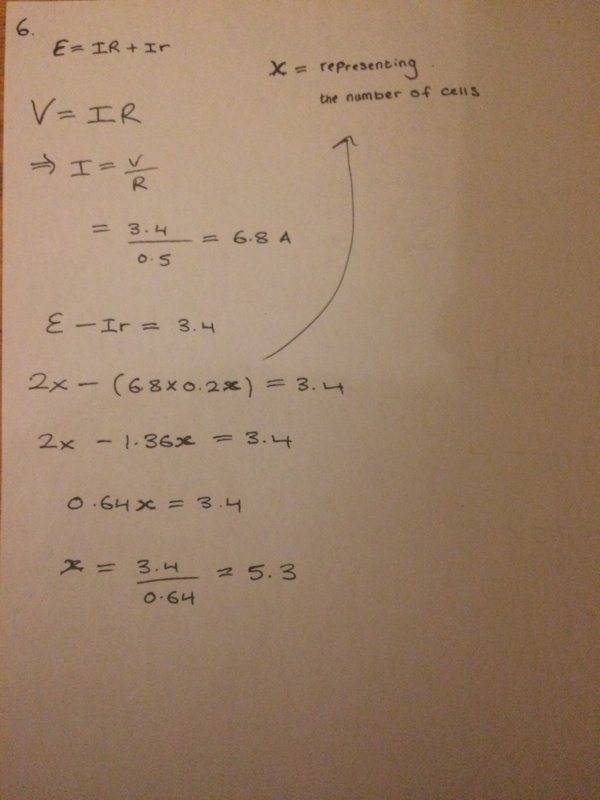
Here is what I have done

IMG_3711.JPG

IMG_3712.JPG


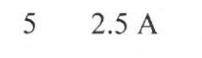
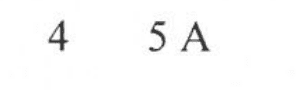
The correct answers for these Q's are:
Screenshot 2020-01-23 at 17.47.36.png

Screenshot 2020-01-23 at 20.43.08.png

Screenshot 2020-01-23 at 20.43.12.png

I'm not sure what I have done wrong for Q4, I assumed that all 12 cells were connected in series thus each individual emf sums up to 24V
Similarly the internal resistances must sum up to 7.2 ohms

Is there anything that I am missing for me to get a current value of 5 amps instead of 3 amps?

Any help would be really appreciated! Thanks
 
Physics news on Phys.org
Bolter said:
I'm not sure what I have done wrong for Q4, I assumed that all 12 cells were connected in series
You just answered your own question.
Bear in mind that if the cells are in series then so are their internal resistances.
 
  • Like
Likes   Reactions: DaveE
Your calculation is correct, given the assumptions you made about the configuration of the circuit elements. Try some other arrangements to see if you've found the best one.
 
DaveE said:
Your calculation is correct, given the assumptions you made about the configuration of the circuit elements. Try some other arrangements to see if you've found the best one.

I believe that the maximum current can only be drawn out when all cells are attached in series, as this is the only way to produce the biggest EMF.
Arranging some or all cells in parallel would give a smaller EMF off

So biggest current has to be 3 amps then?
 
Bolter said:
Similarly the internal resistances must sum up to 7.2 ohms
Hint: this also means that all current has to pass through all internal resistances -- not so favourable.
 
Bolter said:
So biggest current has to be 3 amps then?
Nope :nb)
 
BvU said:
Hint: this also means that all current has to pass through all internal resistances -- not so favourable.

Would this be a case of trial and error in figuring out what configuration the circuit elements must be to give a current of 5A?

So there has to be some parallel arrangement involved I suppose to decrease the total internal resistance since I=V/R, if R gets smaller then surely a bigger current is drawn. However that would also mean the emf, V gets smaller too?
 
Bolter said:
as this is the only way to produce the biggest EMF.
biggest EMF at zero current - you found that 90% of that EMF is lost on internal resistances !
 
Bolter said:
Would this be a case of trial and error in figuring out what configuration the circuit elements must be to give a current of 5A?
Basically: yes. I can't think of a 'golden rule'. In electronics there is somethinig called 'impedance matching', but for this exercise it doesn't work --- [edit] or does it ?

I, for example started with a try of all 12 parallel -- then the internal power loss is minimal, but the final EMF is too low. Fortunately there are only five sensible variations :cool: .
 
  • #10
BvU said:
Basically: yes. I can't think of a 'golden rule'. In electronics there is somethinig called 'impedance matching', but for this exercise it doesn't work --- [edit] or does it ?

I, for example started with a try of all 12 parallel -- then the internal power loss is minimal, but the final EMF is too low. Fortunately there are only five sensible variations :cool: .

I tried one other variation now where the cells are arranged in two parallel rows of 6, and this set up is then in series with the 0.8 ohm resistor

IMG_3713.JPG


I get a new current of 4.62 A which is close to 5 A but not exactly 5 A :frown:
 
  • #11
Keep going ...
You tried 12 x 1 with 24 V, 7.2 ##\Omega## internal resistance and 6 x 2 with 12 V, 1.8 ##\Omega## internal resistance.
I tried 1 x 12 with 2 V, 0.05 ##\Omega## internal resistance. Three down, two to go ...
 
  • #12
BvU said:
Keep going ...
You tried 12 x 1 with 24 V, 7.2 ##\Omega## internal resistance and 6 x 2 with 12 V, 1.8 ##\Omega## internal resistance.
I tried 1 x 12 with 2 V, 0.05 ##\Omega## internal resistance. Three down, two to go ...

Is this some sort of pattern that I'm not seeing?

I tried with 2 more possible set ups
Where one involved 4 parallel rows of 3 cells in series with fixed resistor
and another involved 3 parallel rows of 4 cells in series with fixed resistor

IMG_3714.JPG


IMG_3715.JPG


But the currents that I obtain from both are either 3.6 A or 3.75 A (not close to 5 A)
 
  • #13
These are designated as 2V cells. (!)
 
  • Like
Likes   Reactions: Bolter
  • #14
1579821900987.png


get some rest !
 
  • Like
Likes   Reactions: Bolter and hutchphd
  • #15
Bolter said:
Would this be a case of trial and error
Not entirely.
In posts #10 and #12 you tried rectangular arrangements. You can generalise this to m by n, where mxn=12. It is not hard to figure out the current as a function of m.
 
  • #16
BvU said:
View attachment 256008

get some rest !

Oh shoot yes you're right!
My brain hasn't been processing properly which is why I mistook the value, actually was feeling tired :rolleyes:

I tried with the emf of cell being 2.0 V now and get current to be 4.8 A for the circuit with 4 parallel rows of 3 cells
and 5 A with 3 parallel rows of 4 cells.

So the last configuration must be the one I am looking for to use, to generate a circuit current of 5 A
 
  • #17
haruspex said:
Not entirely.
In posts #10 and #12 you tried rectangular arrangements. You can generalise this to m by n, where mxn=12. It is not hard to figure out the current as a function of m.

Right I now see, so all possible combinations I could have used are:

12 cells all in series
2 parallel rows of 6 cells
4 parallel rows of 3 cells
3 parallel rows of 4 cells
6 parallel rows of 2 cells

And then finally all 12 cells in parallel with each other so we have 12 rows then

so for mxn=12

I know m denotes the number of branches
and n denotes the number of cells in that branch

What do you mean when you say current can written as a function of m

I know that in parallel arrangements, current is known to split when it comes to an entry junction however same amount of current must leave at exit junction too. This is just Kirchhoff's 1st law that I am stating.

Looking at my case, I believe I will have equal amount of current flowing through all branches. This is since I'm dealing with identical cells all which has same number of cells on each branch. Current has to shared proportionately from resistance available in each row, right?

Is this the sort of information I have to use to formulate a function of m to give current?
 
Last edited:
  • #18
And it so happens that in the 4 x 3 case the internal impedance is 0.8 ##\Omega## ...
Must be more than just a coincidence ...
 
  • Like
Likes   Reactions: hutchphd
  • #19
BvU said:
And it so happens that in the 4 x 3 case the internal impedance is 0.8 ##\Omega## ...
Must be more than just a coincidence ...

Yep, should really look into this. Would come into be nifty at times
 
  • #20
Bolter said:
What do you mean when you say current can written as a function of m
Let the current in each branch be I and end to end voltage be V.
If the external resistance is R, what equation relates V, I, m and R?
If the internal resistance is r and the internal voltage is v, what equation relates V, v, n, I and r?
 
  • Like
Likes   Reactions: BvU
  • #21
haruspex said:
Let the current in each branch be I and end to end voltage be V.
If the external resistance is R, what equation relates V, I, m and R?
If the internal resistance is r and the internal voltage is v, what equation relates V, v, n, I and r?

Looking at the whole circuit, isn't external resistance R just R = V/I. I can't see how m gets related

And focusing on one single branch, where let's say there are 'n' number of cells in that branch

v = nIr
so V + v = IR + nIr = I (R + nr)

Edit: Is V = mIR?

As a same current I, is flowing through 'm' number of branches, all these currents then get combined at the the end of a node to produce a current of mI. Thus R = V/mI
 
Last edited:
  • #22
Bolter said:
v = nIr
No. In each cell in the line you have an emf of v partly used up by the emf needed to push a current I through internal resistance r.
But it isn't all used up or V would be 0.
Bolter said:
Is V = mIR?
Yes.
 
  • #23
haruspex said:
No. In each cell in the line you have an emf of v partly used up by the emf needed to push a current I through internal resistance r.
But it isn't all used up or V would be 0.

Yes.

Hmm ok so terminal voltage (V) + lost volts (v) = emf

Then v = emf – V

v = emf – mIR

I would express emf as 2n, where 2 is the emf of a single cell and 'n' is the number of cells in that line

Therefore v = 2n – mIR?
 
  • #24
Bolter said:
Hmm ok so terminal voltage (V) + lost volts (v) = emf

Then v = emf – V

v = emf – mIR

I would express emf as 2n, where 2 is the emf of a single cell and 'n' is the number of cells in that line

Therefore v = 2n – mIR?
No, I defined v as the nominal voltage (2 Volts) of each cell. Of that, Ir is lost in each cell leaving ...? Adding that up for the line of n cells gives ...? Which is equal to what other variable?
 
  • Like
Likes   Reactions: Bolter
  • #25
haruspex said:
No, I defined v as the nominal voltage (2 Volts) of each cell. Of that, Ir is lost in each cell leaving ...? Adding that up for the line of n cells gives ...? Which is equal to what other variable?

So it should be nv – nIr = V

factoring out n gives n(v – Ir) = V
 
  • #26
Bolter said:
So it should be nv – nIr = V

factoring out n gives n(v – Ir) = V
Right.
Combine that with your other equation for V to get mI (the total current) in terms of n, m, v, r and R.
 
  • #27
haruspex said:
Right.
Combine that with your other equation for V to get mI (the total current) in terms of n, m, v, r and R.

Combining it, I get this,
where I do get 5A once I let m = 3 and n = 4

IMG_3721.JPG
 
  • #28
Bolter said:
Combining it, I get this,
where I do get 5A once I let m = 3 and n = 4

View attachment 256077
Yes, but better still you can avoid having to guess. How do you find the maximum of a function?
 
  • Like
Likes   Reactions: Bolter
  • #29
haruspex said:
Yes, but better still you can avoid having to guess. How do you find the maximum of a function?

Work out the first order derivative of that function and equate it to zero. Though don't we have 2 unknowns in the function which are m and n? so you couldn't find either?
 
  • #30
Bolter said:
Work out the first order derivative of that function and equate it to zero. Though don't we have 2 unknowns in the function which are m and n? so you couldn't find either?
The product mn is fixed, so there is only one independent variable.
 

Similar threads

  • · Replies 3 ·
Replies
3
Views
2K
  • · Replies 10 ·
Replies
10
Views
1K
Replies
9
Views
1K
  • · Replies 42 ·
2
Replies
42
Views
6K
Replies
3
Views
2K
Replies
7
Views
1K
Replies
9
Views
1K
  • · Replies 8 ·
Replies
8
Views
3K
  • · Replies 2 ·
Replies
2
Views
1K
  • · Replies 12 ·
Replies
12
Views
3K