Would space stations of sci-fi fame actually work?

Click For Summary
SUMMARY

The discussion confirms that spinning space stations can create artificial gravity through centrifugal force, effectively allowing astronauts to experience a force similar to gravity. Key points include the necessity for astronauts to be secured to the station to avoid floating away and the importance of the station's size and rotational speed. A proposed design with a 30-meter radius and a rim speed of 10 meters per second would generate an apparent surface acceleration of approximately 3 meters per second, akin to Mars' gravity. The conversation references the mechanics of motion within such a station, including the effects of speed on perceived weight.

PREREQUISITES
  • Understanding of centrifugal force and its application in artificial gravity
  • Familiarity with basic physics concepts such as acceleration and motion
  • Knowledge of space station design principles and constraints
  • Awareness of the differences between microgravity and artificial gravity environments
NEXT STEPS
  • Research the engineering challenges of building rotating space stations
  • Explore the effects of centrifugal force on human physiology in space
  • Investigate existing proposals for artificial gravity systems in space habitats
  • Learn about the physics of motion in rotating reference frames
USEFUL FOR

Aerospace engineers, physicists, space station designers, and anyone interested in the practical applications of artificial gravity in space exploration.
F Mills
Messages
8
Reaction score
0
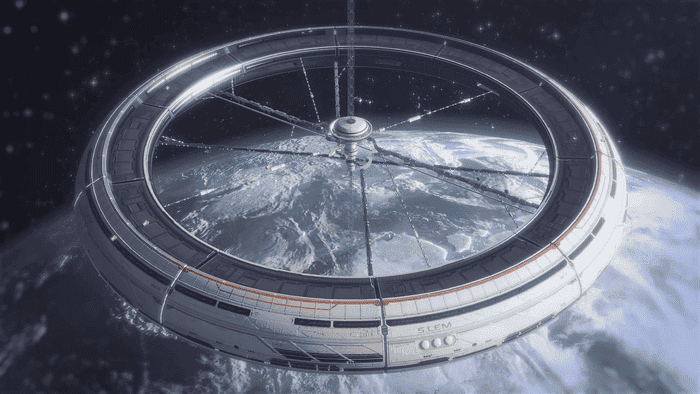
Would a spinning space station as depicted below that use centrifugal force to create artificial gravity actually work? I'm thinking that it would not, this is because the centrifugal force would not affect an astronaut inside unless he was actually fastened mechanically to the hub. The fact that it is only used in sci fi and not sci reality is another indication to me that it is not viable as an artificial gravity tool for space station inhabitants.


latest?cb=20151110142655.png
 
Physics news on Phys.org
jedishrfu said:
Yes, it would work. Think of why water stays in a bucket as you spin it around.

Wikipedia as more on it:

https://en.wikipedia.org/wiki/Artificial_gravity

So i found an acceptable subject, good. I do think of it as water in a bucket, but the water in question is in zero (or micro) G. I see it as an astronaut just floating around while the space station walls are spinning around him. I just noticed you have a link, I have to post to be able to look at it. BRB
 
Still nothing to make astronaut adhere to surface. If you are buckeled into a seat on the inside of the hub, and forced to spin with the hull, I can see you experience G at that point. Otherwise unattached you would float off the surface as it spun.
 
F Mills said:
but the water in question is in zero (or micro) G
In the spinning bucket it is not.

The astronaut would have to move around with the station, sure. What else do you expect? You don't want to shoot through the space station at high speed (as seen by the astronaut). If the astronaut moves relative to the station at high speeds, they will experience a higher or lower effective gravity, depending on the direction. Typical space station designs for artificial gravity are so large that this effect is small for walking speeds. And if you stand on the outer surface, you feel the artificial gravity downwards, you don't need any attachment.

Existing space stations don't rotate because (a) this requires some minimal size to be useful, and this size exceeds the current space stations, (b) it is much more complex to build such a space station and (c) most space station experiments want to use the microgravity environment. A small-scale test setup was planned for the ISS but got canceled due to budget constraints. Here is another proposal.
 
  • Like
Likes   Reactions: F Mills
Thanks
 
Put simply, you would need a lateral force on the astronaut to get her spinning with the spaceship. But, once the spaceship and astronaut reach the required rotational speed, only a centripetal force is required to maintain the astronaut's circular motion. And, that force would feel much like gravity.
 
  • Like
Likes   Reactions: F Mills
PeroK said:
Put simply, you would need a lateral force on the astronaut to get her spinning with the spaceship.
Consider the movie "2001: A Space Odyssey", which has a large rotating living-chamber inside a non-rotating spaceship. Astronauts enter the chamber from the rest of the ship via the axis and climb "down" a ladder towards the rim. Holding the rungs of the ladder provides the lateral force.
 
  • Like
Likes   Reactions: F Mills
 
  • Like
Likes   Reactions: F Mills and mfb
  • #10
If there is air inside the space station then that air will move with the station. Otherwise it tends to swirl around light fixtures, doors and desks and gains speed in the process. If there are astronauts floating in the moving air then they tend to move with it. Otherwise it tends to muss their hair and speed them up in the process.

Like motes of sediment suspended in water in a test tube in a centrifuge, the astronauts then precipitate out onto the floor.
 
  • Like
Likes   Reactions: F Mills
  • #11
Consider a station with a 30 meter radius, and rotational speed at the rim of 10 meters per second. This would have an apparent surface acceleration of v^2/r = 10^2/30 or about 3 meters per second. Roughly Mars surface.

10 meters per second is roughly 22 mph.

Now put a bicycle track inside the station. If I ride at 22 mph with the direction of motion, I double my weight. If I ride against the rotation, I lesson my weight. Put a jump in place and do awesome tricks.
 
  • #12
Sherwood Botsford said:
If I ride at 22 mph with the direction of motion, I double my weight.
Acceleration scales with velocity squared. You experience 4g, which is quite uncomfortable.
 
  • #13
Good point. But it would be 4 times the effective non moving (relative to the local chunk of station) force or about 1.3 G.
 
  • #14
Ah, you took a Mars-like gravity as baseline, right.
1.3 g are fine.
 

Similar threads

  • · Replies 28 ·
Replies
28
Views
6K
  • · Replies 35 ·
2
Replies
35
Views
3K
  • · Replies 159 ·
6
Replies
159
Views
15K
  • · Replies 3 ·
Replies
3
Views
2K
  • · Replies 11 ·
Replies
11
Views
2K
  • · Replies 19 ·
Replies
19
Views
5K
Replies
9
Views
4K
  • · Replies 4 ·
Replies
4
Views
2K
  • · Replies 5 ·
Replies
5
Views
4K
  • · Replies 3 ·
Replies
3
Views
2K