New Reply

Finding mass within a pulley system. Finding coefficient of friction

 
Share Thread Thread Tools
Oct11-11, 12:18 AM   #1
 

Finding mass within a pulley system. Finding coefficient of friction


Ok so I'm in college upgrading, and doing my physics 20. I have a hand in assignment due Wednesday and I can't for the life of me figure out these two questions.

6. The 4.0kg block shown accelerates across a frictionless horizontal table at 1.5m/s2.
Find the mass of object m1
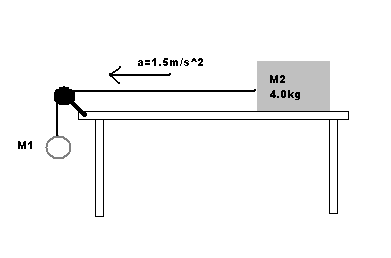
A. 0.61kg B. 0.72kg C. 6.0kg D. 26kg

For m1 I have: FN=Fg. Fg=mg, so 39N. FT-0(no Ff)=ma . So FT is 6.0N. And then I'm lost.


8. A 45kg toboggan and rider decelerate on level show at 0.53m/s2. What is the coefficient of friction between the toboggan and the snow?

A. 0.012 B. 0.054 C. 0.22 D. 0.53

I got that FN=Fg. Fg=mg so 441.45N(rounded to 2SD). Fnet=ma so 24N. And then I'm lost. I know that μ=Ff/FN

Someone help me please!
 
PhysOrg.com
PhysOrg
science news on PhysOrg.com

>> Heat-related deaths in Manhattan projected to rise
>> Dire outlook despite global warming 'pause': study
>> Sea level influenced tropical climate during the last ice age
Oct11-11, 12:41 AM   #2
 
Recognitions:
Homework Helper Homework Help
You have a combined mass of M1 + M2 being accelerated (together). Write an equation for the force that is needed to accelerate such a mass.
 
Oct11-11, 12:44 AM   #3
 
I got the mass...I think. FT=ma. 6.0N=m1(9.81m/s2) So m1=0.6112kg

Now for the other one...
 
Oct11-11, 12:58 AM   #4
 

Finding mass within a pulley system. Finding coefficient of friction


Quote by Serendipitydo View Post
I got the mass...I think. FT=ma. 6.0N=m1(9.81m/s2) So m1=0.6112kg

Now for the other one...

---
Ok I think I solved it. Ff is Fnet in the direction of acceleration? So since it's decelerating, wouldn't it accelerate in the direction of the friction?

So Ff=ma
Ff=24N

μ=Ff/FN
μ=24N/441N
μ=0.05442
 
Oct11-11, 02:14 AM   #5
 
Recognitions:
Homework Helper Homework Help
Quote by Serendipitydo View Post
I got the mass...I think. FT=ma. 6.0N=m1(9.81m/s2) So m1=0.6112kg

Now for the other one...
Not so fast. You haven't got this one right, yet. You must determine the force needed to accelerate the combined masses, since they accelerate together.
 
Oct11-11, 11:55 AM   #6
 
Quote by NascentOxygen View Post
Not so fast. You haven't got this one right, yet. You must determine the force needed to accelerate the combined masses, since they accelerate together.
But I only need the mass of the one.
 
Oct11-11, 01:31 PM   #7
 
Mentor
Quote by NascentOxygen View Post
You have a combined mass of M1 + M2 being accelerated (together). Write an equation for the force that is needed to accelerate such a mass.
NascentOxygen has asked you this question for a reason. Answering it will help you answer the question asked in the problem. More importantly, it should help you understand how to approach such a problem in general.
 
Oct11-11, 04:42 PM   #8
 
Quote by SammyS View Post
NascentOxygen has asked you this question for a reason. Answering it will help you answer the question asked in the problem. More importantly, it should help you understand how to approach such a problem in general.
I'm not having problems with the others, just when I need to find a mass with minimal info.
Fg1-FT=ma
Use the total mass of the system. The difference of force of gravity and tension on the rope would be the net force acting on the system.
 
Oct12-11, 04:31 AM   #9
 
Recognitions:
Homework Helper Homework Help
The question supplies all the information you need. You have a mass (M1 + M2) being accelerated. The force that is causing the acceleration is the weight of M1.

One equation, one unknown.
 
Oct12-11, 04:44 AM   #10
 
Recognitions:
Homework Helper Homework Help
Quote by Serendipitydo View Post
---
Ok I think I solved it. Ff is Fnet in the direction of acceleration? So since it's decelerating, wouldn't it accelerate in the direction of the friction?

So Ff=ma
Ff=24N

u=Ff/FN
u=24N/441N
u=0.05442
That looks right.
 
Oct12-11, 11:15 AM   #11
 
Thanks for your help. I tend to overthink these things
 
New Reply
Thread Tools


Similar Threads for: Finding mass within a pulley system. Finding coefficient of friction
Thread Forum Replies
Finding Mass of Block from Friction Coefficient Introductory Physics Homework 2
Finding coefficient of friction and the mass Introductory Physics Homework 6
Finding stopping distance given coefficient of kinetic friction and mass Introductory Physics Homework 1
finding mass and acceleration? (deals with coefficient of static friction) Introductory Physics Homework 0
Finding kinetic coefficient of friction (pulley involved) Introductory Physics Homework 1