How exactly does convection motion start?

Join the discussion
Registration is free. Ask a follow-up in this thread, or start your own.
21 replies · 2K views
aletheia
Messages
42
Reaction score
12
TL;DR
Colder mass has more density and sinks while hotter mass has less density therefore it raises, but where exactly do the convection cycle begins?
I’m having trouble understanding how exactly non-equilibrium heat-transfer initiates convection, whether or not phase change is involved.

Consider the following experiments.

First: heating soy oil in a glass kettle on a regular gas stove; 4 probes — at the bottom, midway, near the surface inside the oil, and in the air above the oil (as in the image below); turn the fire on and follow the changes in temperature.
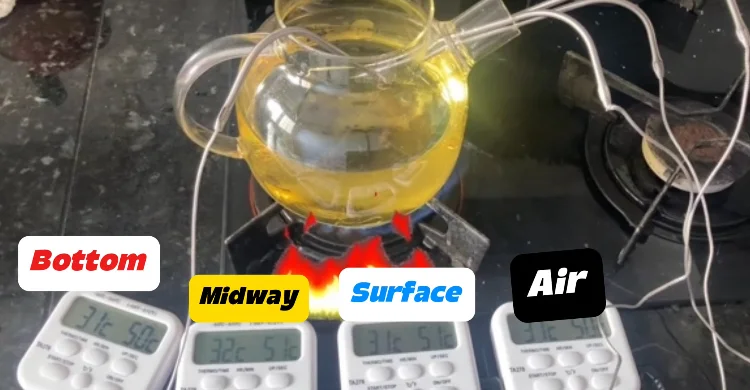
IMG_4127.webp

I was expecting that the bottom would lead — i.e., the temperature at the bottom, specially during active heating, would be hotter than the temperature at the surface.
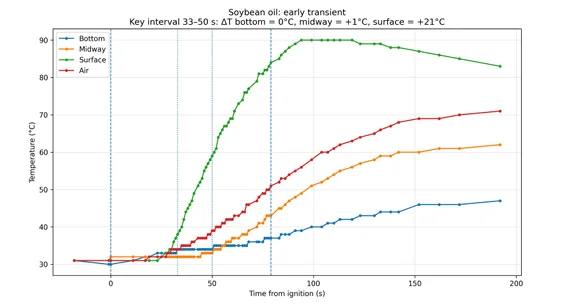
I plotted the dynamics on a chart:
Captura de tela 2026-09-19 193811_Original.webp


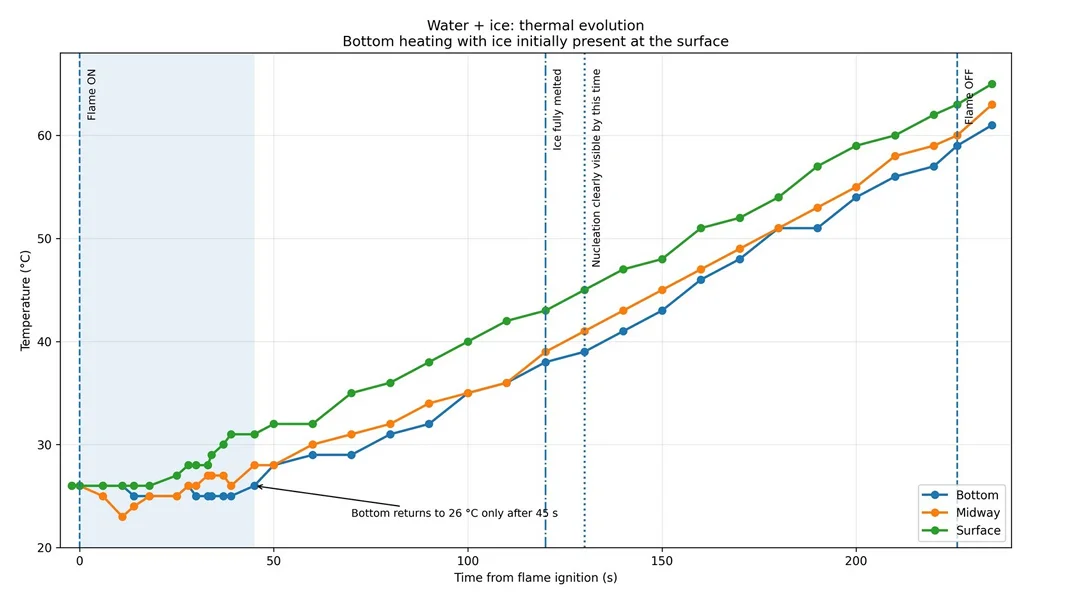
Second: same stove-kettle setup, 3 probes (bottom, midway, and surface, as in the image below), ice on the surface and fire on simultaneously; here again my naive expectative was that the button, directly receiving the heat from the fire would be hotter than the surface, especially while having ice still floating on the surface.
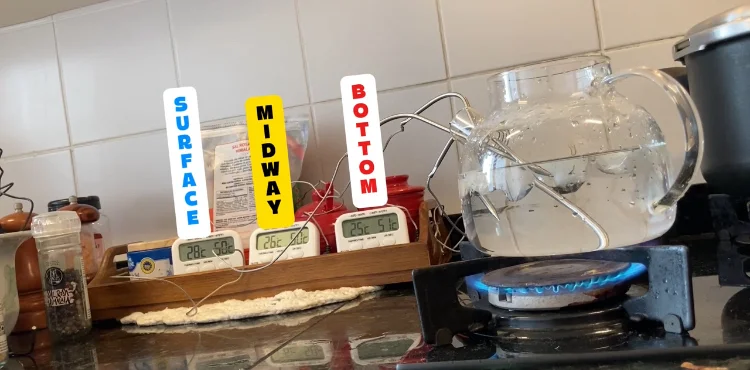
IMG_4128.webp

The data is on the chart below:
Captura de tela 2026-09-19 193921_Original.webp


I have obviously repeated the experiments with different containers, different types of probes, etc., and the results were qualitatively similar.

Could someone explain how this dynamic happens?

The videos of the experiments are at the links below:
Soy oil
Water & Ice
 
Physics news on Phys.org
Dale said:
The best bet for seeing convective motion is to use a drop of ink or food coloring in the liquid.
I’ve been doing it and it is indeed good for seeing the motion, specially in oil, but my doubt is more about where the cycle begins, because, visually and from the data from the thermometers, it makes me wonder if it starts by colder mass sinking before hotter mass rises, but that doesn’t seem right, or does it?
 
The fluids are pretty incompressible. So sinking and rising will be essentially simultaneous (to within the size of the container divided by the speed of sound within the fluid which is less than ##1\mathrm{\ ms}##)
 
It may not be exactly what you asked about, but note that onset of natural heat convection (instead of conduction) occurs at rather low temperature gradients (say, 10 K/m) so in your setup it would be reasonably to assume convection is ongoing all the time after heater is turned on, even If you start out with water, jar, stove and air all at same temperature. The change-over to convection flow is characterized by the Rayleigh number so for actual calculations matching your setup you may want to look into this.
 
Filip Larsen said:
The change-over to convection flow is characterized by the Rayleigh number so for actual calculations matching your setup you may want to look into this.
I’ll dig into it — thanks for the suggestion.
@Dale
I appreciate your attention and I apologize if my doubts seem naive.

I understood that the convection cycle is at motion at the very moment the heat source is turned on, and that the motion upward and downward start also simultaneously, nevertheless, I still have a very basic doubt: is it the colder mass that displaces the hotter mass upwards or is it the hotter mass that displaces the colder mass downwards?

Both possibilities can result in a convection cycle, but their causality would be antagonistic.
 
aletheia said:
... nevertheless, I still have a very basic doubt: is it the colder mass that displaces the hotter mass upwards or is it the hotter mass that displaces the colder mass downwards?
Without the energy transferred from the hot source into the cold liquid, there would not be the localized change of density; therefore, no convective movement withing the mass of liquid would be induced.

Note that the internal movement or mixing depends on the location of the heat source.
Relocating the heat source to the surface harmonizes the internal forces induced by thermal energy gain and gravity: the hotter and less dense superficial mass tends to "float" above the colder mass and to remain in its original location.

Reading about stratification in nature may help you understand its oposite:
https://en.wikipedia.org/wiki/Stratification_(water)

:cool:
 
aletheia said:
I still have a very basic doubt: is it the colder mass that displaces the hotter mass upwards or is it the hotter mass that displaces the colder mass downwards?
This is a false dichotomy. Both happen at the same time. Remember, this isn't spatially uniform, some places will have hotter mass going up and others will have colder mass going down.

You should read up on Rayleigh-Benard convection and the associated Rayleigh-Benard instability.

aletheia said:
their causality would be antagonistic
Causal signals in this scenario will propagate at the speed of sound in the fluid. So, to address that topic you would need to be able to make measurements at the 10's or 100's of kilohertz temporal resolution. And you would also need a spatial resolution substantially smaller than the size of the convection cells. There is simply no way that you can investigate the causality with the current setup. You would probably also need to measure other variables besides just temperature.
 
Last edited:
Ok, I understand that it may not be very simple to determine the outcome quantitatively from this setup, nevertheless, qualitatively, I would expect, in the case of the fire-water-ice experiment, for instance, that, while having ice on the surface and heat from beneath, that the temperature at the bottom would be hotter than the temperature at the surface.
Captura de tela 2026-09-22 005249_Original.webp

Whereas the bottom probe was placed directly where the flame touches the glass, the surface probe was at the center surrounded by ice.
At t=0s, all 3 probes read 26C, when simultaneously ice was put on the surface and the fire was ignited.
At t=45s, the bottom, after initially dropping 1C, returned to 26C, whereas the surface never dropped below the initial reading and had risen by 5C (i.e., reading 31C).
Captura de tela 2026-09-19 193921_Original.webp

As the chart shows, despite the heat entering the system from beneath, and despite colder mass (i.e., the ice cubes) was floating on the surface, the temperature at the surface remained hotter than the bottom the whole time.

I know that this is not an exception that only happens in this specific setup because I have tested different types of containers, different types of liquids and several different types of probes/thermometers — and the qualitative outcome, i.e., heating from beneath makes the bottom colder; so, why is that?
Captura de tela 2026-09-19 193811_Original.webp

Using oil makes this discrepancy even greater as even the air above the oil is significantly warmer than the region where the heat enters to the oil — in that case, in 79s of flame, the bottom rose from 30C to 37C, whereas the surface rose to 84C (Δsb=+47C) and even the air above the oil rose to 51C.
Before looking at the results, is that what you would have predicted (qualitatively) to happen?
If so, based on what specifically?
 
aletheia said:
I understand that it may not be very simple to determine the outcome quantitatively from this setup
Did you even calculate the Rayleigh number from the page I pointed you to? How can you expect to determine things quantitatively if you don’t calculate the relevant quantities?

aletheia said:
simultaneously ice was put on the surface and the fire was ignited
The placing the ice makes the early evolution mechanical rather than thermal.

aletheia said:
Using oil makes this discrepancy even greater
Actually, the oil shows exactly what I would have expected. Before convection sets in you briefly see the bottom layer being the hottest. Then convection sets in and draws the hot oil to the top.

This feature is barely at the limit of your experimental setup for oil. For the less viscous water and with the initial mechanical effects, it is not surprising that you miss it entirely there.

Here is a more detailed paper on the topic: https://courses.physics.ucsd.edu/2019/Winter/physics116_216/Berge and Dubois convection_W17.pdf

You should work through that paper, calculating the relevant quantities for your oil setup. In particular, the dimensionless parameters, and any length or time scales. I would focus on the oil due to the mechanical agitation of the ice

aletheia said:
Before looking at the results, is that what you would have predicted (qualitatively) to happen?
If so, based on what specifically?
For the oil, yes. For the water I think that the viscosity is too low and the initial agitation is too great to see the same features with your setup.
 
Last edited:
If you want to visualizing convection (and not so much the resulting turbulent mixing flow) in a bottom-heated fluid "stack" you may want to simply get your hand on a lava lamp. I am not aware of the precise mix of fluids normally used in these or the exact range of Rayleigh numbers achieved going from cold (non-convective) to full heated convective state, but I would be surprised if that range does not indeed cover the onset of convection as I understand you want to measure and visualize. It may even be you can put a electric damper on the bulb in order to fine-tune the effective Rayleigh number to be close to the change-over point.
 
aletheia said:
Could someone explain how this dynamic happens?

The videos of the experiments are at the links below:

Something that hasn't yet been mentioned but that may be relevant- what is the thermal conductivity of your glass kettle? I expect somewhat somewhat conductive, otherwise it would not be a good kettle....
 
In addition to the excellent posts above:

Ice is floating in hot water because it has no other option, it is the less dense actor in there.

Simultaneously, it is absorbing heat from (and therefore reducing the temperature of) the water and the air that is surrounding it.

The recoded temperatures could be different if the three probes were located exactly along a vertical line.

In the following video, the white color represents water at higher temperature than the one represented by yellow.
Note how the most superficial layer is cooled by the air, and how the water melting from the ice immediately sinks.
In this case, the mass of ice/water rate seems to be smaller than the one in your experiment, which greatly reduces the melting time.


Last edited:
I think @Lnewqban has it right; the water at the base gets replaced rapidly and mixed with adjacent cooler water whilst the warmer water that rises tends to accumulate at the top, especially if the heating is slow rather than fast enough to cause vigorous overturning and mixing through the whole container.
 
aletheia said:
TL;DR: Colder mass has more density and sinks while hotter mass has less density therefore it raises, but where exactly do the convection cycle begins?

I’m having trouble understanding how exactly non-equilibrium heat-transfer initiates convection, whether or not phase change is involved.

Consider the following experiments.

First: heating soy oil in a glass kettle on a regular gas stove; 4 probes — at the bottom, midway, near the surface inside the oil, and in the air above the oil (as in the image below); turn the fire on and follow the changes in temperature.
View attachment 374222
I was expecting that the bottom would lead — i.e., the temperature at the bottom, specially during active heating, would be hotter than the temperature at the surface.
I plotted the dynamics on a chart:
View attachment 374223
as far as I can tell that is what is happening. The bottom temperature is leading during the transient phase while a significant the thermal gradient is being established ( its penetrating depth is ## x \propto \sqrt{\alpha t } ## ). Initially ( 0s - 25 s ) Your blue line is climbing while your green line is flat. The mass of the water involved in the free convection is growing during this period ( from the bottom up as teh boundary layer grows) but in/around the 25 second mark the effects of free convection are beginning to register at the surface. They have been established throughout the entire mass of the fluid, and begin to dominate the thermal effects.

Thats my take?
 
Last edited:
I’d like to thank everyone so far — it’s being pretty helpful for my understanding of thermodynamics and I really appreciate your attention.
Nevertheless, non-equilibrium thermodynamics requires a much better understanding for someone to understand its causality.
With that in mind, I design another relative simple experiment that I’d like your thoughts about it:
A block of butter 🧈 (as in the image below) is placed on a leveled stainless steel at the furthest (about 15cm) point from the region where the flame 🔥 hits the pan from below.
BUTTER_Original.webp

My question here is:
what mainstream literature must be used in order to predict if the butter will mostly melt where it is hotter (i.e., on the red circle) or if will mostly melt on its original position (i.e., the yellow circle)?

Roughly what I’m trying to understand is if the heat would simply be dissipated towards the cold butter and the butter would melt there and, obviously, spread itself through the pan from there, or if an active heat source could pull the butter towards it?

As in the red and yellow arrows, what would be expected: the red arrow — i.e., the hot from the flame reaches the butter and it melts there —, or the yellow arrow — i.e., when the heat reaches the butter, the butter is pulled/attracted by the heat?
 
I don't think that the motion of a pat of butter has anything to do with thermodynamics, that will just be Newtonian mechanics. That will have to do with how level your pan is as it heats up unevenly. There will always be some error in the leveling when cold, and when it heats up unevenly that will perturb the cold leveling.
 
  • Agree
  • Like
Likes   Reactions: erobz and Bystander
Dale said:
I don't think that the motion of a pat of butter has anything to do with thermodynamics, that will just be Newtonian mechanics. That will have to do with how level your pan is as it heats up unevenly. There will always be some error in the leveling when cold, and when it heats up unevenly that will perturb the cold leveling.
I totally understand your point and I partially agree: thermodynamics, as a field of physics, is not the (sole) determinant here — there will be other important correlate fields, e.g., solid conduction in steel, phase change in the butter, capillarity, wetting hysteresis, geometry, gravity, etc., —, nonetheless, I still beg to disagree, since the dynamics of the butter pat will be determined by the "thermo", but ok, I know I'm theoretically wrong (i.e., it's not about thermodynamics).

Anyway, which physics specialty must be used to deal with this prediction was also one branch of my question; so forget the term thermodynamics for a moment and help me reason on the issue.

Assume a perfect flat leveled pan — the prediction from mainstream physics (whichever area of physics must be consulted) for the outcome should be:
butter2_Original.webp

would the butter melts from its start position (red arrows) or would it be pulled towards the hotter region first and then melt there (blue arrows)?
 
aletheia said:
Assume a perfect flat leveled pan
That isn’t a reasonable assumption to allow for a kitchen experiment. The pan is not perfectly flat and will not be perfectly level. And by heating it unevenly it will distort further.

Butter can slide any direction, whichever direction is downhill, regardless of which direction the heat source is. It could be towards or away from the hotter region or any other direction.
 
Last edited:
aletheia said:
I totally understand your point and I partially agree: thermodynamics, as a field of physics, is not the (sole) determinant here — there will be other important correlate fields, e.g., solid conduction in steel, phase change in the butter, capillarity, wetting hysteresis, geometry, gravity, etc., —, nonetheless, I still beg to disagree, since the dynamics of the butter pat will be determined by the "thermo", but ok, I know I'm theoretically wrong (i.e., it's not about thermodynamics).

Anyway, which physics specialty must be used to deal with this prediction was also one branch of my question; so forget the term thermodynamics for a moment and help me reason on the issue.

Assume a perfect flat leveled pan — the prediction from mainstream physics (whichever area of physics must be consulted) for the outcome should be:
View attachment 374557
would the butter melts from its start position (red arrows) or would it be pulled towards the hotter region first and then melt there (blue arrows)?
The butter is experiencing a force ( frictional) that is holding it in place against basically imperceptible elevation gradient ( a bubble level measurement ) and/or temperature gradients are changing the pans geometry as its heated asymmetrically. When the heat reaches the butter pad, it begins a phase change to liquid butter at interface. An effective lubricant (melted butter) is now between the unmelted butter and the pan. That friction force that was holding it in place now decreases, and it goes where gravity, and the viscous shear forces allow it via Newtons Second Law.
 
Dale said:
Butter can slide any direction, whichever direction is downhill, regardless of which direction the heat source is.
@erobz
Ok. So we can assume that the butter shouldn’t melt upwards, i.e., against gravity (assuming that the heat source is at a higher gravitational position)?
 
aletheia said:
@erobz
Ok. So we can assume that the butter shouldn’t melt upwards, i.e., against gravity (assuming that the heat source is at a higher gravitational position)?
Not sure I completely follow, but the butter will not slide uphill once it gets a layer of melted butter beneath it. In your experiment, when you exaggerate the incline of your pan (such that the heat source is higher like shown) do you observe the butter pad climb from the bottom of the pan toward the heat source as it melts?

1791311838852.webp