Circuit Analysis for Power Transmission Network Question

Click For Summary
SUMMARY

The discussion centers on the concepts of lossless networks and the use of complex conjugates in power calculations within power transmission systems. A lossless network is defined as one that contains no resistances, allowing it to store and release energy without any loss. The power flow is expressed as Re[Vi(t) Ii,k(t)*] to ensure the correct phasor angle for power calculations, which involves using the complex conjugate of the current to account for the power factor angle. This ensures accurate representation of real and reactive power in the system.

PREREQUISITES
  • Understanding of phasor representation in electrical engineering
  • Knowledge of complex numbers and their conjugates
  • Familiarity with power factor concepts
  • Basic principles of reactance and susceptance in electrical networks
NEXT STEPS
  • Study the principles of lossless networks in electrical engineering
  • Learn about the significance of complex conjugates in power calculations
  • Explore the relationship between power factor and phasor angles
  • Investigate the differences between real power and reactive power in AC circuits
USEFUL FOR

Electrical engineers, students studying circuit analysis, and professionals involved in power transmission network design and optimization.

Constantinos
Messages
80
Reaction score
1
Hey!

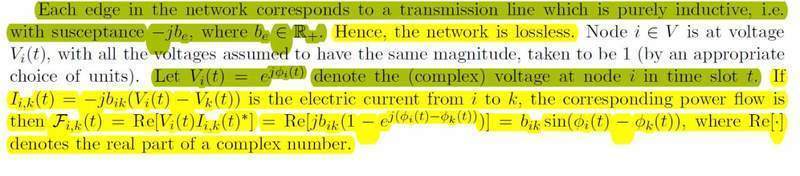
Below you will find a piece of text I found on a paper. There are some things I don't get, perhaps you could help me.

What it means for the network to be lossless?
Also, why is the power flow equal to Re[Vi(t) Ii,k(t)*] and not outright Vi(t)*Ii,k(t) ? Why the complex conjugate?

I get the math, but not the definitions really!
attachment.php?attachmentid=46400&stc=1&d=1334832268.jpg


Attachments

  • Image.jpg
    Image.jpg
    29.3 KB · Views: 520
Physics news on Phys.org
A lossless network contains no resistances, so no real energy can be lost by that network (remember that reactances only store and release energy without loss).

The complex conjugate of the current is used in order to get the phosor angle correct for the power. It has to do with how phasors are multiplied.

Suppose:
##V = |V| \angle \phi_v##
##I = |I| \angle \phi_i ##

Multiplying:
##V I = |V||I| \angle \phi_v + \phi_i##

However, for the power we should have the angle corresponding to the power factor:

##\phi_v - \phi_i = \phi~~~~##

So we need to invert the sign of the current angle, hence the complex conjugate is taken.
 
gneill said:
A lossless network contains no resistances, so no real energy can be lost by that network (remember that reactances only store and release energy without loss).

Ah yes I see, having susceptance means it also has reactance (I forgot about that).

gneill said:
The complex conjugate of the current is used in order to get the phosor angle correct for the power. It has to do with how phasors are multiplied.

Suppose:
##V = |V| \angle \phi_v##
##I = |I| \angle \phi_i ##

Multiplying:
##V I = |V||I| \angle \phi_v + \phi_i##

However, for the power we should have the angle corresponding to the power factor:

##\phi_v - \phi_i = \phi~~~~##

So we need to invert the sign of the current angle, hence the complex conjugate is taken.

I'm not sure I understand. Why would we need the angle of the power factor and not the angle of power itself? By power factor I assume you mean this correct?
 
Constantinos said:
I'm not sure I understand. Why would we need the angle of the power factor and not the angle of power itself? By power factor I assume you mean this correct?

If you expand VI* then:

##V I^* = |V||I| \angle \phi = |V||I| cos(\phi) + j|V||I| sin(\phi)##

But this is just the sum of the real and imaginary power P + jQ.

##VI^* = P + jQ##
 
Yes I think I get it now, thanks for the clarifications!
 

Similar threads

  • · Replies 4 ·
Replies
4
Views
2K
  • · Replies 16 ·
Replies
16
Views
3K
Replies
0
Views
2K
  • · Replies 2 ·
Replies
2
Views
1K
  • · Replies 5 ·
Replies
5
Views
3K
  • · Replies 3 ·
Replies
3
Views
3K
Replies
15
Views
2K
  • · Replies 7 ·
Replies
7
Views
4K
  • · Replies 1 ·
Replies
1
Views
2K
  • · Replies 3 ·
Replies
3
Views
1K