Analyzing an Oscillator Circuit: Voltage and Current Dynamics

Click For Summary

Discussion Overview

The discussion revolves around analyzing an oscillator circuit, specifically focusing on the voltage across the capacitor as a function of time. Participants explore the dynamics of voltage and current in relation to the circuit's components, including the transformer and transistor, and the implications of non-linear characteristics on circuit behavior.

Discussion Character

  • Exploratory
  • Technical explanation
  • Debate/contested

Main Points Raised

  • One participant notes that the voltage oscillates at a frequency dependent on the capacitor value and the inductance of the transformer, based on physical testing.
  • Another participant challenges the assertion that conventional circuit analysis cannot be used, suggesting that the operation may depend on whether the transformer exhibits non-linear characteristics.
  • A later reply clarifies that the transformer coils are oppositely wound and emphasizes the circuit's dependence on the non-linear characteristics of the transistor.
  • There is a question raised about the applicability of Kirchhoff's laws to determine the voltage across the capacitor.
  • One participant requests a graph showing the relationship between the base voltage and the capacitor voltage over time.

Areas of Agreement / Disagreement

Participants express differing views on the applicability of conventional circuit analysis and the nature of the transformer’s characteristics, indicating that multiple competing views remain in the discussion.

Contextual Notes

There are unresolved assumptions regarding the linearity or non-linearity of the transformer and the implications for circuit analysis. The discussion also lacks specific mathematical steps or definitions that could clarify the analysis further.

tburke2
Messages
5
Reaction score
0
I have the following circuit that I need to calculate the voltage across the capacitor as a function of time. Standard variables for the component values, voltage drops, currents, ect.
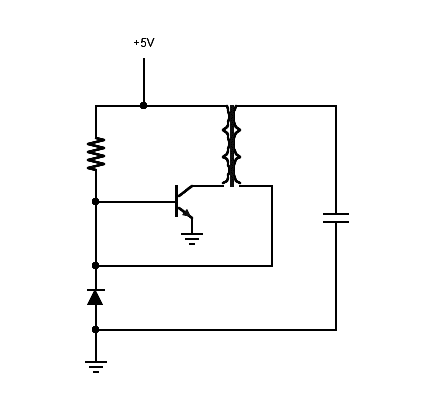
Untitled.png

You'll notice that the voltage (at the top right corner) oscillates at a frequency dependent on the capacitor value and the inductance of the transformer (what i found when physically testing the circuit). When the resistor is large enough it doesn't allow enough current through to activate the transistor when current is flowing through the transistor, turning it off and allowing current to flow back to the base. This is why I cannot use conventional circuit analysis, we assume that changes in the circuit are instantaneous while this circuit depends on the finite speed of the current.

Thanks for any assistance.
T. Burke
 
Physics news on Phys.org
tburke2 said:
This is why I cannot use conventional circuit analysis, we assume that changes in the circuit are instantaneous while this circuit depends on the finite speed of the current.
I think what you say here could not possibly be correct.

The first thing you should do is mark the dots on the transformer windings.

Next, find a reference that tells you how this circuit operates. Does operation hinge on non-linear characteristics of the transformer, or can you assume a linear model?
 
Sorry, the transformer coils are oppositely wound so a dot should be on top of the left coil and on the bottom of the right coil. The circuit is dependent on the non-linear characteristics of the transistor. Can Kirchoffs laws be used to find the voltage across the cap?
 
You built the circuit using real components? Can you post a graph showing how the base voltage varies with time, and show this in relation to the capacitor voltage?
 

Similar threads

  • · Replies 1 ·
Replies
1
Views
2K
Replies
15
Views
3K
  • · Replies 7 ·
Replies
7
Views
2K
  • · Replies 8 ·
Replies
8
Views
2K
  • · Replies 7 ·
Replies
7
Views
3K
  • · Replies 3 ·
Replies
3
Views
2K
  • · Replies 6 ·
Replies
6
Views
3K
  • · Replies 7 ·
Replies
7
Views
5K
  • · Replies 9 ·
Replies
9
Views
6K
  • · Replies 1 ·
Replies
1
Views
2K