2-Resistor, 2-Capacitor Circuit with Switch

Click For Summary
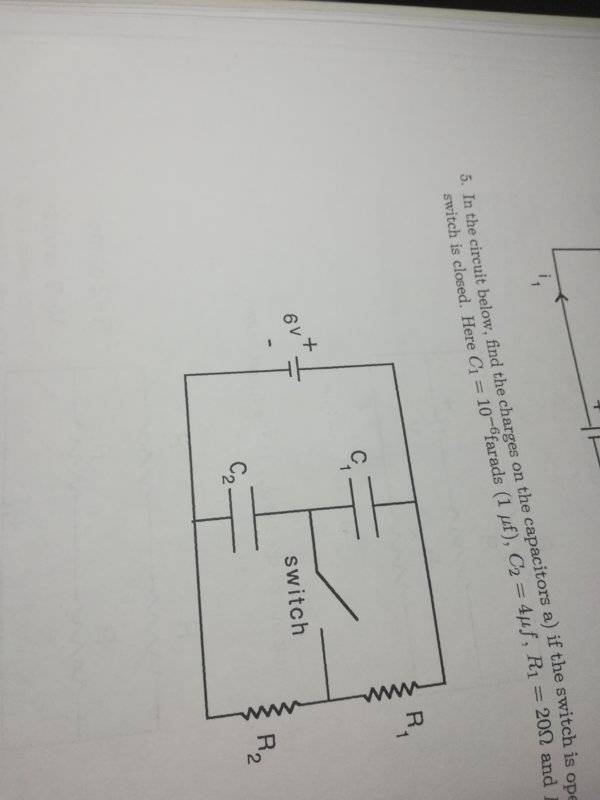
The discussion focuses on solving a circuit problem involving two resistors and two capacitors with a switch. The initial correct charge for one capacitor is 4.8 microC, but confusion arises regarding the charges on the capacitors when the switch is closed. It is clarified that the two capacitors cannot be combined into an equivalent capacitor due to the path created when the switch is closed. The textbook provides specific charge values for the capacitors: Q1 is 2 microC and Q2 is 16 microC. The participant expresses gratitude after resolving the confusion with the help provided.
Mark Zhu
Messages
32
Reaction score
3
Homework Statement
In the circuit below, find the charges on the capacitors a) if the switch is open, b) if the switch is closed. Here C1 = 1 microfarads, C2 = 4 microfarads, R1 = 20 ohms and R2 = 40 ohms.
Relevant Equations
V = iR
Q = CV
I already did part a and got the correct answer of 4.8 microC. However, I am unsure how to approach part b, where the switch is closed and apparently the two capacitors end up with different charges. For part b, since there is a path between the two capacitors, I don't know if I am able to combine the two capacitors into an equivalent capacitor. According to the textbook, the solution is that Q1 is 2 microC and Q2 is 16 microC. Any help is appreciated.
IMG_20190612_164654.jpg
 
Physics news on Phys.org
Hi,

Well, what do you get for the voltage over C1 if you apply your first relevant equation ?

(after you determined -- qualitatively -- what happens with the current through the switch when it is closed and afterwards :smile:)
 
I think I got it, thank you.
 
With the answers given it's a piece of cake :smile:
 
The book claims the answer is that all the magnitudes are the same because "the gravitational force on the penguin is the same". I'm having trouble understanding this. I thought the buoyant force was equal to the weight of the fluid displaced. Weight depends on mass which depends on density. Therefore, due to the differing densities the buoyant force will be different in each case? Is this incorrect?

Similar threads

Replies
2
Views
920
Replies
20
Views
2K
  • · Replies 4 ·
Replies
4
Views
2K
Replies
9
Views
2K
  • · Replies 62 ·
3
Replies
62
Views
6K
Replies
15
Views
2K
Replies
3
Views
2K
  • · Replies 15 ·
Replies
15
Views
887
  • · Replies 11 ·
Replies
11
Views
2K
  • · Replies 5 ·
Replies
5
Views
2K