2-Resistor, 2-Capacitor Circuit with Switch

Click For Summary

Homework Help Overview

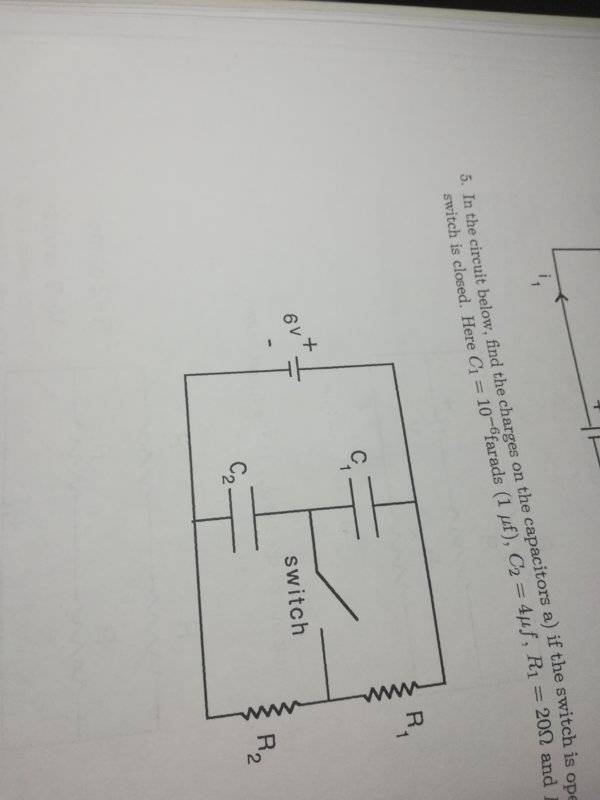
The discussion revolves around a circuit involving two resistors and two capacitors, specifically focusing on the behavior of the circuit when a switch is closed. The original poster has successfully completed part a of the problem but is seeking guidance on part b, where the charge distribution on the capacitors is in question.

Discussion Character

  • Exploratory, Assumption checking

Approaches and Questions Raised

  • The original poster expresses uncertainty about whether the two capacitors can be combined into an equivalent capacitor due to the path created when the switch is closed. They reference textbook values for the charges on the capacitors but seek clarification on their reasoning.

Discussion Status

Some participants engage by prompting the original poster to consider the voltage across one of the capacitors and the implications of the current flow when the switch is closed. There appears to be a mix of confidence and uncertainty among participants regarding the approach to part b.

Contextual Notes

The original poster mentions specific charge values from the textbook, indicating a potential discrepancy between their understanding and the textbook solution. There is an emphasis on qualitative analysis of the circuit behavior when the switch is closed.

Mark Zhu
Messages
32
Reaction score
3
Homework Statement
In the circuit below, find the charges on the capacitors a) if the switch is open, b) if the switch is closed. Here C1 = 1 microfarads, C2 = 4 microfarads, R1 = 20 ohms and R2 = 40 ohms.
Relevant Equations
V = iR
Q = CV
I already did part a and got the correct answer of 4.8 microC. However, I am unsure how to approach part b, where the switch is closed and apparently the two capacitors end up with different charges. For part b, since there is a path between the two capacitors, I don't know if I am able to combine the two capacitors into an equivalent capacitor. According to the textbook, the solution is that Q1 is 2 microC and Q2 is 16 microC. Any help is appreciated.
IMG_20190612_164654.jpg
 
Physics news on Phys.org
Hi,

Well, what do you get for the voltage over C1 if you apply your first relevant equation ?

(after you determined -- qualitatively -- what happens with the current through the switch when it is closed and afterwards :smile:)
 
I think I got it, thank you.
 
With the answers given it's a piece of cake :smile:
 

Similar threads

Replies
2
Views
1K
Replies
20
Views
2K
  • · Replies 4 ·
Replies
4
Views
2K
Replies
9
Views
3K
  • · Replies 62 ·
3
Replies
62
Views
6K
Replies
15
Views
2K
Replies
3
Views
2K
  • · Replies 15 ·
Replies
15
Views
1K
  • · Replies 11 ·
Replies
11
Views
2K
  • · Replies 5 ·
Replies
5
Views
2K