2 slits : diffraction always "enveloppe" of interference ?

Click For Summary
In the double-slit diffraction experiment, two types of interference occur: single-slit diffraction and double-slit interference. The diffraction pattern acts as an envelope for the double-slit interference because the intensity of the double-slit interference does not decrease at the edges of the screen, while the diffraction intensity does. The width of the single-slit envelope is inversely related to the slit width, meaning wider slits create narrower envelopes. For multiple slits, the spacing between the slits must exceed their width to maintain this relationship. The discussion emphasizes the physical justification for why diffraction envelopes the double-slit interference pattern.
DoobleD
Messages
259
Reaction score
20
In the double-slit diffraction experiment, two interferences are observed simultaneously : diffraction interference from each single-slit, and double-slit interference (where in the double-slit interference, diffraction is ignored because we considered theoretical slits way smaller than wavelength).

Intensity of the light reaching the screen behind the slits then looks like that :
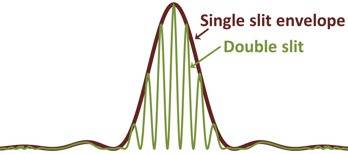
AV3Do.jpg


My questions are :

1 - why is it the diffraction part the envelope of the double slit interference, and not the other way around ?
2 - Is it actually always in this way only ?

I've looked at 5 textbooks (undergrad level) and none of them justifies that. They all say something like : the diffraction act as an envelope, and the corresponding equation is the product of both equations for the single-slit diffraction and for the double-slit interference together.
 
Science news on Phys.org
Actually it kind of makes sense somehow because in the other way around, well, the light due to double-slit interference does not decrease in intensity on "left" and "right" of the screen. So I guess somehow, only the diffraction interference part, which has a decreasing intensity, can be the envelope. But that "somehow" is not really physical, I can't see the logical/physical justification of it.
 
The width of the single-slit envelope varies inversely with the width of the slit(s): wider slits produce a narrower envelope and vice versa. Similarly, the spacing between the interference maxima varies inversely with the spacing between the slits.

In a multiple-slit setup, the spacing between the slits (center to center) has to be larger than the width of the slits, so the spacing between the interference maxima has to be smaller than the width of the diffraction envelope.
 
  • Like
Likes DoobleD
jtbell said:
The width of the single-slit envelope varies inversely with the width of the slit(s): wider slits produce a narrower envelope and vice versa. Similarly, the spacing between the interference maxima varies inversely with the spacing between the slits.

In a multiple-slit setup, the spacing between the slits (center to center) has to be larger than the width of the slits, so the spacing between the interference maxima has to be smaller than the width of the diffraction envelope.

Very clear answer, as usual, thank you !

You wrote "the spacing between the slits (center to center) has to be larger". Why does it have to be that way? If we imagine a setup with space between slits shorter than width of each slit, then the envelope would be the slits interference instead of the diffraction right?

EDIT : I just realized that when measuring the spacing between the slits center to center, indeed the distance measured that way cannot be smaller than the width of the slits. Thus, the distance between each pair of wavelet source (one in each slit) is always greater than the width of one slit. You can ignore my last question, sorry.
 

Similar threads

  • · Replies 6 ·
Replies
6
Views
8K
  • · Replies 5 ·
Replies
5
Views
3K
  • · Replies 17 ·
Replies
17
Views
3K
  • · Replies 4 ·
Replies
4
Views
2K
  • · Replies 1 ·
Replies
1
Views
2K
  • · Replies 7 ·
Replies
7
Views
651
  • · Replies 6 ·
Replies
6
Views
2K
  • · Replies 8 ·
Replies
8
Views
6K
  • · Replies 17 ·
Replies
17
Views
3K
  • · Replies 20 ·
Replies
20
Views
3K