A block diagram reduction [sign error]

Click For Summary
SUMMARY

The forum discussion centers on the correct method for block diagram reduction, specifically addressing a sign error in the transfer function T(s). The correct transfer function is T(s) = G3 + G1G2G3/(1 + G1H1), while the user mistakenly derived T(s) = -G3 + G1G2G3/(1 + G1H1). Key points include the proper handling of feedback loops and the significance of signal transformations during the reduction process. The discussion highlights the importance of understanding the movement of feedback signals and their impact on overall system behavior.

PREREQUISITES
  • Understanding of block diagram representation in control systems
  • Familiarity with feedback control theory
  • Knowledge of transfer functions and their derivation
  • Experience with signal flow analysis
NEXT STEPS
  • Study the principles of block diagram reduction techniques
  • Learn about feedback loop transformations in control systems
  • Explore the concept of signal flow graphs and their applications
  • Review the "Shifting of Take-off Point" in block diagrams for better clarity
USEFUL FOR

Control system engineers, students studying feedback control theory, and anyone involved in the analysis and design of control systems will benefit from this discussion.

mech-eng
Messages
825
Reaction score
13
I try to solve a block diagram reduction example but when I did the operations, sign of one operation is incorrect. I tried to understand why it is so? Would somebody like to help me.

(1) First I carry the feedback into the parallel line.
(2) I add +1/G1H1 in the parallel line because I thought the orinal signal is that signal entering the parallel line.

3) I did serial and parallel operations but the result is incorrect by just a sign.

T(s)=G3 +G1G2G3/1+G1H1 which is the correct answer.

But the result I found by myself is
T(s)=-G3+G1G2G3/1+G1H1 which is the wrong answer by a sign.
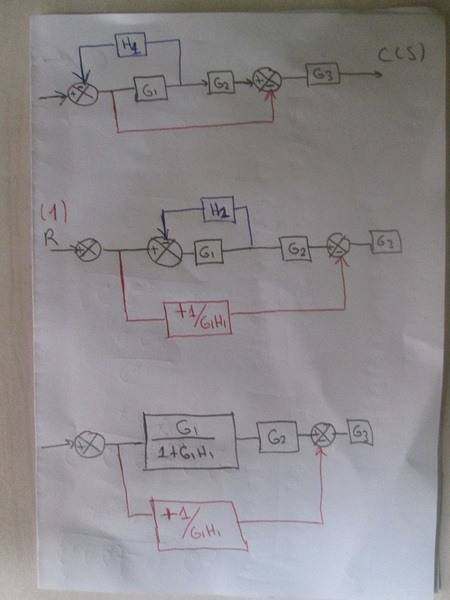
sign error.JPG


Thank you.
 
Engineering news on Phys.org
I am really not aware of the movement you did from the first to the second pic, moving the feedback.

To solve this problem first I would move G1 to the right, we would have G1G2 and G1H1.
Then I would use the feedback formula to H1 and the unit.
Then I would make the parallel formula with the red wire and G1G2.
 
  • Like
Likes mech-eng
Phellippe Marques said:
I am really not aware of the movement you did from the first to the second pic, moving the feedback.

To solve this problem first I would move G1 to the right, we would have G1G2 and G1H1.
Then I would use the feedback formula to H1 and the unit.
Then I would make the parallel formula with the red wire and G1G2.

I have also solved this but moving feed back is an interesting way for me. But now I do not understand your method. Would you like to explain how you have G1H1 when you move G1 to the right and, of course out of the feed back.

Thank you.
 
It is confusing for me to mount redline under the upper feedback. If I attach redline under the upper feedback does the system change or the signal going through redline change?
 
Are all those step relevant for the sign of G3, which seems independent of the previous operations? Where does the minus sign come from?
 
mfb said:
Are all those step relevant for the sign of G3, which seems independent of the previous operations? Where does the minus sign come from?

There is no problem with G3 or its sign. It is the last block and only serial to all the system before itself.

The problem is that how to put upper feed back inside the red line and while doing this how this line affects?

Thank you.
 
mech-eng said:
There is no problem with G3 or its sign.
The first post suggests that the sign there is the problem.

I don't understand the problem.
 
I assume that you left some parentheses off the denominator of your answer.

With that in mind, I got the same answer that you did. I think that the sign of the "correct" answer in the OP is wrong.

But I don't see how you got your answer. When I move the feed-forward take-off back in figure 2, I get 1/(1+G1H1) on the feed-forward signal.

EDIT ADDED:
You can move the take-off point of the feed-forward signal in front of the summation block or after the G1 block.

After the G1 block: The feed-forward signal gets a gain block 1/G1

In front of the summation block: The feed-forward signal gets a gain block 1/(1+G1H1)
You can see this by
1) first moving it after the G1 block as above, giving it a block 1/G1
2) consolidating the feedback to a single block K = G1/(1+G1H1);
3) move the take-off point in front of K, giving it a block K/G1 = 1/(1+G1H1)
I don't see how you got your feed-forward block 1/G1H1. I don't agree with that.
 
Last edited:
  • Like
Likes mfb
mfb said:
The first post suggests that the sign there is the problem.

I don't understand the problem.

The problem is actually two part.

1. How can we carry blue line, which is upper feedback into the redline, which parallel line. I am asking about this.

2. I tried to do it intuitively from the result, but parallel line enters the summing joint with negative sign. So the result of last step in the picture
[ G1G2/1+H1G1 - (+1/G1H1 ] * G3 there is substraction in the rectangular paranthesis because of negative summing of parallel line. I am asking about this.

Thank you.
 
  • #10
FactChecker said:
In front of the summation block: The feed-forward signal gets a gain block 1/(1+G1H1)
You can see this by
1) first moving it after the G1 block as above, giving it a block 1/G1
2) consolidating the feedback to a single block K = G1/(1+G1H1);
3) move the take-off point in front of K, giving it a block K/G1 = 1/(1+G1H1)
I don't see how you got your feed-forward block 1/G1H1. I don't agree with that.

It seems this is what I want to success. But I cannot do the operations well. Something is wrong. Would you like to explain where I am wrong?

IMG_1491.JPG


Thank you.
 
  • #11
Step 1 is wrong. The signal going straight through now has a transform G1*1/G1 = I up to the feedback tap-point, which is wrong. It must still have the G1 transformation.

PS. People can discuss this more clearly if you label the signal points so we can say that a signal is being moved from point pm to point pn.
 
  • Like
Likes mech-eng
  • #12
FactChecker said:
Step 1 is wrong. The signal going straight through now has a transform G1*1/G1 = I, which is wrong. It must still have the G1 transformation.

PS. People can discuss this more clearly if you label the signal points so we can say that a signal is being moved from point pm to point pn.

This show even I do not know nature of signals and so I am making mistakes in calculating of feedbacks. How will I learn this?
Do we calculate feedbacks always with respect to forward signals? I first tried to calculate the feedback then I multiplied it with G1 which is wrong.

Thank you.
 
  • #13
FactChecker said:
1) first moving it after the G1 block as above, giving it a block 1/G1.

Does not your step 1 corresponds to my step one in the last picture? If not, how can I do your step 1?

Thank you.
 
  • #14
mech-eng said:
Does not your step 1 corresponds to my step one in the last picture? If not, how can I do your step 1?
From your original post first figure: Move the beginning of the feed-forward loop to the other side of the G1 block and put a 1/G1 block on the feed forward loop. Nothing else changes.

See "Shifting of Take off Point" in http://www.electrical4u.com/block-diagrams-of-control-system/

You will want to study the basic steps for reducing a diagram and stick with combinations of those. Notice that shifting a take off point backward past a summing junction is not a basic step that has a simple solution. That is what you were doing and it can be difficult or impossible, depending on the situation.
 
Last edited:

Similar threads

  • · Replies 4 ·
Replies
4
Views
3K
  • · Replies 4 ·
Replies
4
Views
4K
  • · Replies 4 ·
Replies
4
Views
2K
  • · Replies 5 ·
Replies
5
Views
2K
Replies
4
Views
2K
  • · Replies 2 ·
Replies
2
Views
2K
  • · Replies 6 ·
Replies
6
Views
2K
  • · Replies 6 ·
Replies
6
Views
3K
  • · Replies 2 ·
Replies
2
Views
8K
  • · Replies 5 ·
Replies
5
Views
2K